Researchers reconstruct 3-D hand movement using brain signals
March 2, 2010
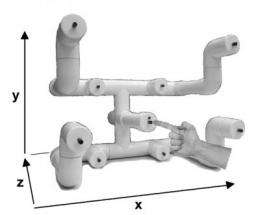
The reaching apparatus used to study the finger paths from a center button to eight other buttons in random order. While volunteers touched the buttons, researchers recorded their brain signals and hand motions. Afterward, the researchers attempted to decode the signals and reconstruct the 3-D hand movements. Credit: Courtesy, with permission: Bradberry et al. The Journal of Neuroscience 2010.
Researchers have successfully reconstructed 3-D hand motions from brain signals recorded in a non-invasive way, according to a study in the March 3 issue of The Journal of Neuroscience. This finding uses a technique that may open new doors for portable brain-computer interface systems. Such a non-invasive system could potentially operate a robotic arm or motorized wheelchair -- a huge advance for people with disabilities or paralysis.
Until now, to reconstruct hand motions, researchers have used non-portable and invasive methods that place sensors inside the brain. In this study, a team of neuroscientists led by José Contreras-Vidal, PhD, of the University of Maryland, College Park, placed an array of sensors on the scalps of five participants to record their brains' electrical activity, using a process called electroencephalography, or EEG. Volunteers were asked to reach from a center button and touch eight other buttons in random order 10 times, while the authors recorded their brain signals and hand motions. Afterward, the researchers attempted to decode the signals and reconstruct the 3-D hand movements.
"Our results showed that electrical brain activity acquired from the scalp surface carries enough information to reconstruct continuous, unconstrained hand movements," Contreras-Vidal said.
The researchers found that one sensor in particular (of the 34 used) provided the most accurate information. The sensor was located over a part of the brain called the primary sensorimotor cortex, a region associated with voluntary movement. Useful signals were also recorded from another region called the inferior parietal lobule, which is known to help guide limb movement. The authors used these findings to confirm the validity of their methods.
This study has implications for future brain-computer interface technologies and for those already in existence. "It may eventually be possible for people with severe neuromuscular disorders, such as amyotrophic lateral sclerosis (ALS), stroke, or spinal cord injury, to regain control of complex tasks without needing to have electrodes implanted in their brains," said Jonathan Wolpaw, MD, of the New York State Department of Health's Wadsworth Center in Albany, who was unaffiliated with the study. "The paper enhances the potential value of EEG for laboratory studies and clinical monitoring of brain function."
The findings could also help improve existing EEG-based systems designed to allow movement-impaired people to control a computer cursor with just their thoughts. These systems now require that users undergo extensive training sessions. Contreras-Vidal said the length of this training could be reduced and more effortless control achieved using the methods in this study.
-
Brain-computer interface, developed at Brown, begins new clinical trial
Jun 10, 2009 |
not rated yet |
0
-
Reading the brain without poking it
Jun 29, 2009 |
not rated yet |
0
-
Brain measurements could lead to better devices to move injured or artificial limbs
Oct 18, 2007 |
not rated yet |
0
-
'Smart' prosthetics: restoring independence to people with disabilities
Feb 16, 2007 |
not rated yet |
0
-
Brain-controlled cursor doubles as a neural workout
Feb 15, 2010 |
not rated yet |
0
-
Engineers build first sub-10-nm carbon nanotube transistor
Feb 01, 2012 |
4.9 / 5 (30) |
30
-
Something old, something new: Evolution and the structural divergence of duplicate genes
Jan 31, 2012 |
4.6 / 5 (7) |
1
-
The hidden nanoworld of ice crystals: Revealing the dynamic behavior of quasi-liquid layers
Jan 30, 2012 |
5 / 5 (3) |
1
-
Stock market network reveals investor clustering
Jan 27, 2012 |
3.9 / 5 (23) |
8
-
Of microchemistry and molecules: Electronic microfluidic device synthesizes biocompatible probes
Jan 26, 2012 |
5 / 5 (1) |
0
-
Is Everyday Technology Killing Us?
Feb 08, 2012
-
Exercise and weight loss
Feb 08, 2012
-
Why do we have head aches? Our brains can't feel anything.
Feb 07, 2012
-
"The end of diseases" by David Agus, interview from Daily Show with Jon Stewart
Feb 04, 2012
-
Oncolytic adenovirus
Feb 04, 2012
-
Nutrition label stuffs and diets
Feb 02, 2012
- More from Physics Forums - Medical Sciences
More news stories
Seeing colors in music, tasting flavors in shapes may happen in life's early months
Famed violinist Itzhak Perlman sees a deep forest green whenever he plays a B-flat on his Stradivarius' G string. The A on the E string is red.
Medicine & Health / Psychology & Psychiatry
1 hour ago |
5 / 5 (1) |
0
|
Team isolates nerve cells involved in storing long term memory and gene proteins associated with them
(Medical Xpress) -- A research team in Taiwan has succeeded in isolating two nerve cells in fruit fly brains that are believed to be the major players in allowing for the formation of long term memories. Furthermore, ...
News of plaque-clearing drug tops week of major advances against Alzheimer's disease
In the last eight days, scientists have delivered a powerful one-two punch in the fight to defeat Alzheimer's disease. At the same time, the White House and members of Congress are proposing increases in Alzheimer's research ...
21 minutes ago |
not rated yet |
0
S.Africa in $208 mln AIDS drug venture with Swiss Lonza
South Africa on Friday unveiled plans for a 1.6 billion rand ($208 million, 157 million euro) pharmaceutical plant, in a joint venture with Swiss biochemicals group Lonza to produce anti-AIDS drugs.
Medicine & Health / HIV & AIDS
34 minutes ago |
not rated yet |
0
Russia sounds alarm over spiralling teenage suicides
Top Russian psychiatrists on Friday called for urgent measures to battle the soaring teenage suicide rate, one of the world's highest.
Medicine & Health / Psychology & Psychiatry
14 minutes ago |
not rated yet |
0
The power of estrogen -- male snakes attract other males
A new study has shown that boosting the estrogen levels of male garter snakes causes them to secrete the same pheromones that females use to attract suitors, and turned the males into just about the sexiest ...
Could Venus be shifting gear?
(PhysOrg.com) -- ESAs Venus Express spacecraft has discovered that our cloud-covered neighbour spins a little slower than previously measured. Peering through the dense atmosphere in the infrared, the ...
Experts reveal how plants don't get sunburn
(PhysOrg.com) -- Experts at the University of Glasgow have discovered how plants survive the harmful rays of the sun.
Engineering images bring life to submerged city
(PhysOrg.com) -- Photo-realistic 3D mapping and digital reconstruction of an ancient underwater city in Greece have earned a team from the University of Sydney's Faculty of Engineering and Information Technologies ...
New power source discovered
(PhysOrg.com) -- Researchers at the Massachusetts Institute of Technology (MIT) and RMIT University have made a breakthrough in energy storage and power generation.
The turbulent birth of super star clusters in galaxy mergers
By combining two of the most advanced telescopes in the world -- the new Atacama Large Millimeter Array (ALMA) and the Very Large Telescope (VLT) of ESO -- a team of French astronomers from the Institut d'astrophysique ...
Mar 02, 2010
Rank: not rated yet