Measuring material hotter than the sun

March 2, 2010 By David F. Salisbury
Top-down view of the PHENIX detector, which is about the size of a small house.
(PhysOrg.com) -- Three Vanderbilt physicists are members of the scientific team that have reported creating an exotic state of matter with a temperature of four trillion degrees Celsius. It's the hottest temperature ever achieved in a laboratory and 250,000 times hotter than the heart of the sun.
Scientists have produced this super-heated state of matter by accelerating gold nuclei to nearly the speed of light in opposite directions and then colliding them. They have done this in the Relativistic Heavy Ion Collider (RHIC) at Brookhaven National Laboratory, the largest particle accelerator in the world dedicated to nuclear physics research. The new temperature measurement has strengthened the physicists' conviction that they have managed to recreate the quark-gluon plasma (QGP), a state of matter that may have existed fractions of seconds after the Big Bang.
The three scientists are Victoria Greene, professor of physics and executive dean in the College of Arts and Science; Charles Maguire, professor of physics; and Julia Velkovska, associate professor of physics. For the last nine years, they have played a key role in the design and operation of PHENIX, the largest of the four detectors positioned around the accelerator's 2.4-mile-circumference. The new results were announced Feb. 15 at the annual meeting of the American Physical Society in New York.
"The temperature measurement was made at PHENIX by measuring the photons, the light particles, that were created with the plasma and escaped without interacting with other particles,” says Greene, who contributed to the paper reporting the result. To do this, the scientists figured out a clever way to separate the primordial photons from those coming from more mundane sources by comparing the photons produced in the collisions of the gold nuclei with those produced in simple collisions between two protons.
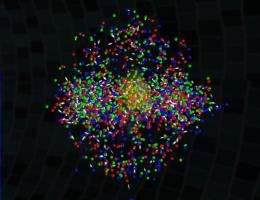
Simulation of the thousands of subatomic particles that are created when gold nuclei collide in the RHIC collider. Image: Brookhaven National Laboratory
RHIC scientists don't know the exact temperature at which the protons and neutrons in atoms "melt” into their constituent parts, quarks and gluons. But they do think it is considerably below four trillion degrees. So the new measurement increases their confidence that the matter they are creating and studying is indeed the sought-for QGP.
Their observations of the most primordial of all primordial soups is improving scientists' understanding of the "strong force,” the force that acts within the nucleus of the atom and holds it together. Originally, they had predicted that the QGP would act like a gas, with all the particles moving independently. They were surprised to find that the quarks appear to be bound together in a way similar to the molecules in a liquid. This is forcing theoreticians back to their drawing boards.
Increased knowledge about the nature of the QGP can also improve cosmologists' understanding of the origin of the universe. For the first few microseconds after the Big Bang, cosmologists calculate that temperatures were so hot that a quark-gluon plasma should have formed. However, the universe immediately began to expand and cool. As it cooled below the melting point of protons and neutrons, these particles began forming much like rain drops condensing out of steam.
A fundamental physics principle called charge-parity (CP) symmetry holds that when energy is converted to mass or mass is converted into energy equal numbers of particles and oppositely charged antiparticles must be created or annihilated. However, if that principle were followed after the Big Bang, the universe would be essentially empty because equal numbers of matter and antimatter particles would have totally annihilated one another as they come into contact. There would be no matter left over to form stars and planets and people.
That leads to the second new result, which was obtained by the scientists working on one of the other RHIC detectors. They found evidence that CP symmetry may be broken in the plasma. Although this effect is not strong enough to explain the predominance of ordinary matter in the universe, it may provide new insights into how symmetry violations of this sort occur.
Brookhaven officials have announced that they will be upgrading RHIC over the next five years to get better measurements of the QGP's temperature, viscosity and other basic properties. Greene, Maguire and Velkovska will continue to participate in the RHIC collaboration, but they have also joined the scientific team using one of the detectors (the Compact Muon Solenoid) on the new Large Hadron Collider, the world's most powerful particle accelerator operated by the European Organization for Nuclear Research (CERN) in Switzerland. Here they hope to study the behavior of the quark-gluon plasma at even more extreme temperatures. They are in the process of creating a control room at Vanderbilt that will allow them to monitor the quality of the data and analyze the results in near real time without leaving home.
-
'Perfect' Liquid Hot Enough to be Quark Soup (w/ Video)
Feb 15, 2010 |
not rated yet |
0
-
'Bubbles' of Broken Symmetry in Quark Soup at RHIC (w/ Video)
Feb 15, 2010 |
not rated yet |
0
-
eRHIC gets to the heart of the matter
Apr 26, 2006 |
not rated yet |
0
-
After the Big Bang: Project explores seconds that shaped the universe
Jul 12, 2006 |
not rated yet |
0
-
Ultracold gas mimics ultrahot plasma
Feb 15, 2009 |
not rated yet |
0
-
Engineers build first sub-10-nm carbon nanotube transistor
Feb 01, 2012 |
4.9 / 5 (31) |
30
-
Something old, something new: Evolution and the structural divergence of duplicate genes
Jan 31, 2012 |
4.6 / 5 (7) |
1
-
The hidden nanoworld of ice crystals: Revealing the dynamic behavior of quasi-liquid layers
Jan 30, 2012 |
5 / 5 (3) |
1
-
Stock market network reveals investor clustering
Jan 27, 2012 |
3.9 / 5 (23) |
8
-
Of microchemistry and molecules: Electronic microfluidic device synthesizes biocompatible probes
Jan 26, 2012 |
5 / 5 (1) |
0
-
Infinity by Particles
1 hour ago
-
what does negative resistivity mean
2 hours ago
-
Calculating Electrostatic force between parallel plates
3 hours ago
-
Strength of induced magnetic field inside an inductor
6 hours ago
-
increasing time of daylight
7 hours ago
-
Light & Sight
8 hours ago
- More from Physics Forums - General Physics
More news stories
Putting the squeeze on planets outside our solar system
(PhysOrg.com) -- Using high-powered lasers, scientists at Lawrence Livermore National Laboratory and collaborators discovered that molten magnesium silicate undergoes a phase change in the liquid state, abruptly ...
6 hours ago |
4.7 / 5 (3) |
0
|
Hovering not hard if you're top-heavy, researchers find
Top-heavy structures are more likely to maintain their balance while hovering in the air than are those that bear a lower center of gravity, researchers at New York University's Courant Institute of Mathematical Sciences ...
7 hours ago |
5 / 5 (1) |
1
|
SLAC, Stanford team focuses on high-energy electrons to treat cancer
Accelerator physicists at SLAC and cancer specialists from Stanford are working on a new technology that could dramatically reduce the time needed for cancer radiation treatments. The team ran an initial experiment ...
10 hours ago |
5 / 5 (1) |
0
Measurements from high-energy collisions lead to better understanding of why meson particles disappear
For several years, physicists at the Relativistic Heavy Ion Collider (RHIC) at Brookhaven National Laboratory (BNL), USA, have studied an unusual state of matter called the quarkgluon plasma, which they ...
11 hours ago |
5 / 5 (1) |
0
Explained: Sigma
It's a question that arises with virtually every major new finding in science or medicine: What makes a result reliable enough to be taken seriously? The answer has to do with statistical significance -- but ...
Feb 09, 2012 |
5 / 5 (16) |
46
Google users warned of threat to smartphone wallets
Users of Google smartphone wallets were being warned on Friday that there is a way to crack pass codes intended to thwart thieves from going on illicit shopping sprees.
Anonymous knocks CIA website offline (Update)
The website of the Central Intelligence Agency was inaccessible on Friday after the hacker group Anonymous claimed to have knocked it offline.
Complex wiring of the nervous system may rely on a just a handful of genes and proteins
Researchers at the Salk Institute have discovered a startling feature of early brain development that helps to explain how complex neuron wiring patterns are programmed using just a handful of critical genes. ...
NASA sees wide-eyed cyclone Jasmine
Cyclone Jasmine's eye has opened wider on NASA satellite imagery, as it moves through the Southern Pacific Ocean.
New error-correcting codes guarantee the fastest possible rate of data transmission
Error-correcting codes are one of the triumphs of the digital age. Theyre a way of encoding information so that it can be transmitted across a communication channel such as an optical fiber o ...
The power of estrogen -- male snakes attract other males
A new study has shown that boosting the estrogen levels of male garter snakes causes them to secrete the same pheromones that females use to attract suitors, and turned the males into just about the sexiest ...

Mar 03, 2010
Rank: 2 / 5 (2)
Temperature is a statistical thing and if you are eliminating the "coldest" components from your calculation you are changing the definition of temperature.
Mar 03, 2010
Rank: 3 / 5 (1)
Mar 03, 2010
Rank: 3 / 5 (2)
I wonder what wavelength is given off at 4.5 trillion degrees, it's gotta be in the gamma range i would think.
Mar 04, 2010
Rank: not rated yet
So how do they define temperature in their experiment? Did they calculate partial temperatures only? Why don't they just tell the energy of the components in GeV?
I can't get rid of the impression that someone was pushing for artificial excitement here.