Call Forwarding: New NIST Procedure Could Speed Cell Phone Testing
March 3, 2010
Call Forwarding: New NIST Procedure Could Speed Cell Phone Testing

Enlarge

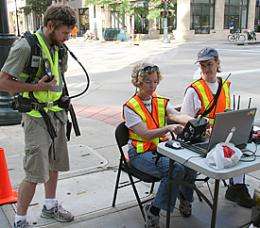
NIST engineer Kate Remley (center) was part of a team that conducted wireless communications tests using several different technologies in downtown Denver in 2009. At left is Jeremy May, a participant in NIST's Summer Undergraduate Research Fellowship program, and David Matolak, a professor at Ohio University in Athens, Ohio. Credit: NIST

(PhysOrg.com) -- By accurately re-creating the jumbled wireless signal environment of a city business district in a special indoor test facility, researchers at the National Institute of Standards and Technology have shown how the wireless industry could lop hours off the process of testing the capabilities of new cellular phones. The NIST techniques also could simulate complex real-world environments for design and test of other wireless equipment.

As described in a forthcoming paper,* NIST researchers conducted tests in downtown Denver, Colo., to measure precisely the clustering of signal reflections from radio waves bouncing off one or more multi-story buildings multiple times before reaching a distant receiver. The researchers replicated this environment indoors using a “reverberation chamber,” a room with highly reflective surfaces and a big, slowly rotating paddle that automatically alters signal paths. First, researchers feed a wireless transmitter’s signal into a device called a fading simulator, which is adjusted to re-create the timing and strength of the reflections of an outdoor urban area. The output then is fed into the reverberation chamber, where signal reflections decay exponentially over time, creating a cluster of signals similar to that observed in the field tests.

Industry certification of cell phones currently requires tests of parameters such as total radiated power using the opposite of a reverberation chamber, a room called an anechoic chamber that is lined with materials that absorb and reflect as little as possible. This testing takes about a day, requiring dozens of measurements of cell phone directional power from multiple angles. By contrast, an equivalent set of tests could be performed in about an hour in a reverberation chamber, according to NIST engineer Kate Remley, a senior author of the new paper. Reverberation chambers also could be used to measure cell phone receiver sensitivity, although currently there would be no time savings for this test, Remley says. Many industry testing practices are established by CTIA-The Wireless Association, the trade group representing the wireless industry.

NIST is studying new applications for reverberation chambers, which have typically been used to measure electronic equipment’s immunity to radio-frequency interference. By adjusting the reflectivity of the chamber through selective use of signal-absorbing material, researchers have found they can “tune” the signal decay time to simulate the conditions found in real-world environments. NIST researchers expect the new method will be useful for test and design of wireless devices such as cell phones, notebook computers equipped with wireless links, as well as new technology such as wireless beacons being developed for the emergency responder community.

The Denver tests were conducted in 2009. NIST researchers measured the power delays between a transmitter and a distant receiver positioned on streets lined with buildings three floors high or taller and a flat, single-layer parking lot. Most buildings were constructed of glass, steel, and concrete.

More information: * H. Fielitz, K.A. Remley, C.L. Holloway, Q. Zhang, Q. Wu and D.W. Matolak. Reverberation-chamber test environment for outdoor urban wireless propagation studies. IEEE Antennas and Wireless Propagation Letters. Forthcoming.

Provided by National Institute of Standards and Technology (news : web)


Rank not rated yet
Related Stories
Relevant PhysicsForums posts
  • feed hold button on CNC lathe
    created18 hours ago
  • Mechanics of Solids ( Final exam question) please help!
    created20 hours ago
  • RFAC in Fortran
    created23 hours ago
  • dynamics 2/32
    createdFeb 08, 2012
  • dynamics
    createdFeb 08, 2012
  • Vibration Absorbtion Problem
    createdFeb 08, 2012
  • More from Physics Forums - General Engineering

More news stories

Soraa LED light may dim 50-watt halogen rivals

(PhysOrg.com) -- Soraa, a Fremont, California company founded in 2008, this week launched its first product, a light that uses LEDS (light emitting diodes). The "Soraa LED MR16 lamp" is the "perfect" replacement ...

Technology / Semiconductors

created 19 hours ago | popularity 4.3 / 5 (17) | comments 15 | with audio podcast report

First Google hire leaving for online academy

The first person hired by Google's founders is leaving the Internet giant to devote himself to an innovative online education website called Khan Academy.

Technology / Internet

created 7 hours ago | popularity 5 / 5 (1) | comments 0

FBI file: Steve Jobs was considered for govt post

(AP) -- FBI background interviews of some people who knew Apple co-founder Steve Jobs reveal a man driven by power and alienating some of the people who worked with him.

Technology / Business

created 7 hours ago | popularity 3.4 / 5 (5) | comments 0

New integrated building model may improve fish farming operations

Today's "locavore" movement with its emphasis on eating more locally-produced food is a natural fit for fruits and vegetables in nearly every region, but few entrepreneurs have dared to apply the concept to ...

Technology / Engineering

created 7 hours ago | popularity not rated yet | comments 0

Samsung can continue selling Galaxy tabs in Germany: court

South Korea's Samsung Electronics can continue to sell its Galaxy Tab 10.1N tablet computer in Germany, a German court ruled Thursday, rejecting a bid by arch-rival Apple to have them banned.

Technology / Business

created 17 hours ago | popularity 3.7 / 5 (3) | comments 3


'Dark plasmons' transmit energy

Microscopic channels of gold nanoparticles have the ability to transmit electromagnetic energy that starts as light and propagates via "dark plasmons," according to researchers at Rice University.

FDA-approved drug rapidly clears amyloid from the brain, reverses Alzheimer's symptoms in mice

Neuroscientists at Case Western Reserve University School of Medicine have made a dramatic breakthrough in their efforts to find a cure for Alzheimer's disease. The researchers' findings, published in the journal Science, show t ...

Hydrogen from acidic water: Researchers develop potential low cost alternative to platinum for splitting water

A technique for creating a new molecule that structurally and chemically replicates the active part of the widely used industrial catalyst molybdenite has been developed by researchers with the Lawrence Berkeley ...

Ultraviolet protection molecule in plants yields its secrets

Lying around in the sun all day is hazardous not just for humans but also for plants, which have no means of escape. Ultraviolet (UV) radiation from the sun can damage proteins and DNA inside cells, leading ...

Anyone can learn to be more inventive, cognitive researcher says

There will always be a wild and unpredictable quality to creativity and invention, says Anthony McCaffrey, a cognitive psychology researcher at the University of Massachusetts Amherst, because an "Aha moment" is rare and ...

New method makes culture of complex tissue possible in any lab

Scientists at the University of California, San Diego have developed a new method for making scaffolds for culturing tissue in three-dimensional arrangements that mimic those in the body. This advance, published online in ...