Free will is an illusion, biologist says
March 3, 2010 By Lisa Zyga
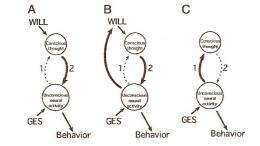
Three different models explain the causal mechanism of free will and the flow of information between unconscious neural activity and conscious thought (GES = genes, environment, stochasticism). In A, the intuitive model, there is no causal component for will. Will influences conscious thought, which in turn influences unconscious neural activity to direct behavior. In B, a causal component of will is introduced: unconscious neural activity and GES. But now will loses its “freedom.” In C, the model that Cashmore advocates, will is dispensed with. Conscious thought is simply a reflection of, rather than an influence on, unconscious neural activity, which directs behavior. The dotted arrow 2 in C indicates a subservient role of conscious thought in directing behavior. Credit: Anthony Cashmore.
(PhysOrg.com) -- When biologist Anthony Cashmore claims that the concept of free will is an illusion, he's not breaking any new ground. At least as far back as the ancient Greeks, people have wondered how humans seem to have the ability to make their own personal decisions in a manner lacking any causal component other than their desire to "will" something. But Cashmore, Professor of Biology at the University of Pennsylvania, says that many biologists today still cling to the idea of free will, and reject the idea that we are simply conscious machines, completely controlled by a combination of our chemistry and external environmental forces.
In a recent study, Cashmore has argued that a belief in free will is akin to religious beliefs, since neither complies with the laws of the physical world. One of the basic premises of biology and biochemistry is that biological systems are nothing more than a bag of chemicals that obey chemical and physical laws. Generally, we have no problem with the “bag of chemicals” notion when it comes to bacteria, plants, and similar entities. So why is it so difficult to say the same about humans or other “higher level” species, when we’re all governed by the same laws?
No causal mechanism
As Cashmore explains, the human brain acts at both the conscious level as well as the unconscious. It’s our consciousness that makes us aware of our actions, giving us the sense that we control them, as well. But even without this awareness, our brains can still induce our bodies to act, and studies have indicated that consciousness is something that follows unconscious neural activity. Just because we are often aware of multiple paths to take, that doesn’t mean we actually get to choose one of them based on our own free will. As the ancient Greeks asked, by what mechanism would we be choosing? The physical world is made of causes and effects - “nothing comes from nothing” - but free will, by its very definition, has no physical cause. The Roman philosopher and poet Lucretius, in reference to this problem of free will, noted that the Greek philosophers concluded that atoms "randomly swerve" - the likely source of this movement being the numerous Greek gods.
Today, as researchers gain a better understanding of the molecular details underlying consciousness, some people think that we may discover a molecular mechanism responsible for free will - but Cashmore doesn’t think so. Such a discovery, he says, would require a new physical law that breaks the causal laws of nature. As it is, the only “wild card” that allows any room for maneuvering outside of genetics and one’s environment is the inherent uncertainty of the physical properties of matter, and even this stochastic element is beyond our conscious control. (However, it can help explain why identical twins growing up in the same environment are unique individuals.)
To put it simply, free will just doesn’t fit with how the physical world works. Cashmore compares a belief in free will to an earlier belief in vitalism - the belief that there are forces governing the biological world that are distinct from those governing the physical world. Vitalism was discarded more than 100 years ago, being replaced with evidence that biological systems obey the laws of chemistry and physics, not special biological laws for living things.
“I would like to convince biologists that a belief in free will is nothing other than a continuing belief in vitalism (or, as I say, a belief in magic),” Cashmore told PhysOrg.com.
Conscious Deception
It all seems quite rational, so why is our lack of free will so difficult to accept for many people? Cashmore explains that there are several compelling reasons that people have for believing in free will, not the least of which is that we have a constant awareness of making decisions that seem to be driven by our own volition. In addition, free will is a very useful concept when it comes to the justice system; we take responsibility for our criminal actions and accordingly, are eligible for personal punishment, which is deemed to be necessary for protecting society.
However, Cashmore argues that there are deeper explanations for why we think we have free will. He thinks that there must be a genetic basis for consciousness and the associated belief in free will. Consciousness has an evolutionary selective advantage: it provides us with the illusion of responsibility, which is beneficial for society, if not for individuals as well. In this sense, consciousness is our “preview function” that comforts us into thinking that we are in control of what we will (or at least may) do ahead of time. As Cashmore notes, the irony is that the very existence of these "free will genes" is predicated on their ability to con us into believing in free will and responsibility. However, in reality, all behavioral decisions are nothing more than a reflection of our genetic and environmental history.
“Whereas the impressions are that we are making ‘free’ conscious decisions, the reality is that consciousness is simply a state of awareness that reflects the input signals, and these are an unavoidable consequence of GES [genes, environment, and stochasticism],” Cashmore explained.
“Few neurobiologists would argue with the notion that consciousness influences behavior by acting through unconscious neural activity,” he said. “More controversial is the notion that consciousness plays a relatively minor role in governing our behavior. The conscious mind is conceivably more a mechanism of following unconscious neural activity than it is one of directing such activity. I find it interesting to compare this line of thinking with that of Freud, who created a controversy by suggesting that the unconscious mind played a role in our behavior. The way of thinking regarding these matters now has moved to the extent that some are questioning what role, if any, the conscious mind plays in directing behavior. Namely, Freud was right to an extent that was much greater than he realized.”
To summarize, Cashmore’s argument is that free will is an illusion derived from consciousness, but consciousness has an evolutionary advantage of conferring the illusion of responsibility. So what is the point of publicizing the fact that we have no free will, and letting everyone off the hook of individual responsibility? Cashmore says that, as researchers deepen their understanding of the molecular basis of human behavior, it will become increasingly difficult to entertain the fallacy of free will.
Can’t Be Held Responsible
Perhaps the most obvious impact of this paradigm shift will be on our judicial system, in which the notions of free will and responsibility form an integral component. Currently, in order to be found guilty, a criminal must be considered responsible for his actions; otherwise, he can be found not guilty by reason of insanity. Cashmore disagrees with these rules, noting that psychiatric research is finding its way more and more into the courts and causing time-wasting debates. (For example, is alcoholism a disease? Are sex crimes an addiction?)
“Where is the logic in debating an individual’s level of responsibility, when the reality is that none of us are biologically responsible for our actions?" he said.
Cashmore proposes a change, based on “the elimination of the illogical concept that individuals are in control of their behavior in a manner that is something other than a reflection of their genetic makeup and their environmental history.”
He says that psychiatrists and other experts on human behavior should not be involved in initial judicial proceedings. The jury should simply determine whether or not a defendant is guilty of committing a crime, and not be concerned with mental issues. Then, if the defendant is found guilty, a court-appointed panel of experts would advise on the most appropriate punishment and treatment. Cashmore argues that, even though individuals are not biologically responsible for their actions, in order to minimize criminal activity, people should still be held accountable, and be punished when necessary. Such punishment is rationalized on the grounds that it will serve as an incentive (an environmental influence) not to participate in criminal behavior.
“Here I introduce the practice of ‘I am sorry about this but I am going to have to beat you,’” Cashmore said. “This punishment is rationalized in the sense that it serves as a lesson to individuals not to break the law. So people would be held accountable for their actions, even though they are not ‘biologically responsible’ for such actions. This punishment may involve fines or placing people in prison. Such punishment should not reflect any sense of retribution, and given this I do not personally see how one could continue to impose the death penalty - the alleged effectiveness of such a penalty presumably being far outweighed by its unfairness. The exact way in which one balances the presumptive requirement for punishment, and the lack of biological responsibility, would indeed be difficult, and would require much discussion within the legal system and society as a whole.”
He said that tailoring punishment on an individual basis is presently done, at least to some extent.
“Why is it important to make a change? Because increasingly the legal system is being forced to confront the reality that people’s behavior is governed by nothing other than their biological history: their genes, their environment and a degree of stochasticism (if you wish, a degree of chance). The legal system is increasingly seen to be a farce, with lawyers spending endless time and money debating this nonsensical question of how responsible or not their clients are. Why nonsensical? Because no one is biologically responsible for their actions. As Francis Crick said, ‘Dream as we may, reality knocks relentlessly at the door.’ And as a result of the rapid and ongoing progress in neuroscience, the reality that individual behavior is governed by one’s genetic and environmental history is becoming increasingly apparent.”
• PhysOrg.com iPhone Apps
• PhysOrg.com Audio Podcasts / iTunes
• Join PhysOrg.com on Facebook!
• Follow PhysOrg.com on Twitter!
More information: Anthony R. Cashmore. “The Lucretian swerve: The biological basis of human behavior and the criminal justice system.” Proceedings of the National Academy of Sciences. To be published. Doi:10.1073/pnas.0915161107
Copyright 2010 PhysOrg.com.
All rights reserved. This material may not be published, broadcast, rewritten or redistributed in whole or part without the express written permission of PhysOrg.com.


How does this "lesson" deter others from breaking the same law if the other don't have free will?
Because their decisions are based on cost/reward. If a logic system (computer software or a human brain) determines that action A (robbing a store) seems to be too risky a payoff than action B (not robbing), then action B will be taken. The more data the logic system has that action A costs more, the less likely the logic system will choose A. This works perfectly well with a "no free will" system.
His views on the justice system just blow me away. We make choices everyday and I challenge him to prove to me that we are biologically programmed to make these choices.
What is reality? There are people out there that think we are living in a holographic universe. Maybe biology is nothing more than an illusion.
He speaks on the idea of LAWS.
Only incompetent individuals thinks that Theories, which is ALL that we have, are some sort of LAW.
LAW, is a dogmatic statement that can sneak below the conscious level and color one's thinking and make things that are possible - impossible.
It's psychology 101 class, kiddies. Any person who postulates new THEORIES needs to be schooled in psychological discourse, as well.
Otherwise their 'theories' based on 'laws' will only allow the ever changing and ever moving arrow of science to move in one specific direction only, one direction that is somehow predetermined by the past, as an extension of *dogmatism*.
This is brutally dangerous and is the core issue of religion, it allows one to invest the issues of ego into the religion as a form of self control of events and reality.
This is patently absurd on the most fundamental levels possible and I find his musings, based in that sort of psychological anchor- quite offensive.
Did you write that last sentence before or after your unconscious caused you to stop writing?
Exactly.
What is so controversial here? Of course there is no ghost in the machine. Your "choices" have already been made for you, you simply have to play your part.
Of course this does not mean you should accept fatalism. But it means you are ultimately not responsible for your actions.
This is not truly scientific, if he (as the article puts it) does not accept the possibility of causal mechanism for will without violation of standing laws.
This is just postulation unless we see experiments and results.
"He says that psychiatrists and other experts on human behavior should not be involved in initial judicial proceedings. The jury should simply determine whether or not a defendant is guilty of committing a crime, and not be concerned with mental issues. Then, if the defendant is found guilty, a court-appointed panel of experts would advise on the most appropriate punishment and treatment."
Chaos dominates all in any scale. That means gravity could suddenly become repulsive, shooting us all into space. Naturally we don't experience this world, because we don't live in it, we experience a world which is bound by cause and effect. We experience a world where all is dominated by order, and has no room for chaos.
It's fairly simple to exclude the possibility of a "free will". Humans and their silly anthropocentrism.
Seemed too subjective to have much validity.
Does anyone out there know of a theory that develops this idea fully?
I tend to believe that the other 5% could also be explained in a way that permits deterministic behaviour. Mainly because I strongly favour the possibility that, after all, everything is detministic.
Citation, please.
What seperates man is his ability to do this. And despite Cashman's best attempts, he falls flat at proving that man does not. In fact, the article doesnt even address what he actually studied, only rambles on about his ideals.
How can any punishment, be any sort of a deterent, if such things like murder are not in essence wrong, but just the result of chemical feedback? Cashman cant have his cake and eat it to.
I tend to argue that it may be so by looking for examples of behavior that is self-destructive, especially knowingly so. Why would anyone do something self-destructive? Could it be similar to mixing two chemical together, one really doesn't have a free choice in the formation of the products?
Granted, biological systems are very complex and in constant flux. Our brains are continually making new connections upon listening, reading, and thinking. I do not feel that I can control how my brain will react to any given stimulus. However, studies do show the statistics of the different ways that people do react. So, does testosterone affect behavior?
For will999999, goog Quantum Consciousness for a big selection of articles. Stuart Hameroff comes up often- he is one of the biggest proponents. The Wikipedia article has a pretty good overview.
there's a second thing: we are under the ILLUSION of having free will.
its JUST AS GOOD as having it.
Well, Cashmore is, obviously, a classical mechanics thinker.
‘To put it simply, free will just doesn’t fit with how the physical world works.'
What a statement! As a physicist, I would like to know how the physical world ultimately works. There are too many questions to be answered and things to be done on the frontiers of physics!
But wait! Why even write this article at all. Either we Skinner-humans will implement such laws or we won't -- it's not a choice, it's a tautology. Either people will accept his theory or they won't ... no need to argue anything, all is determined.
I actually think this argues for very harsh criminal justice. If you're just an action-response autonoma, we should just kill all the "defective ones". But, what does it matter, we will do this or not since there's no real way to start a different change of causality to lead to "freedom" or "tyranny".
Cashmore apparently is involved in some kind of crusade to free the biologists (what about the physicists, philosophers and computer scientists?) of thinking of free will as a supernatural thing. Well, that will be hard to do since some biologists are programmed to think that free will is not an illusion unlike Cashmore that is programmed to think that free will is an illusion. The biologists will have to re-program their brain but that means that there is a mechanism that allows biologists to re-program themselves at will. How this mechanism works is the Holy Grail of true
Yes, yes you are.
The issue people have with Cashman's line of thought is that we decouple our mind from our body and assume that the concious mind has some master control mechanism.
Think of it this way,
If your mind had complete control in all things, do you think we'd ever have such a thing as physical drug addiction?
Side-note: what is the placebo effect? LMAO!!
I'm wondering when they give a 5 day forecast of human societies like the wheater now.
But if we can predict our actions then we can change it, or should we assume we are too 'stupid' to ever have the ability to forecast our world.
A bit like the the smarter we get to be able to predict it the more complex it get to do it and this way we never catch up.
What may be missing in Cashmore's analysis is that determinism make sense with fixed boundary conditions -- but the boundary conditions in our Universe are not fixed. Inventing the iPhone created new affordances that never existed before. This isn't an "answer" to Cashmore, only a possible direction.
Or perhaps, like the affects of religion, the chemicals secreted by the triggered interactions provided by drugs cause the user to crave that same chemical interaction.
It's all down to chemistry. That's how magicians make their money.
Emotional conditioning (sooo we can't recondition?)... lol! Just like science (along with religion), people want to know, so they look for answers that make them feel good. Addicted until they become aware of this perpetual search for an answer they will never find. When one stops searching only then will one find the, metaphorical, key. (Trust me, the answer is not found in science or religion -both are drugs)
Shouldn't it be a one way street?
I'm also interested to see what a molecular basis of consciousness would look like, my guess is Cashmore has no idea either and could only provide a molecular basis of "when" consciousness happens, not how.
ever see an EEG or an active scan of a thinking brain?
Or better yet, how do you think consciousness happens?
Is that your best answer to a valid questions posed by somnum?
No I have no better answer, I am not a biologist. However, maybe you are, then: Tell us, JayK, how do you think consciousness happens?
It was an honest question, if somnum can tell that Dr. Cashmore has no idea how consciousness happens from a simple review article like this, then surely he has the knowledge to answer how consciousness does happen, right?
I mean, the idea that potassium and calcium ions are released and inhibited in complex fashions based on neural pathways in over 100 billion neurons and 100 trillion synapses to form a consciousness? Well that's just silly, right?
I'm wondering, though, does somnum actually think that humans are the only primates with consciousness? I didn't really need to limit the question to primates, but I thought I would start simple.
Oh wait! the house stands because of its framing.. No-no wait, the house stands because it was nailed together. Wait -no, the house stands because it was built on a foundation.. Wait..... I think you get the point... :-) (When one focuses on a single point one loses the ability to see the whole picture)
Given all the uncertainties currently inherent in our understanding of even the idea of consciousness, his evidence can only partially support a claim one way or the other.
In my opinion, the Sub-(or Un-)conscious is the part of the organism that is directly responsible for collating all the environmental information, and making the fight/flight decisions for survival. It is truly the "Lizard Brain". Our Conscious mind is emergent, and is there to seek out further benefit, and carry out cost/benefit metaanalysis of our situation. The two interact on a sliding scale- some responses are purely instinctual, some purely Rational. If it were not so, there would be no need for consciousness at all, since we would only be acting instinctively.
No, I'm afraid that Dr. Cashmore is selling the same old justification of Oligarchy, except in this case, it's NO-FAULT.
To my mind, it is obviously pseudoscience aimed at influencing policy. Unfortunately, I know that it will be seized upon and incorporated into endless hours of empty debate publicly, and used by policymaker$$$ as an unacknowledged bolster to back up their policymaking agenda.
I say Dr. Cashmore is a dick for trying to make us believe that we are nothing more than mindless zombie consumers.
I'd like to see how an explanation like that can explain seeing the color red. I'd also like to know why that then consciousness is only generated in neurons - remember, vitalism is incorrect. Does any transfer of charge denote consciousness? Are lightning bolts conscious?
For what it's worth JayK, of course I don't think we're the only primate that's conscious. What would lead you to believe that? I have gathered though from your statements that you really just have cursory knowledge of this subject.
But ultimately, I'm trying to decide which one of you will be the first to mention the "soul" in order to dismiss this PhD's opinions.
Like biologists know how to mix up some inorganic matter in a lab, apply some power, and voila, life.
Because trying to frame consciousness in currently accepted scientific terms is going to be inherently flawed...take a look at your post for example. You describe the path a photon of light takes, and then you use the statement "generate the color 'red'" to experience...HOW? How exactly does that neural pathway generate the color red. Good luck trying to answer that question while appealing to neural architecture WITHOUT reducing it to pure physics, which is what you're trying to do. You want to say somehow the brain is special, that is vitalism at work JayK. Otherwise you are saying charge creates consciousness or something similar, and you have no way to argue that it doesn't occur elsewhere in other ordered systems with those properties, ie, the entire universe.
As for an appeal to authority, sure! The guy has worked long and hard and he has a professional opinion that deserves recognition until such time as it is deemed incorrect. Many here are ready to dismiss his opinion out of hand with nothing more than sniff and a huff, including you, and I'd like to try to figure out why.
Here I'll use the acceptation of the 'soul'. The soul is apart of 'us' just as the ego is. Some call it the 'third-eye' or reptilian mind, you can call it whatever because it both exist and does not exist (Oh my God! Using quantum theory to describe something!). We have the freewill to listen to the 'ego -conscience' or the 'soul -unconscious'. When we choose to listen to our 'ego' we are abandoning freewill for supposed fact and opinions -fractal information (I hope no-one is arrogant enough to say that any science is 'real-fact', to those people I say study some science history), or we can live 'free' and only listen to our 'soul'. The soul is only concerned with the 'here'. What is 'here' is the only true information that one can rely on. This doesn't prove or disprove anything it's just one of an infinite amount of ways to describe our reality..
The question of the internet is interesting, however, and I find myself unable to really answer it. What do you think? Then again, the internet really doesn't rely upon the time domain in order to make connections to other objects with every input in order to generate unique outputs. There might be some applications that do that that I'm not aware of, and in fact might make for an interesting experiment.
Thanks for the idea, I might have to play with that.
Why are you expecting me, for example, to mention the soul? I don't know if a supernatural soul exists (neither do you, that I am sure) but I am convinced that biologists and neurologists alone will never be able to explain consciousness by using the brain biochemical properties alone. I am siding with Penrose that a new physics is needed to explain consciousness.
Well now that everyone is aware of one of my intentions, it is no longer a valid question, but I never said I expected you to. I've already written off much of your opinion because you've attached a lot of weight to the "magic" of quantum theory in order to try to explain consciousness, with absolutely nothing to prove that that theory would have any validity (hence why I called it "magic").
SmartK8 actually brings up an important point, that most decisions are made without the consciousness and later (very short time) are justified by the more active consciousness. That happens to be a throwback effect of our poorly evolved brains. I'd post a link to a couple of the studies that came to that conclusion, but I just made an unconscious decision to be petulant and lazy about it.
'Neurological' based theories of mind are so narrow in scope with no reason why they should be so, they are ad hoc and arbitrary.
I will no longer pursuit a discussion with you in that matter. I think that you have created your own set of beliefs and myths.
Some multidimensional physics, like string theory, could explain many things.
The author of 'Stalking the Wild Pendulum' had some interesting ideas.
More then a biological explanation, yes.. Though it still lacks totality. It can explain what information is and how it is assimilated.. But not were it comes from. People who believe science will answers their questions are as blind as people who fumble with dogma.
Am I following correctly when you are just saying that our perception of reality isn't dead on? If so, I'm not sure where anything I said was in disagreement with that. Basically...what point are you clarifying?
I did not read the book but saw some of the reviews. I think that is only mystical literature if I am right. How that would compare to more serious ideas on quantum consciousness developed by serious researcher?
Please check the Stanford Encyclopedia of Philosophy on Quantum Consciousness.
Not willing to be left behind the new-ish field of neurobiology, theoretical physicists have latched onto the fact that there are mathematical bases for the reactions of each neuron. Quantum physicists, not content just with that level of involvement, have now come up with the idea of quantum consciousness, which appears to have some following of people that like it because of the religious implications, or because of other implications that they like, but really are just couched in science-y sounding terminology.
I didn't mean to say that all quantum physics is magic, only those that like to act like they understand (not the physicists) do so because of the same kind of attraction as "magic". Demeaning? Yes, intentionally.
I see you're familiar with Craig Venter's work on synthetic biology.
Also: eliminative materialism FTW! http://www.newsci...5780.070
Note the inconsistency in Cashmore's argument. If indeed there is no free will, there is no ability to respond to the possibility of punishment (or, for that matter, reward).
Of course, there is free will and the prospect of punishment does influence behavior.
http://ase.tufts....mers.htm
Of course I'm biased, as he's come to the same conclusion that I have, that the material sciences are quite sufficient to model the brain and consciousness and don't require the added complexity of quantum mechanics or quantum field theory.
I agree, but for more than just quantum physics. Scientist have to admit that all fields of science are still evolving (some slower than others). This goes for those who fully subscribe to religion for an explanation, also. So for any person trying to describe the whole by using it's parts you are insane. Lol!
First, I am a physicist with two advanced degrees in the field.
I mentioned the article form Stanford because that is a readable article at the level here present.
I am not sure how to connect your second paragraph where you complain about the involvement of physicists with your third paragraph one where you mention people who like the word "magic".and think that they understand quantum theory.
I think that you are a pop science book reader, that is all. Keep googling maybe you will learn something.
Oh, you went there. You know this means you forfeit, right?
YOU DONT !!!
contact Neil Farbstein
protn7@att.net
I'm not sure. There's a possibilty that all ghosts are really doppegangers.
If I am presented with a situation, my response to that situation will be largely based on my previous experiences, the nature of the situation itself, my genes (to what extent, I don't know; I'm a chemistry geek, after all, not a biology geek), and various other factors--perhaps including random neuron misfirings. The closest I can get to free will from there is if I base my actions on none of the above; however, if I do that, I'm acting randomly and am just exhibiting stochastic will, not free will.
...But, again, that's with MY definition of "free will." I imagine a different definition would give a different result as regards its existence or nonexistence.
Not yet!
In 1965 Marine L/cpl Thomas Creek threw himself on a grenade to protect his fellow Marines. His last words were,"I've got it." Blatant proof of free will.
I wake out of peaceful slumber, every nerve straining to hear a sound- a sound that will allow me to locate the source of an eminent threat.
Question- if the unconscious mind rules all, why do I need to CONSCIOUSLY evaluate the threat, before taking action to resolve it?
Because Jesus is in the third quadrant with A-Rod and the secondary rotation axis is left handed.
How is that evidence for free will? I'm not trying to be sarcastic, I just honestly don't follow.
Conversely, which level of consciousness decided you needed to wake up to evaluate the sound? YOU certainly weren't aware of it. YOU were sleeping. Tsk tsk :)
Conversely, Determinism fails of insufficient proof at the same tme.
@Ronan
Determinalistically speaking, all human action is based in self interest/self preservation. Therefore, to consciously act in contravention of this principle is, in itself, proof of Free Will.
You've probably heard all the counter arguments: "He did it for Glory, because he was an attention hog.." -and the like. But do those arguments hold water? No. It is, however, possible to split enough hairs to cast superficial doubt.
1. All biochemical processes are deterministic.
2. Therefore all neurological processes are deterministic.
3. Mind is purely an extension of these underlying processes, therefore mind is purely deterministic.
4. Therefore anything I perceive as Free Will is just an illusion, and part of the deterministic pattern.QED
But there is plenty of research, and well-known phenomena, showing non-deterministic behaviors at each of these levels. Biochemistry is only deterministic in bulk, and then only within the bounds of stochastic variation. Quantum effects at the electrochemical level create random variations in the neural processing of our brains that seem essential to many higher mental functions. And many complex systems exhibit "emergent phenomena" which seem to be completely un-implicit in the underlying processes (brain versus mind). Read some David Bohm for details.
Cheers!
free will or not and its implications do have a history. simply because we not find an explanation easily forthcoming does not mean conclusions based in that inadequacy are truth.
Are you trying to say the your conscious-mind or subconscious-mind is not also YOU? granted your subconscious-mind -soul is more aware than your conscious-mind -ego, but I'm pretty sure both are still a part of you. That's like trying to argue whether or not your eye saw something or your mind allowed your eye to see something.. I'm fairly positive both are required.
So you're saying that Evolutionary principles(directly or indirectly) dictated that there should be a war, in order to apply selective pressure to refine humankind's genome, by having a few of the millions involved act in an altruistic fashion? Altruism is a part of Natural Selection?
That's a long leap, my friend!
Assume Dr. Cashmore is correct. Should our justice system change? I think not. Punishments add to the negative consequences of certain actions for survival of self and propagation of genes. Putting someone away for short or long periods reduces the future propagation of a set of genes that is detrimental to the rest of our collective health. Whether we put them away since they are responsible or just for the benefits of our society leads to the same actions.
As an aside, one interesting question: why was it Creek and not any of the others, who consummated the deed?
But let's not get side-tracked by evolution and genes too much. A great deal of human behavior is not inherited; it is LEARNED. But this does not invalidate determinism. Learning shapes the brain, altering the mind. Knowledge, experience, behavioral scripts, etc. subsequently feed into whatever calculations the brain makes (and the mind, respectively, interprets as "choices".)
1) Object A does not have property P.
2) Object B is constructed entirely from multiple copies of Object A.
3) (From 1 and 2) Object B cannot have property P.
Essentially this article makes this argument. More succinctly, it argues that there are no emergent properties. There are countless examples to the contrary.
I would argue that, in fact, choices are made by EVERYTHING, including particles, but that these choices are constrained by the parameter space within which an object is forced to operate.
For example, an electron will have some energy and must maintain this energy unless it can transfer it to some other particle. Whatever state that it enters at some point, it must CHOOSE some state consistent with its energy. I, on the other hand, can only move forward if I can push against something, but I CHOOSE to push against that something.
This here question of free will vs determinism is as old as dirt, and is still without definitive solution.
I choose to believe in free will. As I said earlier- why would consciousness have even developed if it was entirely superfluous, as it must be if we are devoid of free will. Elsewise, the Un- or Sub- or Preconscious would suffice, yes?
Also no possible use for love, hate, regret, longing, art, music, politics, religion, et c- essentially the things that define HUMAN.
For me, Consciousness=Free Will=Technology. None of them can meaningfully exist independent of the others.
In purely operational terms, I will note that without free will, there really aren't any meaningful consequences to human action or inaction- and you are Always, and Perfectly justified in whatever you do, as is the person who is, in turn, DOING IT TO YOU. PRAISE MAMMON!!!WORLD WITHOUT END!!! So hurry out and buy Dr. Ca$hmore's EXCELLELLENT, IMPERVIOUS SNAKE OIL!
Well, if I'm jumping off a cliff, I can at least offer the defense that all the cool kids (evolutionary biologists) are doing it. It's not that hard to get altruism and self-sacrifice out of such a heartless process as evolution, and a good deal of work has been done, so I understand, towards figuring out precisely how such (apparently) maladaptive traits can arise. If you really aren't familiar with this, I'd recommend doing a few searches on kin selection, group selection, and game theory; those all should turn up some information on how selfishness can, paradoxically, create a sort of selflessness. Fascinating stuff.
(Edit:) And Caliban...I kinda suspect that we're talking at cross purposes, and using slightly (but significantly) different definitions of "free will." Could you define the term, please? As I stated somewhat earlier, I have trouble imagining a logically consistent situation in which free will (as I define it) could exist, and you don't seem to have that problem--so odds are, I'm misunderstanding you.
I think I've got a fairly good grip on those concepts, and I understand your argument.
What I'm trying to point out is that the very same information can as easily be cited as evidence FOR free will, and with just as much validity.
Really, though, the defining difference in this argument is that there is no moral dimension to Determinism, whereas the very concept of Morality/Amorality would seem to imply Free Will...
A biological argument claiming humans have no free will then contradicts that atheist argument that God cannot exist.
With very primitive tools.
I mean the ability to decide in a manner not necessarily consistent with what would be considered self-interest/self-preservation(even when it is defined across a group). As Pink El pointed out above, some would have it that this is no more than the convergence of genome and experience. I disagree- there is an entire, abstract, separate realm of human experience that affects what, when, how, and why we do things on the material plane. That entire part of human experience is, in a Deterministic universe, entirely unecessary, superfluous, and as such, would have been selected out of the human genome as a positive risk to the survival of the species.
Just think back to the Cold War- in a "D" universe- the concept of Total Annihilation of the species would have been entirely at odds with any concept of Determinism being the a priori mechanism of human survival, and by extension, as the basis of individual or group action.
That said, my interpretation of goodness and badness is different than yours; Now, granted, I'm NOT an evolutionary biologist; I'm an undergrad studying chemistry. But to me, "choosing" between good or evil (as defined by...oneself, I guess, although "evil" tends to get kind of hyper-justified by the ne'er do well) is just another unchosen action, influenced by circumstance, personal experience, upbringing, etc. (continued)
Assumption 1: God is omniscient.
Assumption 2: God created the universe.
Assumption 3: God was omniscient before he created the universe.
From 1, we have that God knew that I would type this message.
From 1 and 3, God knew that if he were to create the universe, I would be typing this message right now.
From the preceding statement, and from 2, we have that God both knew that I would do this IN THE CASE that he created the universe, and that he DID in fact create the universe.
From this, it follows that God caused me to type this message.
And (slow typer, aren't I?) going on your latest post (in re the Cold War and similarly massively non-adaptive behaviors)...well, I never said evolution was perfect. It does make mistakes, and creatures are left with traits that are just plain maladaptive. These tend to get selected out over time. Remember, when we evolved all our armament of instincts and characteristics, we didn't have thermonuclear warheads! We evolved to fit one environment, and we are now, effectively, in a different one--and many of our instincts simply don't match up with it. There would, of course, be "bad" instincts and traits even if we were all still hunter-gatherers, as evolution aims for "good enough" rather than "perfect," but considering how much we've changed the world we live in (as in, the social world, and the abilities we've given ourselves), mismatched traits are expected.
The reason you bothered to read and comment is because you had an opinion and felt it was worthy to express. That expresses a will to act upon an of your own choosing. If you had no choice in the matter, then the musings are random and cannot be described as an opinion.
So unless your opinion is that free will exists, don't bother to twitch your fingers forming an pseudo comment since it is just random noise.
When potential repercussions of an impending action are considered as one of the inputs, the ultimate decision is affected by such considerations. Deterministically. And yet note, we're talking about 'consequences'.
PE-
Should I take this to mean that you don't see any difference between human activity influenced by free will vs that governed by determinism? Are you saying that they are one and the same? Simultaneous? I am, apparently, not understanding. Please to enlighten.
No its proof that people can resist biological impulses and do things that are unnatural like enduring extreme heat or cold or sticking pins in themselves. That does not prove free will, it proves something different. And the soldier that jumped onto the grenade to save his friends was doing something against human nature that went against his own personal survival instincts. It seems to take more will power to do that than to sit in a lounge chair drinking gin.
It's implications on the otherhand are quite heavy.
These findings validate the fact that we are only animals and are mostly maximizing our survival. I find then when we look too closely sometimes *we miss the big picture*.
Free will is all a question of whether a person wants to *defy* it's own reasons for survival. Stochasticism exists amongst people or else "mental illness" and other asymptotic anomolies wouldn't exist.
"Free will" is an illusion, just like it's an illusion that the sun goes around the earth.
I see. It's Newton's "Clockwork Universe". Free Will is illusory. Hope is Hopeless, and, to quote myself from earlier:
"you are Always, and Perfectly justified in whatever you do, as is the person who is, in turn, DOING IT TO YOU. PRAISE MAMMON!!!WORLD WITHOUT END!!! So hurry out and buy Dr. Ca$hmore's EXCELLELLENT, IMPERVIOUS SNAKE OIL!"
Our present understanding of the fabric of reality fits almost too well into the world view given thousands of years ago through the people of Isreal and Jesus Christ. While one might think that God would create a universe where you must seek God first to find Him and where there is no indication of the mechanism of His interaction with the world, it seems if we seek the fundamental nature of the universe, even in a secular way, His signature is there. At the very smallest levels it seems we see arrows to the biggest truth about which our life centers and without which our lives will be wasted.
For his next trick, I suppose, he'll logically prove there is no such thing as logic.
1. All biochemical processes are deterministic.
2. Therefore all neurological processes are deterministic.
3. Mind is purely an extension of these underlying processes, therefore mind is purely deterministic.
4. Therefore anything I perceive as Free Will is just an illusion, and part of the deterministic pattern.QED
But there is plenty of research, and well-known phenomena, showing non-deterministic behaviors at each of these levels. Biochemistry is only deterministic in bulk, and then only within the bounds of stochastic variation. Quantum effects at the electrochemical level create random variations in the neural processing of our brains that seem essential to many higher mental functions. And many complex systems exhibit "emergent phenomena" which seem to be completely un-implicit in the underlying processes (brain versus mind). Read some David Bohm for details.
Now explain exactly what you mean by "freewill".
Therein is the rub. We all "know" what we mean by "freewill" whatever "it" is (much as we do by the word "spirit"), but I suspect that many of us are talking about something very different to everyone else.
Free will is Control.
Do we surround the universe or does the universe surround(control) us? Clearly, the cosmos win. Free will is caveman logic much like the concept of hope. Nothing comes from nothing is rather an interesting concept when it comes to free will because we know that when we make a decision that decision is based on something. In fact it is that something (your value) that determines your decision, not the other way around. In essence, we live in a system of control...if we cannot escape this system then (values or what not).....in other words....every decision is calculated according to something already in our minds(values)....how thenwe cannot have power over it(our destiny).
Free will is Control.
Do we surround the universe or does the universe surround(control) us? Clearly, the cosmos win. Free will is caveman logic much like the concept of hope. Nothing comes from nothing is rather an interesting concept when it comes to free will because we know that when we make a decision that decision is based on something. In fact it is that something (your value) that determines your decision, not the other way around. In essence, we live in a system of control...if we cannot escape this system then we cannot have power over it(our destiny). Every decision is a predetermined calculation of "what suits you best". Free will is jumping off the bridge when you believe its a bad thing. Suiciders believe its a good thing.
Incorrect. The statement is that free will and god cannot exist at the same time.
The reason god cannot exist is because christians state that the bible is perfect, but since the bible has self contradiction on the topic of free will it cannot be perfect, thusly, god cannot be perfect and therefore cannot exist as you say he does.
God is the system of control - the universe, God is everywhere. If the universe was imperfect then the stability required to sustain anything (keep matter intact) and life would be impossible. If the universe is perfect then God is perfect(view first line). System of control are laws of physics which interestingly are blended with matter...so God is in everything too. God is the determiner, but the conundrum is that god while being in the position of having free will since there is no system of control above God does not have free will because he can only affect every atom(or smaller) at once...since laws effect all matter. Thus praying god is a foolish endeavor.
Why we have this illusion of "free will" stems I believe from the fact that very little of our decision-making processes are subject to conscious evaluation. Only for a tiny fraction of our decisions do we perceive the true causes of our actions. Given this lack of self-awareness, it is natural that we view these subconscious decisions as arising spontaneously from a "will". I agree with the author, the strength of this illusion will fade as we get a better understanding of the brain.
In some ways the retribution-based and rational justice systems coincide, in others they do not. Rationally for example, a criminal's punishment should not depend on whether he is mentally unfit, or a minor, unless these factors somehow have bearing on the likelihood that he will commit additional crimes in the future. And there may be some criminals that we believe are guilty, but through circumstances won't likely have the ability or motive to commit crimes again, and we might rationally let them go without punishment. An example might be a rapist who agrees to castration.
1. Free will is NOT a scientific concept yet because it can't be falsified (http://en.wikiped...ability) until we can travel in time.
2. Mr. Cashmore is forgeting the information or entropy (http://en.wikiped...entropy) ... Information is independent of the matter.
*By "matter", I actually mean matter-energy-space-time, which I understand as being just facets of a single holistic entity. So you can substitute "the realm of the material", or simply just "nature", for "matter".
My consciousness isn't yet aware of what's going to be my opinion on "free will" but I feel like being pregnant with an idea.
That "coding" is what I could call projection of information in the 4D space-time... but as I said in point 1, still we are in the philosophical arena and since I don't "believe" in practical time travel it will remain at the same status as religion... maybe that's why this discussion is so popular today :)
Please note that quantum mechanics can only be deterministic if you assert non-locality.
more on this here: http://cli.gs/free-will & here http://RoboEco.co...a-Robots
That was Frankl's observations.
This is not so different from the way the human brain functions. There is, essentially, a network, of neurons. Each of these neurons either fires or does not fire at a certain instant given the conditions around the neuron at this instant. These conditions are determined by the genetic makeup of whatever thing we're talking about as well as the various connections this neuron has with other neuron's around it and its immediate external chemistry. The question is: can a network of neurons fire independently of external stimuli? A single one can't, as far as we know. But if a network of neurons can fire independently, a network of transistors possible could as well.
So when you're given a lobotomy and the hardwired part of your brain that decodes and responds to stimuli via genetically built "emotive" mechanisms is missing, you still have the power to "feel" about it?
If you always had the freedom to deny chemistry, then there would be no need for psycological medications as they simply wouldn't work.
Paradoxically, to enhance our choices and opportunities to express our free-will, we must increase the use of robots who have no free-will to abuse.
Free will is the ability to make the decisions that you want to make. When something/someone prevents you from making the decisions you want to make THEN your free will is being taken away.
The debate doesn't seem to be over free will, but over whether or not we have control over the decisions we make. We do have control in such a way that our decisions are based on what we believe is best (conciously and subconciously)... but the decision is always based on a pre-existing set of conditions and, given the EXACT same set of conditions, a given person would make the same decision every time.
EXACTLY, of course they do not work. Once one receives a lobotomy it can be argued that only their body exists, and that the interface between their body and their self has been severed. You are making the point yourself, can you see it ?
All bigpharma products are poison based on faulty premise, this is abundantly clear. It is as simple as seeing that the connection between self & body can be restored by self only.
A marjon syllogism:
All ripe bananas are yellow.
Sometimes, sun is yellow.
Therefore, sometimes the sun is a ripe banana.
But wait, how do you know it is there, yourself?
How can I encourage you to deliver?
No you're missing the point. The "self" you refer to is a complex sum of the chemical interactions occuring within your body. You are your body. You are not some esoteric higher plane being with a soul and metaphysical components. Your physical parts are all the parts you have. When you lose them or they break they no longer function.
Since you're bordering on the religious already we'll go to the next point you're going to make and refute it.
Free will cannot exist if the concept of "God" holds true. A being that knows everything and created everything who's sight is irrespective of time predetermines everything within your life simply by creating you.
Free will IS an illusion, especially if you believe in a Judeo-Christian god.
Yes, yes JayK, Please PayPal $1500 to get us started, then go and read these to sites in their entirety: http://cli.gs/free-will & http://RoboeEco.c...freewill and be prepared to answer questions to demonstrate your comprehension and devotion to the truth that is so true it works for everyone, including YOU.
Please share your current understanding of freewill. Isn't your expression of such, or refusal thereof itself proof of freewill's existence ? Please explain how it isn't JayK, will you please ?
Mental disorder -> neurons malfunction -> brain is practically 'rewired' : neuo-chemical activity changes.. etc.
Result: you're suddenly doing/thinking/saying what you would have NOT normally do. Nor can you 'control' it.
Will is no longer so 'free' now is he?
Free will is a perfectly justified concept if we look at the macroscopic of things. We are decision making machines, our decisions are affected but not IMPOSED by external events, thus relatively - free.
On the microscopic scale, everything, every thought, every idea, decision, and reaction, could be well documented in logical sequences without loopholes.
Except that, the infinite amount of possible inputs/outputs per decision make it look 'free'. in my opinion.
You are not your car are you ? If you are not your car, how are you your body ? Your body is an earth suit, that you drive with freewill. You are freewill. If your interface with your body is clear and unimpeded, we call that healthy. Remember your body is composed of what you eat, yet it is not you. Just because you have a hard time understanding that you are not your body, only in control of it to a greater or lesser extent, does NOT mean that you ARE your body. You HAVE a body, and will continue to especially if your free-will decisions are good ones. You do NOT however HAVE a soul, since you ARE SOUL. ARE and HAVE are two different words. Follow ? Please explain your opinion. This may help too: http://cli.gs/free-will
Complexity is the illusion, and where you see complexity is where you are confused. Recall that in a healthy individual the free-will instantly manifests in proper action.
In many cases, I can correctly predict my own future actions. I can say out loud in detail what I am going to do during the next minutes or days, and subsequently perform exactly these actions as I said I would (e.g. making a long series of specific dance moves).
The fact that I can requires that either:
1) I can choose to do these actions second by second while performing them because I have free will and remember my statement.
2) If determinism is true, the entire series of actions must have been stored in my brain beforehand.
For 2) to be possible, my brain must have predicted or calculated the series of actions, otherwise I could not have both made the statement and performed the actions. This knowledge is impossible for arbitrarily complex or unusual actions. Does this mean 1) is true or do I overlook something?
Thanks a lot for your help.
@sysop:
Care to prove that?
You simply don't understand what your body does, this much is plain as day. It's very simple, if I chemically alter your brain, your personality and attitude change, this is proved true in all cases where chemical reaction is observed.
If I chemically alter your brain with pills, it's no different from your brain releasing those chemicals in response to external stimuli. You are the sum of your parts.
That you can't recouple you with your existence is a problem that you'll have to address.
@sysop:
Care to prove that?
Self-evident. Complexity can always be reduced in piece-meal fashion to a set of interconnected simplex relationships, therefore it does not exist except as an illusion, since it is in the end simplex, not complex. Complexity that is not in the end simplex is obfuscation, or confusion meant to hide the truth. Many people profit from this sort of "complexity", especially BigPharma http://MercuryJustice.org yet in the end it is a zero-sum game unless it is both necessary and sufficient, and in the end, like all truth, simple when stood under.
http://RoboEco.com/simple
Exactly Skeptic, and only via your free-will can you do this.
Look @ those that can via force of their free-will cut through haze of chemicals, by producing their own to counteract their environment.
Regardless free-will does exists, no matter what is thrown @ the body, the free-will can decide to leave a body damaged beyond a certain point, so lets do all we can via free-will to make life safer in our bodies.
It appears that you're ill prepared to have this conversation. Please come back when you've understood the difference between complex and simple systems.
The fact you took an insult as a positive proof for your ideology is frightening.
So educate me, where does one's free will go when they die? Make sure you provide evidence, preferably experimental as your observations cannot be trusted.
Why believe when you can know, and if you know, why do you call it belief ?
Know that free-will is.
http://teaminfini...it.shtml
Sure, if you are ready Skeptic, you do not HAVE free-will, you ARE free-will, that is who you are unless you choose not to BE, which appears you may have done, just change your mind, its that simple.
FREE-WILL cannot "go" anywhere, as it is everywhere already except where it is not welcome. Whose side are you on anyway ?
Read this Skeptic, it will make sense to the real you:
http://teaminfini...er.shtml
dude, why are you arguing with Sysop ? when I read his statement 'your body is an earthsuit' i had to re-check the website im on. no offense Sysop, but people who believe in Souls should not engage in 'logical' arguments. I'm not dissing or anything, it's just comparing apples with oranges. Spirituality is great and all, but MUST be differentiated from what we know as facts.
Milz, with all due respect, if you do not recognize the obvious, you must not venture into any science, so it is actually just the opposite.
To not have a frame of reference within which to guide science you will only produce pseudo-science like eugenics, the death camps, tobacco science, and BigPharma - http://MercuryJustice.org
There is no belief involved, you either know or you do not know.
Belief is very dangerous, for it means to accept as true with questioning.
Ask all the questions you want you deserve to know too. http://teaminfini...NKS.html
So you are then putting someone in jail because society has not found a better way to have their biological system not make the decision it made. We as a whole have failed this person and as a result will now be used as a tool to try to teach others biological systems. Yet we know that this doesn't work because this system was in place and he committed the crime.
You are too close and too enamored with circular terminology. Like flat landers trying to explain 3D. If Free-will did exist, which it does, it would not be a PART of anything and still be free, therefore trying to find it in a bunch of parts, no matter how eloquently defined and saying, cant find it, says nothing. Think Ptolemy, and how premise is key.
Remember in a dictionary that ultimately every word must be defined, including those in the definitions, thus circularity must need occur, pointing to something outside of language, i.e. something outside of terms that cannot be defined with terms so to speak. None of which suggests anything more than we are still learning, i.e. term has yet to be defined etc, but even then the circularity cannot be eliminated, do you see it ?
This site may help explaining the New word Order:
http://teaminfini...07.shtml
We produce machines to assist us, we are not machines, we are designers of machines, their rules do not apply to us, we are creators, they the creation. Our bodies indeed are machines, but we are not. It is important and useful to understand how they work, but never mistake yourself with that you master. You are sacred, your body is here to serve you, yet it is not you.
Please prove that you ARE your body and not merely in possession of one ? Where were you before your body was here ? Do you not see the absurdity of your own position ? You are suggesting a far bigger mystery than to just accept that you ARE freewill, for you deny your very existence.
Keep thinking yourself nothing more than a machine, and you will be treated like one.
Design vs. Assemble: http://teaminfini...le.shtml
Because unlike those who have religous intent, I must take it upon myself to save my fellow rational beings from the evil that is organized self-delusion.
I've found that sysop is not a rational being and as such have decided that he'll be one of the first against the wall when the revolution comes.
Sysop, I certainly hope you would treat me like a machine, as you've been played like one for this entire thread.
Funny how between Jayk and myself we've predicted each of your retorts, even the more crazed and unexpected of them.
How do you differentiate your self from those holy rollers who want to save your soul?
You are just as obnoxious.
I can evidence my stance, can you?
Be well friend.
Read these and you will understand:
http://teaminfini...it.shtml
http://teaminfini...er.shtml
http://teaminfini...nd.shtml
http://teaminfini...eo.shtml
http://teaminfini...LO.shtml
http://TeamInfnit...NKS.html
So, obviously, your 'will' must be the result of physical action, in this case, mental action. It doesn't follow that it must be conscious action. Our will, free of supernatural influence, then, must be the result of unconscious mental activity. Obviously, logical people, that is, people who are not influenced by a mental defect or illness, are thinking logically, even if unconsciously, about their options and their experiences and also being influenced by their genetic predispositions. Still, whether or not the conclusions of your mental reasoning are arived at consciously or unconsciously, they are still a product of your own thinking, based either on your own interests, needs and desires.
Interesting heuristic. Please proceed.
My statements on chemical interactions leading to decision are evidenced by the field of psycology, pharmacology, and general medicine.
It is known that the insertion of synthetic hormones and neural chemicals creates immediate and subsequent lasting mental response.
Marjon, you think God grants free will, I've already addressed that topic and have disproved your stance using your own sources.
Sysop doesn't recognize that he is stating a stance for which there is NO evidence. It cannot be proven, and as he has stated it, is not falsifiable. He asserts this to be a fact of reality when the truth is he's repeating the same craziness I heard from many a philosophy major while enjoying large amounts of cannabis at University.
Greatest hits in Contradiction: volume 5.
And for a small sum of $1500, you too can be saved.
Interesting heuristic. Proceed with your evidence.
Gravity and free-will are equally self-evident and in fact are the same force of self preservation in the most profound sense. If you do not understand yet, think deeper, just because you do not understand the mechanisms connecting it all does not mean they are not there. Show us the mechanism behind gravity please. Absence of proof is not proof of absence. Gravity is. Freewill is.
Just as gravity is detectable by scales, free-will is detectable by the scales of justice over eons of history including that of the Church attempting to crush people's freewill in the name of freewill, even saying that people cannot avoid sinning, while saying they have freewill, such ridiculous contradictions.
Apparently Sceptik believes something other than his free-will guides his decisions to respond to our emails, if so Sceptik, please do tell us what it is, and by all means present your evidence of course.
http://cli.gs/free-will
You're committing a classical error of reasoning, in assuming your conclusion (a.k.a. circular argument):
http://en.wikiped..._fallacy
Also, stating that "Absence of proof is not proof of absence" is another rank fallacy. For example, I am haunted by a herd of invisible dragons: please disprove. Ockham addressed this type of erroneous argumentation quite some time ago.
If you want to argue for "free will" as a supernatural phenomenon, then you will have to first show why mind is not a product of the brain, and why it cannot be a natural phenomenon.
There are entire fields of science flourishing around the identity of mind and brain: neuroscience, psychiatry, neural computation, cognitive science. The evidence is overwhelming that the mind is merely a phenomenological outcome of the brain's underlying processes. Analogous to how your computer's interactions with external stimuli are emergent from its internal hardware and software.
Not done being the fool yet? Where to start....
Too easy.
A subjective intangible proving another... still too easy.
Bingo, this will be a winner.
Free will appears to be "self-evident" to you as you're unable to become objective in your reasoning.
They said the world was flat, and that it was self evident because you don't fall off the planet.
They said the sun traveling around the earth was self evident because it traversed the sky.
They said man is the only sentient life in the universe because they didn't think other planets existed.
Then we refined our measurements. The church couldn't cope. You say you're against religion, take a look in the mirror.
"Researcher Forced To Write Meaningless Article For Prestigious Journal"
-- Blames Environment
-- Says Journal Doesn't Deserve Reputation, Either
-- Commenters Ineluctably Drawn Into Pointless Debate About Undecidable Proposition
BBB
In this vein, any thought, action, or argument is an inescapable and predetermined event. Overall, the society evolves from interaction to interaction; its state transforms in response to new inputs and to ongoing processing. Cashmore's actions are not in contradiction to his thesis; they should be viewed as just a small part of the overall and ongoing process.
A question: Passing over specific examples, where is there room for free will? If I'm presented with a situation, I can respond to it according to my predilections (based on what the situation is, my thoughts, my past, my genes, and various other factors). If this situation is exactly replicated, logically I'll respond in exactly the same way every time--no free will. I could also respond in a completely random way, in which case I'll provide different responses each time--but that's just stochastic "will", not free will. How is it possible for me to act in a way that isn't based on anything, but isn't random? If that's free will, how is it logically possible?
No no no , buddy, dudah, amigo ..
Trust me on this one : none of us here take sysop seriously. I mean, not even grandiose amounts of pot can make you this delusional, comparing free-will with gravity and warning us from the threats of pseudo-science which, relatively, sounds great at the moment.
So, relax! the only person you're trying to save is him from himself. You did well, but unfortunately it's a long shot.
Anyway, after I have given it some thought, the concept of free-will should stay in social sciences and 'will' has absolutely no meaning in physical sciences. Although it is kindof obvious that it is nothing but a 'glorious piece of meat' that is running the show
But if one simply denies that everything in the world is potentially knowable (that is, deny that science will ever be complete), then there's plenty of room for free-will. What I want to know is how this "scientist" plans to do any science without really making choices.
How is that evidence for free will? I'm not trying to be sarcastic, I just honestly don't follow.
Creek chose to jump on the grenade to save the others. He did not chose the safer alternative of jumping out of the fighting hole to save himself. That's what the article seems to be saying he would be compelled to do. The others may have not seen the grenade in time so we can't mull on their actions. The key word is chose, he chose the self sacrifice path over the self preservation path. Cashmore's stance says he should have been compelled to chose self preservation.
Sorry, I tried to head you off at the pass and botched it. I anticipated your objection to another line of thought, and didn't do a very good job of it. Let me try again.
Cashman says we have no free will. Therefore, the future is unchangeable. Cashman then (effectively) asks "What are we to do, now that we know this?"
Excuse me? Do? That's suggesting that if we don't do something there will be one future, and if we do something else, there will be a different future.
He's implying that our choices make a difference. Whether he's compelled to say this by his lack of free will is irrelevant. The fact that he advocates a pro-active stance suggests that he hasn't internalized his own theory. If he can't logically speak of his own theory, how can we be expected to make a better future through our (non)choices? Maybe that ironically supports his theory, but it doesn't make me take him very seriously.
Cashmore's stance is that choices aren't made acausally by some nebulous agency. Choices are calculations that brains make, and are based on the brain's state and activity at the time. Which would include all the knowledge, experience, values, morals, and so on that the brain has incorporated over its lifetime. It would also include "random" brain activity, induced by metabolic and sensory noise (which only serves to add subjective "unpredictability" to choice-making.)
If you're truly free, you're free to do the same thing every time. If you're forced to do it differently at least once, that's not freedom.
I can't explain the "mechanics" of free will. If I could, Cashmore wouldn't have published.
Our choices are an attempt to cause an effect. I don't see free will as the absence of cause and effect, but as a special case of cause and effect.
I think it has something to do with potential energy, making an imperfect mental model of that potential energy, and then rearranging the world in a way that will release a very precise amount of it in a very precise way. All through the law of cause and effect. Don't ask me how.
Every effect has a cause, and a choice is a perfectly valid cause even if the choice itself is just an effect of some other causes.
Yes, the future is predetermined. But that future incorporates all sorts of choices that must be made, as well as the outcomes of those choices. Just because the outcome is in essence inevitable, doesn't mean we're somehow absolved from having to bring it about (even through our choices)!
How is it that an electron, moving past a proton, with a finite dispersion in its momentum, energy and spatial separation from the proton (which also has finite dispersions in these three quantities), is capable of forming some sort of bound state with this proton? Why does it fall into a superposition of energy eigenstates, and why will it, if measured after capture, appear in a definite energy eigenstate?
"Choice" is another word for "free will." Your argument still implies that the future might be altered through our choices, and therefore is not predetermined.
Aside from irrelevance to cognition, it's no secret that current models of subatomic physics are rather crude and incomplete. The math works, but the underlying mechanisms remain uncharacterized.
But that's irrelevant to brain function, which occurs at the level of cells, not atoms. Can some quantum noise affect the system in some ghostly fashion once in a blue moon? Maybe, but as a rule the brain is set up to filter out transient low-amplitude noise, rather than amplify or respond to it -- that is to say, the brain is at least as digital as it is analog. To see what I mean, read up on action potentials.
THERE IS NO WHY. It simply IS. It was not predetermined. It was one of infinitely many positions the electron could have been in at the time of measurement. The argument that the future is predetermined is in complete contradiction with our current understanding of the universe.
Try to keep in perspective that QM is a mathematical description of OBSERVATIONAL OUTCOMES. It makes no attempt to postulate any underlying mechanisms. That's how come, as you put it, QM lacks the "why", is concerned only with "what", and to some extent "how".
QM is a bit like astrology: charting (VERY ACCURATELY!) the movements of the heavenly bodies, with no clue as to what those bodies really are, or why/how they really move...
A computer no more makes a choice than does a row of falling dominoes. It's just a bunch of 1s turning into 0s and back. You can stop the program at any point and say exactly why this 1 is not a 0. You can show what external influence and which line in the program made it so. It has no no choice.
People can imagine things that are not. We can also imagine things that might be, and make them so. I know of no computer that can do that.
It gets down to whether all those possibilities are really possible--are really choices--or whether we have no choice, and the only thing that can happen is what we are forced to do.
If the only possible future predestined, it is senseless to suggest doing something about it.
That would be like a character in a book telling another character to write a different ending.
Let me ask you: What do YOU suggest we do with the knowledge that we can't do anything about the future?
And why do you think it will make a difference?
"But maybe we can become ever so incrementally less delusional about the whole process..."
Is that a goal? Something you'd like to cause to happen? Do you think it might not happen unless someone does something about it?
Free will is when the decision you've made (which is based on your genes and environmental history) is based more on your personal history then huge external factor.
For example if you chose to not write poetry because your government has forbidden you to do so (you will face bad consequences if you do so), but excluding this factor you would for sure write poetry then you don't have free will.
It's hard to define free will, it's easier to define lack of it, because it produces discomfort.
Here is the proof:
http://www.cs.auc...rem.html
Biologist should leave the hard stuff to the mathematicians.
You're still failing to grasp something really important. Allow me to quote myself:
Free will- I keep thinking of castaneda's don Juan Matus character and his take on free will. Most people are incapable of acting on their own. A few do have the potential but must undergo long rigorous years of exercise and training to develop this freedom, to become a 'man of power'. His books described what Carlos went thru to get there. Did he make it? Did he escape death by flying up the beak of the Great Eagle and reaching the Third Attention? Point is maybe it's possible to ignore our impulses, but it would probably take effort and experience. Or a good 12 Step program. Or a brujo and many psychotropic drugs.
A completely elementary experiment - the Stern-Gerlach experiment - shows us quite simply and elegantly that we can have perfect knowledge of a given quantity at some initial condition, and no longer be able to say anything about this quantity at some later time.
We may prepare a beam of particles with definite z component of spin and then pass them through a Stern-Gerlach apparatus which measures the x component of spin. After exiting this device, quantum mechanics tells us that we cannot say that any singular particle has a definite z component of spin. This has absolutely nothing to do with an imperfect measure of the initial z component of the spin - we can do WAY better than a 50/50 guess - it has to do with the fact that the z-component of the spin after exiting the x-component analyzer was not predetermined before it entered the x-analyzer.
Hm. This may fall under the category of "asking you how," but I still don't quite understand what you're getting at. Are you arguing for free will being, technically, only partially free? That is, one's choices are mostly governed by environment, genes, memories, etc, but some part isn't?
If that's what you're proposing, then...I still don't follow how that's free, in any way. I mean, what governs that last choice? Is it random, or is it influenced by something (even if that something is one's personality, etc.)? Either way, it's not free.
I just...don't know what free will would look like, so to speak. What would be its characteristics? How is it independent of influence, yet not random?
That link posted is the quick summary presentation.
Conway taught the proof as a graduate course at Princeton. Links to published paper and 1st Lecture in the series can be found here:
http://brainbende...ics.html
Enjoy.
This is an extremely pedestrian view of the nature of quantum mechanics. Not only is it pedestrian, but it is NOT CORRECT. After leaving the x-component analyzer, no given particle can be described as having EITHER a positive OR negative z-component of spin. EVERY particle will be in a state that is an equal superposition of both a positive and negative z-component of spin. This can most easily be seen by forming interference patterns with single particles and is basic quantum mechanics.
Here's another way to look at itWhat if, after measuring the z-component, you again measured the z-component? Assuming nothing disturbs the particle between the two measurements, the two measurements should yield the same result, no? Measure the spin's z-component a third, fourth, fifth time -- what will be the value you'll expect to observe? How would that square with the view that the value isn't predetermined prior to measurement?
There are degrees and levels of freedom. We have no control over the individual particles in our bodies, but we are free to move our arms and legs. We operate within limits. Where there is potential energy that we are aware of and can release within these limits, we're free.
We are also creatures of habit and reflex. In a controlled environment, it's possible to predict accurately what someone will choose 7 seconds before they do it. That doesn't mean we can predict what they'll do before they're aware of the choice.
Normally our actions are based on our desires. We want to see one of the possibilities become real. The degree to which we can do that is the limit of our freedom. I suspect that when we choose to do what's good for us rather than what feels good, we imagine a future where we feel better for making this choice, and then recreate that pleasure in our present minds. At some point, we're just "riding" on the release of potential energy.
Why does that cake exist in my mind? I don't know, probably because I was looking at the box of mix awhile ago and I needed an example. Thinking of the cake may have been largely beyond my control. I flipped through my mental index of examples and went with the first one that seeemed like a "good example." But the decision to bake or not bake is based on many factors I am aware of. I imagine baking and eating the cake, and compare that to how I'd feel if I don't. I'll be happier for the moment if I don't bother with it, so I won't.
If I ever find myself baking a cake against my will, unable to stop, I'll let you know.
I'm afraid I'm a somewhat lackluster pupil; your explanation is understandable enough, but what you're trying to say somehow still eludes me. My own preconceived notions getting in my way, perhaps.
Here's the closest I'll come to trying to say how:
Information has no mass, but its expression requires a medium with mass.
An imaginary cake has no mass, nor has the logical system in which it exists. However, it does require a brain, which does have mass.
First comes the brain, mechanical and massive.
Then the brain creates a logical framework that models the real world. This logical framework allows counterfactual statements.
Then the brain is manipulated by the logical framework. The logical rules hold sway over the brain that models them. However, since the cake doesn't exist, it is not subject to cause and effect. It is subject only to the counterfactual environment. Through counterfactual logic, the brain is configured in a way it cannot be when it models the factual world. We jump out of the system and back in.
Summary: Massless, nonexistent objects following counterfactual logic hold sway over massive, deterministic brains.
The succinct version:
The brain is subject to the laws of cause and effect, but it is also subject to the counterfactual laws of the imagination, which, of course, aren't laws at all. The "impossible" reaches into the real and makes itself possible.
And that's all I've got to say about that.
"This logical framework allows counterfactual statements."
"Then the brain creates a logical framework that models the real world"
Isn't the above something of a chain of causation? Real World + Modeling Methods --> Logical Framework --> Counterfactual Concepts --> Hypothetical Cake?
Let me see if I understand you correctly. You consider free will partly causal, influenced by the events around it but able to make its own decisions based on those situations, right? My argument is that the methods and rules it uses to come to those decisions are ultimately out of its control, rendering it (ultimately) not free--even if, superficially, the will is free as a bird. Am I expressing your point of view correctly? And is that how you understood my argument?
Just one thing you're missing: the information, "counterfactual logic", "nonexistent objects", thoughts, perceptions, facts, memories, feelings, intentions, urges, reflexes: all of these things are manifestations of the brain. They do not exist outside or independently of the brain. They are not expressed nor encoded in any medium other than the brain's own neural networks.
Consequently, all of these things are just as causal as the brain that creates them. They experience no more "freedom" than the brain itself, or any of its constituent neurons.
Incorrect. The statement is that free will and god cannot exist at the same time. [q/]
But they can, since God created man in his own image and gave him a free will to choose based on conscious awareness of self and the environment around.
[q/] The reason god cannot exist is because christians state that the bible is perfect, but since the bible has self contradiction on the topic of free will it cannot be perfect, thusly, god cannot be perfect and therefore cannot exist as you say he does.
We Christians say the bible is infallible in terms of truth, not "perfect" in terms of how we are all are. The bible does describe what perfection should be and that it once existed (in the Garden of Eden)and how the world will one day again be restored to that perfect state. Theologically/philosophically speaking, a perfect God can and does exist in the midst of a creation that he himself cursed because of man's initial rebellion.
For atheists to assume that no Higher Power exists is intellectual vacuous speculation and the height of arrogance.
Behavior of this kind is not humane. Any human who could help would be obliged to help.
How come that some people consider a behavior "perfect" that would be considered immoral for every human being?
Yes, human beings are obliged to help each other...that is self evident in this world of equality.
If a world with god in it is one without suffering and pain, then what have you done to create that ideal? If your life mainly consists of burning energy and consuming goods, happy in your conclusion that you are a powerless victim of circumstance beyond your control, then I would say stop bitching about gods perceived failings and start accepting your own.
It requires huge effort to leave up to that ideal. The truth is, many human beings are just lazy, greedy, sleepy and dopey much of the time. I for one find it easier to watch t.v. than help people who are suffering. I am sure my children in the next life will be rewarded for that.
And btw - I'm not responsible for my "creation". Nobody asked me whether I wanted to be. If you create something you are responsible, not your creation.
We don't have a handle on the meaning of free will, anymore than we have a decent perspective on the nature of time.
How is this self evident?
I recall a scene in Quest for fire where one group of humans had captured another human and was eating a hack off limb while the victim was watching. That happened quite often I suspect.
The only obligation any living creature has is to stay alive any way possible.
Wrong. There is will.
Our brains expend energy organising information. The information of the energy source and the information of the sensory sources are not connected and therefore there is no breaking of any causality.
Those who contend they cannot find self evident freewill, is akin to Ptolemy studiously compiling previous observers data to produce an extremely accurate predictive cosmology, yet its earth centric premise being completely wrong, only it is far worse and very destructive in its absurdity, for without freewill one cannot take responsibility for their actions, as accordingly to them, they are not under their own control, which begs the question, who does control them?
Here Here, great point on the moon landers.
We still need these deniers to explain their faith, i.e. how is it that they decide to respond or not, to our posts, if not by their freewill.
Would the two of you say fire is a living organism? Fire creates great change through spontaneous generation, just as life does.
Who are you to say we're anything more than a liquid analogy to fire? Fire lacks free will, yet it does exactly as you say life does in regards to "destiny".
The confusion is simple. You gentlemen cannot decouple what you think from why or how you think it, and so you have this great "mystery" to contend with. Rather than doing the research and determining what makes you do what you do, you're giving up and saying that free will is a disambiguated concept that just exists without causality.
Arthur C Clarke said "Any sufficiently advanced technology would appear to be magic to the uninitiated."
Well, guess what the human race is? Natural technology. The environment "built" us, just as we build machines. Welcome to the truth of basic biology.
Because perfection is not moral.
The idea that being moral is a way to achieve perfection is a western religious rooted fallacy stemming from the inaccurate belief that a "perfect" being has a set of rules and codes for us to follow that he calls morals.
Since the being is false, the premise of perfection and morality based perfection is also false.
In sympathy to the frustrated and confused, we are in the process of developing , via our expressed freewill, the technology necessary to completely free up your freewill in reality, not just in how you feel, so that the connection between your freewill and the physical reality we all share can be fully expressed safely for all. Read this to understand how we are doing this so you can help spread the word and bring it to you in your lifetime: http://cli.gs/free-will
Speak for yourself DChild, we do however understand your frustration. Indeed time does NOT exist outside of a concept, it has no physical existence, and is one of the biggest illusions of all. However just because time does not exist does not mean free-will does not, any more than electricity or gravity does not, and once one ends their "belief" in time, one will see clearly free-will's purpose in freeing everyone's will, or more to the point, realizing it by destroying the illusion of it not existing. Read this on "time": http://teaminfini...me.shtml
Fire is not life or random. It obeys physical laws from the first moment to last and would never be able to violate or manipulate any. If you light a match it's actions are totally fore-ordained and predictable, unless you hand the matches to a child.
Since eigenstates of spin orientation are stationary states, if you force a particle into a z axis spin eigenstate, then it will stay in that eigenstate indefinitely until a determination of an incompatible observable is made, or you physically change the system. Spin orientations on different axes are incompatible observables, and a state of definite spin in the z-direction is an equal superposition of "up" and "down" x-axis spin eigenstates. Always. This means that in this case, the x-component of spin is completely undetermined.
Care to tell me what physical laws we can violate?
Your match construct is inaccurate. If I put you on the moon we know exactly what would happen to you with 100% certainty. Your actions would be foreordained and predictable.
Are you telling us that you are not alive?
I think you write too much into the human constitution frajo. I think altruism is a necessary component of civilization but is as unnatural to humans as it is to all animals.
But there is no need to make an irrational argument to convince humans to be altruistic.
Every human should be quickly persuaded by rationality to be altruist.
"The idea that observers can influence what they observe has a history that stretches back beyond quantum physics. That we can affect how a system heats up and cools down simply by probing it is a new twist."
http://www.nature...05a.html
Sceptic, you are disingenuous and mean spirited, this much is obvious if one reviews your comments.
You seem to either consciously or subconsciously employ the 25 rules of disinformation. No one is suggesting that we can violate any of the physical laws. You make wide sweeping generalizations & use disinfo rule number 4, the "straw man" over and over again. You are not interested in the truth, you may even deny it exists. We have free-will, just as you have it to deny it exists, that is the whole point you miss. You can't define the infinite yet it exists
http://www.stormf...673.html
(posting stormfront link from google search is not only for comedic effect but to point out that usable facts can come from anywhere- do not limit your quest to palatable venues!)
So when he said: "Fire is not life or random. It obeys physical laws from the first moment to last and would never be able to violate or manipulate any." Was he making a statement just to inform me? Of course not, he was attempting to draw a dividing line between life and non-life via physical law violation. And he's incorrect.
repeating your point of view over and over does not make it more valid with each repitition.
Interesting that you bring up the 25 rules of disinformation. Care to list or show how I exemplify them, or are you going to retreat until you think you have another point to make?
The infinite can be defined as that which does not have a foreseeable physical or logical end.
Next?
Characteristic of the self-deceived is their belief deceit works beyond fools bigger than themselves, i.e. Greater Fool Theory, corollary to which: some are so self-deceived they begin to believe they are in fact telling the truth, or since many in their ranks doubt truth even exists, feel it makes no difference: only mischievously interested in short term quick hit goals : what can I get away with here, like petty thieves therein until caught: then they learn that truth exists, rules are real & respect IS.
"Those who wish to appear wise among fools, among the wise seem foolish"
Thus this is not directed to the fool alone, but to you who love knowledge and eschew ALL belief, even pseudo-science.
"Who is wise? He who learns from every man.... Who is a hero? He who controls his passions"
http://teaminfini...it.shtml
Quintilian, De Institutione Oratoria
Roman rhetorician
-I dont know, I think we're talking Politics here. Those who wish to herd the rabble will want to employ the most talented Scammers and Actors they can find for the Job. This is a highly-regarded and much sought-after talent: all your first-rate demagogues had it, and were installed precisely because they posessed it. Quintilian was either naive or duplicitous. Rhetoricians were prized for their abilities in teaching these talents to what we would call lawyers, litigants, and yes politicians.
Now that we’re clear about our terminology, I’ll proceed to tell you that you don’t have Freewill, per the definition above (and given the common framework of reality.) Yes, you can make a choice (such as put creamer into coffee or follow 1 of 2 children in a corn maze or throw yourself on a grenade in a selfless act of altruism) but that choice IS governed by one of two somethings; Causality or Randomness. I.E., we make choices for reasons.
(more)
Photons have no rest mass, but they have wave mass. Light can move objects with this mass. Ever see one of those little doohickies that loks like a lightbulb with a black-and-white anemometer in it? Put it in front of a lightbulb, and the blades spin around from nothing but light pressure. Photons' pressure also keeps stars from collapsing.
So there! :-P
Notice this definition of ‘will’ is not beset by off-topic burdens such as ‘determinism, consciousness, soul or quantum theory.’ It doesn’t matter if you ARE a soul – you’ve only extended the chain of causality. It doesn’t matter if reality is ‘uncertain’ (as per Heisenburg) at the micro level and deterministic at a macro level. It doesn’t matter if there’s quantum entanglement involved in our thoughts, muddling our understanding of when causality governs our choices… because causality is still governing our choices at some point.
(more)
WHY did you put creamer into the coffee? WHY did you follow one son and not the other in the corn maze? WHY did you jump on the grenade?
Inevitably the answers start with one of two somethings:
I did it BECAUSE… ___ (fill in the blank and be a slave to causality.)
~OR~
I made a random choice. (Slave to randomness.)
(more, and sorry about multiple/repeat posts)
E-gad! I just stated most people are reasonable (unless they're making arbitrary choices, in which case they're being irrational.) Shame on me.
When performing any action of volition, you're always doing what you want MOST and what you want MOST is always governed by one of two things: (perceived) Pleasure Seeking or (perceived) Pain Avoidance (to be qualified.)
(more)
Ah, but what you want more than not being at work is MONEY for being at work. The bigger want ($) trumps the smaller want (time off.) If you don't want to watch a sappy movie, but find yourself watching one, ask yourself what the bigger want is: Do you want to appease your significant other, mayhap? I think yes, so the bigger want wins. You are always doing what you want MOST.
(more)
http://teaminfini...07.shtml same as the old religion, a religion where the individual is regarded as garbage, and flawed from the start, not deserving of anything good, only to beg for a miserable existence grovelling as a human robot with key plank in this platform being to bamboozle people into "believing" they have no free-will, therefore why try expressing it, when in reality real robots are so much more effective vs. lobotomizing people into being robots against their will.
In fact all of BigPharma is geared towards this goal of destroying the human will by killing it pharmacologically. http://MercuryJustice.org In fact it can be shown that BigPharma is a direct and smooth continuation, progression of NAZI Eugenics.
(more)
I'm amazed by the discrepancy between your physics comments and the other ones.
I was questioning the subjective perceptions of "perfection" and "morality" of certain people. Your statement doesn't address the subjectivity but claims that these words have absolute, non-subjective meanings, thereby going off-topic.
Please, do read one or two pages about Buddhism. Again: I'm not talking about some non-human being; I'm talking about the meaning of "perfection" for a certain subset of people. You are not a member of this subset.
(more)
You are not a member of this subset and can't even understand my question.
Perceptions of pain and pleasure are either learned or are something innate (a priori.) Learned perceptions (Accumulated Knowledge) can come from broad cultural sources (consider the differences between American and Asian cultures) or from more local sources (like you're parents.) Innate Desires are things which have nothing to do with learning (craving Salt and Vinegar potato chips when my body indicates it's low on salt.)
(more)
(more)
I don't see why?
The term "perfection" is not necessarily subjective. Especially within the context of reference above. A "perfect" behavior is one that suits all needs and wants of an individual. In that manner it is objective and quantitative.
Because Buddhism is a western religion.....
Mr. Kirk understands !! Well said Sir.
(more)
Perceived Pleasure: PL
Perceived Pain: pa
Accumulated Knowledge: AK
Innate Desire: ID
AV = (AK + ID) * (PL + pa)
Your awareness of this law does not change its effect on you. See next
It is also predictable and funny, since people attached to the idea of freewill inevitably go there. Perhaps you are the coffee-man with sweet tooth who once reached for creamer. Knowing I have trapped your actions of volition with this silly law, you may elect to forgo the tasty goodness of Hazelnut thus exerting your 'will' over my law (and your sweet tooth.)
(more)
(More)
I believe in Freewill. But the why of that is not for this thread, nor is it sufficiently related to this post. I would be happy to share that with you, simply for the sake of sharing, discussing and exposing myself to alternate views. (No, it won't cost you 1500$.) You may email, should you like: Nekhas@hotmail.com.
Best Regards,
Mr. Kirk
Simple animals have relatively simple brains. The neurons help coordinating the functions of the body in very short time. Because of the simplicity of the brain, the number of different reactions to external signals is quite limited and not well suited to handle complex situations.
The human brain is the most complex compound in the known universe. No, it's not the sheer number of neurons and dendrites that makes it the most complex "machine", it's the number and complexity of its internal connections. Someone mentioned the internet here - that's no match to the human brain's complexity as the CPUs of all PCs are only loosely coupled.
The complexity of the brain enables simulation runs of the set of all external signals (the world) and thus anticipation of coming events. This gives an advantage in complex situations for the price of slow reactions. The deeper the simulation run, the more time is consumed: it is called "thinking".
To be human, one must do right because it is right, no other reason, or indeed one would be no more than an animal. And yes Absolute Truth does exist, that is the only truth that exists in fact.
Attempts to get you to dismiss "free-will" as magic, is an attempt to get you to accept being treated as sub-human, and it could be argued, anyone not intelligent enough to see through this ruse is sub-human, only the deviously self-deceived would attempt this deception to dehumanize you however.
I would rephrase your statement as such:
"The human brain is the most complex compound
known." - by us, of course, I would add.
Maybe there are out there (in the universe) some more complex brains, who knows?
Just because some cannot see their own inherent self-worth, does not mean that others do not have infinite sacred self-worth and completely free-will. In fact, sadly it is those who perceive themselves to not have infinite sacredness that are convinced you could not possibly either. We are all sacred and have free-will, no matter how many BELIEVE they do not. KNOW THIS. Positive always trumps negative, that is the definition of positive in fact. 1 vs. 0.
Since some could just as easily assume either, why not assume the positive ? Of course only good exists, as evil is simply the lack of good, thus there is nothing to fear, for fear is nothing, False Evidence Appearing Real.
We must help all see their infinite sacredness expressed via free-will, for that is all any of us really are.
No matter how eloquent the lie, like Alice and Wonderland, it is still a lie. Read this please: http://teaminfini...st.shtml
Back to the simple brains: Their coordinating functionality is more of the philo/phobo reactionary, hardcoded type and therefore very fast. No capacity for simulations ("thinking"), no time lag due to complex simulations.
But the more complex the brain, the more complex the simulations, the longer the time lags, the "thinking". It is during these moments when the coordination symbol, the "ego", is awarded the role of the director of coordination, and it is this performance of the symbolic director's role which is described with the notion of "free will".
We shouldn't ponder too much about the meaning of the term "free will" - it's just one of many historical conventions like "sunday - day of the sun" or "thursday - day of thor" etc.
It seems you're completely ignorant of neuroscience. Talking with you, is like talking with a bronze age philosopher. Until you've educated yourself regarding the modern biological understanding of cognition, any further conversation with you is quite pointless.
How is this so ?
Otherwise your choice to do good could be based solely, or partially on expectation of reward or avoiding pain, thus merely a decision made under duress, thus not a free-will decision as we all know.
Since bad things do indeed happen to good people, for whatever of us does exist, can only be good in the end, even the deceived, therefore free-will indeed can, and does in fact exist...
Thank goodness for that !! Whew.
Any questions ?
http://teaminfini...ct.shtml
http://teaminfini...-1.shtml
http://en.wikiped...he_vanes
Read carefully, "since SOME could just as easily assume..." , indicating SOME do not know, as the issue to some is still in contention, not for you or I, but for SOME it is. You do precisely what you falsely accuse others of.
Of course those who know, never assume...
You have no idea what others know about neuroscience, and according to your own statements, YOU may not be able to KNOW anything.
Modern schmodern, everyone alive has always considered themselves in so called "MODERN" times, you have no idea where we are headed and how great it will be, if you BELIEVE "free-will" does not exist. You have used fancy schmancy jumbo mumbo, like so many before you, to prove nothing. You delineate the obvious, which we are all grateful for, for indeed that work is required, like Ptolemy did for us, yet you too draw completely wrong conclusion
So, aside from Sysop, anyone care to comment on my observations regarding Actions of Volition? Specifically, volition as the result of PERCEIVED pain avoidance and PERCEIVED pleasure seeking (where perception is the result of Accumulated Knowledge and Innate Desire).
@Pink Elephant and others, I recommend you not waste your time with Sysop. Unless you want to see if he'll accidentally agree with you in one post - lol.
Oh boy....
If you would like to debate on a topic, any topic, have some general idea of what you're talking about.
@Mr. Kirk, I greatly appreciate your statements as you have more eloquently expressed my view than I would as I cannot bear the 1000 character limit coupled with a 3 minute post delay time. Your effort is noticed, appreciated, and your genius shown to be true.
Wrong. Before the initial measurement of the z-component of the spin, it was identically indeterminate.
Until it interacts further with some other object, it has no means by which to switch its orientation. It doesn't need to "know" anything. That's just silly.
You're just repeating the same thing over and over again. It's still just as incorrect now as it was before. You're essentially saying that particles cannot exist in a superposition of eigenstates. This is easily the most inane argument regarding quantum mechanics I've ever heard and is tantamount to you saying, "I've never actually studied quantum mechanics. I've only read about it."
By measuring particles, we don't cause their properties to materialize from nothing. We simply discover, to a certain limited degree of precision, what those properties were, prior to measurement. The measurement itself can disturb the particle enough, that the measured property no longer holds the value yielded by the act of measuring after the measurement is completed, but the outcome of the measuring experiment was pre-determined by the state of the particle, and the exact cumulative state of the measuring apparatus and the region of space within the relevant-sized light sphere, over the period of measurement.
As for complementary properties, superpositions, and indeterminacy: none of these things speak to lack of fundamental deterministic mechanisms. They only reflect the imperfections and limitations of measurement via a methodology constrained by the same laws and limits as the object of measurement.
Measurement can also "collapse" superposition of states, but to me that is just analogous to tipping an unstable system into a stable configuration.
For example, imagine a game of heads-or-tails by flipping a coin. A certain method of flipping is developed, that lands the coin reliably on its edge. This is the "superposition" of states -- i.e. both heads and tails, or from another perspective, neither heads nor tails. Then to "measure" whether the coin is heads or tails, you slap it down with the palm of your hand. Starting with a coin on its edge, you'll end up with heads 50% of the time, tails 50% of the time. You could say that this property of the coin emerged only as a result of measurement, but that's a rather superficial understanding. The point is that the coin was ALWAYS in a very well-determined state. Even "superposition" was a well-determined state, and the outcome to which you collapse it is a function of noise, not "free will".
|psi> = (2^(-1/2))*(|+> + exp(i*theta)|->)
Where |+> is an eigenstate of S_z with eigenvalue hbar/2 and |-> is an eigenstate of S_z with eigenvalue -hbar/2.
Fact: The above state has an indefinite z-component of spin.
Fact: The above state is in COMPLETE contradiction to the assertion that the particle is definitely in |+> or definitely in |->.
Fact: If we project the particle's spin in the z-axis (i.e. if we make a measurement of the z-component of its spin), it will take on a value of +/- hbar/2. Not zero. Not both. One or the other. And which value it takes on cannot be predicted. EVER. The assertion that is can contradicts the state it is in.
The act of measuring it tips it over into the measured state; whether it tips in positive or negative direction isn't a matter of "free will" on the part of the particle, but a matter of noise in the system.
The particle is a mechanical entity, and the measuring apparatus it interacts with is similarly composed of mechanical entities. Even the fields it is subjected to, must be expressed via some underlying mechanism (they aren't just abstract scalars or vectors magically suspended in an abstract coordinate system.)
Try to understand something: reality isn't math. It's the other way around: math is an abstract model of reality. Exactly what it is that our models represent, we have yet to find out. Whether we can ever find out, is another question.
Imagine a theoretical Stern-Gerlach apparatus. We create a beam of particles with definite S_x spin (+/- hbar/2). We pass these particles into a device which "measures" the S_z component. Particles in state |+> travel one path, and particles in state |-> travel another path which is very slightly longer than the |+> path. We then recombine the two different paths such that we erase our "measure" of S_z. We will discover that we can create an interference pattern with this beam based on the difference in path length each portion of the indefinite S_z state took. And we can do it even when the intensity of the particles is such that only one passes through the apparatus at a time.
Another macro analogy: billiard balls on a table. You shoot one of them; where will it end up? Can you predict that, unless you know the exact positions, momenta, and surface properties not just of the ball you send rolling, but also of all the other balls on the table, as well as the condition of the table's surface and its borders, and air above?
Just because you don't (and can't) have sufficient information to issue a prediction, doesn't mean the process itself isn't purely mechanistic and deterministic.
And again, let's not confuse measurement noise with true randomness. True randomness requires perfect chaos, and I don't mean that in the sense of dynamically chaotic systems, I mean a total lack of any conceivable order. There's no true randomness in the universe; every event is a direct and causal consequence of its initial conditions.
But all of this is a huge departure from discussion of "free will" as it pertains to humans. Brains are not quantum computers. Neurons are far too large to be sensitive to any quantum effects. Cognition is driven through bulk, large-scale reactions among very large quantities of big molecules, and moreover neuronal action potentials can only be triggered by large-scale stimulation.
http://en.wikiped...m_eraser
Fun stuff.
You're not in love you only think you're in love.
..... What's the difference?
catch 22 its the best catch there is.
How many particles are we talking about here?
Or is it the case that QM is a woefully incomplete description, and doesn't supply remotely enough information to conduct a truly faithful simulation?
Is it the case that we must wait for something like M-theory, or LQG, or some such, to define the structure and nature of particles for us, before we can actually simulate them faithfully?
Any "truth" that is not absolutely true is not the truth.
We can agree with some of what you say without agreeing with it all.
A collection of facts does not necessary imply a conclusion, even if every
fact can be shown to be correct, i.e. Ptolemy is a perfect example, showing
a tendency in science where it is actually more likely to get the exact or
exact opposite conclusion due to the nature of perfect inverses than if the
facts were not correct thereby hiding the pattern or its inverse completely.
This is not unlike what we have here, with free-will, the data collected
being used to support the opposite of the correct conclusion that it does
...more
exist, to say it does not. While such data collection in both the case of
Ptolemy and NeuroScience is crucial to reveal a pattern, yet we must leave
the decision as to what that data means to those with the most expansive
outside the box perspective to conclude what it actually means at the
metalevel, for often those good @ micro, are not good @ meta, unless they
are WILLING to see both.
Pure materialists are trained to only see material, and that is great, we
need them to do that, yet some can see both. And quite frankly, true
machines are better @ that than humans pretending to be machines, yet
apparently this is all these people believe they are hence it is not
surprising they deny freewill, perhaps because they have had theirs crushed
and want others to join them in zombie like fashion ?
...more
And when it is a razor edge, i.e. could go either way, that is a great sign
that we must always pick the positive way, the way most useful to those most
impacted by the decision, so the exhaustive data collection and verification
is key, but in the case of determining freewill's existence, not as much,
since it was always self evident for those possessing it and equally not so
for those not apparently, for both already made up their mind before hand,
no matter what they say, for nothing in the middle changed anything, only
describing the mechanisms between the entry point of freewill into the body,
and its resultant manifestation in physical reality of thoughts words &
deeds, a very useful set of knowledge to be sure, to assist in repairing
damaged bodies which interfere with smooth expression of free-will.
Yet understanding the mechanisms inside the box has nothing to do with how
...more
information gets into the box, thus there is no connection whatsoever
between understanding those internal mechanisms of the body and how it
interfaces @ the meta level. In fact the specious conclusions profered are
a clear attempt to cut humans off from their humanity and reduce them to
machines under the direction of those who know the truth regarding
freewill's existence yet lie to insure easier expression of theirs. Ease or
lack thereof in expressing freewill says nothing about its existence. In
other words, just because someone can choose via their freewill to crush
yours only prooves both exist.
Besides, who benefits but tyrants when we convince the masses that free-will
does not exist, so why bother expressing yours ? Like all false religions,
small minded scribes write up the tedious treatises & dogma guised as the pseudo-science of the day, for the truly
clever who benefit from the ignorance and self-conceit of their hired
...more
hessian hands.
It is so diabolical: they con the masses into the belief that free-will
does not exist for two reasons, one obvious, the other not as.
The not so obvious reason is so the fools gyped out of their free-will
cannot blame those dominating & conning them, for if freewill indeed does
not exist, then those dominating the others are not doing so of their own
freewill, it is just the way everything is ordained to be. How utterly
diabolical. No one said they were not clever, hence the need for you to be
even more so, not to dominate, but to liberate. Freewill is Freewill, that
is why it is a word in the dictionary. How dare you tamper with our
language.
http://teaminfini...07.shtml
http://Roboeco.com/freewill
Anyway, since you're convinced that each particle is accompanied by a few pairs of dice, I'd like to see your experimental detection of said dice. I'd also like to see an explanation of exactly where the particle keeps those dice, how when and where the particle rolls them, how it reads off the result, and how it translates the result into one of its properties.
It's possible, too, to tell the difference between "we don't know enough to tell where they are" and "they literally do not have just one position"; diffraction experiments are quite sufficient to do that, and you get the same results whether you use photons, electrons, or molecules (if I recall correctly, the most massive things for which the single-slit diffraction experiment has been performed are buckyballs). Same initial conditions, different results (due to interference) each time.
Nobody's talking about "classical particles". With QM, it's always wave-particle duality. Which means these things really are NEITHER wave NOR particle, just something that manifests as one or the other under different conditions. Experimentalists are kind of like the blind sages trying to describe a Pink Elephant by touch: one will find a snake, another a tree trunk, etc. and none of them will detect the color...
Interference patterns, in particular, are indicative of the wave aspect in the wave-particle duality.
Wikipedia has a nice summary of legitimate and self-consistent QM interpretations, a fair number of which are deterministic:
http://en.wikiped...mparison
At its root, QM only models observations; it sidesteps the question of underlying mechanisms. As such, it is quite useless when it comes to making judgments regarding the ultimate nature of reality.
In fact, regardless of what your favorite interpretation of QM may be, quantum effects become undetectable and inconsequential when it comes to large assemblies of particles.
A fundamental unit of cognition is the neuron. Neurons are some of the largest and most complex cells in the human body; some have axon lengths measured in meters (in an adult's body.)
No quantum effect can have any detectable influence on membrane polarization over any significant interval (anywhere from dendrites, to the axon hillock.) No quantum effect can affect the saltatory conduction of an action potential down an axon. No quantum effect can affect the release of neurotransmitter vesicles at a synapse, nor the resulting ion currents across the postsynaptic membrane.
The brain is not a quantum computer. This whole conversation is a giant detour on an irrelevant tangent.
QM models states, which are the encoding of some object's entire reality. It's not a statement about our lack of precise knowledge of a system's physical state. The spin example is the most elementary and also the most enlightening. When a particle is in a superposition of up and down states, it's not that it's in one state or the other, and we simply don't know. The particle is identically in both. And there is no spatial representation of this state - no wave propagating through space.
Again, local realism is not compatible with QM. And when we do experiments with REAL PHYSICAL SYSTEMS, QM can correctly predict outcomes, while local realism cannot. Ergo, it follows that local realism is essentially not the way the universe works, and that interactions are strictly not locally deterministic, ie. there is no local deterministic mechanism that governs particle interactions.
Question for you, though: if nothing predetermines a particle's state, why should the probability distribution for measurements remain constrained to any degree at all?
Let's say, for the sake of argument, that a given quantum process has a purely stochastic noise component (i.e. "unpredictable" input.)
Now let's say this noise component comes from superposition of the quantum system against a background of quantum fluctuations. The nature of the noise is still unpredictable, so you're happy.
Now let's say the background of quantum fluctuations, at the finest structure limit, is actually a sea of basic elements (like vibrating strings, or some such.) Still unpredictable, because there's no way in hell we can resolve all those individual fine structure elements, or their individual modes and phases, or whatever, and proximity relationships (if applicable) with respect to each other, and so on.
But now look at the whole system from the bottom up. Each fundamental element is well-defined and well-behaved. Fundamentally (inaccessibly): complete determinism. From a bird's eye view: complete determinism. At mid-scales: sheer "chaos".
@McTool:
"I believe in free will. I have no choice"
or equivalent:
"I believe in free will. I have no will free"
@Conway - who did not participate here.
"if some experimenters are able to behave in a way that is not completely predetermined, then the behavior of elementary particles is also not a function of their prior history."
Both writings were heroic attempts from an axiomatic approach to define the present ill-defined terms: "will free" and (less so) "consciousness". (Probably to make such terms accessible to scientific method.)
(And probably the source of much disagreement among the commentators here)
Through the course of time we have learned, a set of rules to which all can agree(adhere)to by convention, is paramount to advances of (human) endeavor.
In the face of any infinite set of rules, I believe that at least one of those(rules)defines(or determines) free will.
I take a practical approach to ideas on this grand a scale, and I see no practical application for it, nor do I see how it can be proven correct, any more than any other anti-religious (or pro-religious) idea can be.
Your suspicions are well placed: obvious goal of the "research" is to turn the world into a PRISON, where freewill is OFFICIALLY ILLEGAL, creating a new caste system. New dogma, like old, convincing to fools, mentally ill, benefiting only the ruthless whose new religion is wrapped in pseudo-science sheath to avoid detection by your mental immune system fools: thus the most dangerous of all false religions as it claims to be anti-religion, very clever.
Tyrants will have even freer will as mere lies cannot destroy freewill.
Robots have no freewill, lets use them instead of humans reduced to being robots.
http://RoboEco.com/WAKEUP
Most people obviously believe they have the ability to shape the future by their choices and actions. So if it is true that we can not, it must also be true that we were predetermined to believe that we could and behave the way that we do. And again, if it is true, you can't do anything about it, positive or negative, so it does not matter.
On the other hand if it is not true, then it is important that we believe that we can shape the future so that we make it better than it otherwise would be. And that is exactly how most people behave.
The only combination worth attention would be that we can shape the future but we believe that we can not. That
The only combination worth attention would be that we can shape the future but we believe that we can not. That of course would be dangerous and harmful. So the best thing to do is to believe that we do have free will, that we can shape the future, and seek to destroy those who don't. How do you like that Mr. Cashmore?
Consider the example of computer chess programs. Some are better at chess than others. Pit two of them against each other: the better program will tend to win more, on average. At each move, they "strive" to make "choices" that maximize the reward in their immediate "futures".
Of course, despite the appearance that two competitors are striving to best each other, both processes are completely deterministic (as all computers are, pretty much by Turing's definition.)
Not to say that the point of life is competition (though much of life certainly revolves around it.) However, maybe the analogy to chess programs will help you see that even in a deterministic universe, active agents pursuing goals can succeed in achieving said goals via deliberate expenditure of effort.
The semantics of the process change depending on your perspective as observer or participant, but the process itself is unaffected by interpretation...
Another, less constrained aspect, is the synthesis which arises as a result of seemingly competing thesis and antithesis. This synthesis manifests itself as the emergence of hierarchy-free coordinated cooperation of a set of heterogeneous components. As in multicellular living beings, for instance.
I don't disagree with your post. My point was simply that there are only 2 possiblities: (1) Everything is predetermined and whatever goals we pursue are also, whether or not they make a difference to some relative position. (2) Everthing is not predetermined and therefore the future critically hinges on whatever goals we pursue. Neither possibility is provable (that I am aware of). If possibility (1) is true then so be it. But if possibility (2) is true, then believing that it is not, is, in my opinion, detrimental and therefore should be campaigned against.
Whereas in fact, a statement such as "the future critically hinges on whatever goals we pursue", is equally true regardless of and indistinguishably between whether the universe is fundamentally deterministic or not.
You'll have to agree, since you stated yourself:Therefore, I see no justification for the claim that "if possibility (2) is true, then believing that it is not, is, in my opinion, detrimental". I don't see what's detrimental about the scenario.
Honestly the articles on this site provides me with much useful information regarding where the world is heading.
I am sure everyone's government would love to find such a thing, that would probably indeed do the trick when it comes to stomping out the voice of dissent.
I can think of one very good reason why it would serve the public interests to have these gentlemen stop their evil research.
Honestly the articles on this site provides me with much useful information regarding where the world is heading.
I am sure everyone's government would love to find such a thing, that would probably indeed do the trick when it comes to stomping out the voice of dissent.
I can think of one very good reason why it would serve the public interests to have these gentlemen stop their evil research.
You seem quite convinced. Could I bother you to briefly explain how you're so sure? I know it feels as such--heck, I "feel" in "control" of myself, even though I don't believe "I" am--but that proves nothing.
He did both. In complexity it is called concurrence.
Of course your allusion to recursive illogic, is faulty as both "will" and "freedom" are abstractions and this article has juxtaposed them (surrealism) them idiomatically. And, horror of horrors, the author has failed to define causal, and therefore is using it idiomatically.
The author is guilty of "hasty conclusion" he offers no forensic chain of cause, effect, function, and form. Freewill must abide by all rational constraint to be existential, and ... (18 characters left - now why did I stop writing?).
Lol, o.k. I expected too much from Mr. Cashmore. I forgive him for not formally defining his abstractions.
It was silly of me to think that "will", "free will", "consciousness" and "freedom" could ever be subjected to the rigors of the scientific and mathematical community, let alone assign meaning to the terms used. I was confused. I mistakenly thought that Mr. Cashmore came from that community.
It's like saying: "This work of art is meaningless"
@PE:
Go easy on cspotrun. It wasn't apparent until DWCrmcm's comment that the discussion was about art, not science.
The brain is a quantum-critical system, meaning that every once in a while neurons in the brain fire because of the effects of just ONE ELECTRON which is then amplified by cascading firing of more neurons which interacts with the rest of what is going on in our brains,
THEN...
What is going on in your head at any given moment may have much less to do with "Classical Physics" than this author assumes. Some people glob onto saying the universe is a giant game of pool. They think that putting all the atoms back exactly where they started from and letting them go would produce an identical result, but IT DOESN'T!!!
WANT TO KNOW WHAT FREE WILL IS?
Then you have to look "behind" the classical physics and understand why the exact position of basic particles have no definite position, and what is the source of their "random" nature.
But this does not really touch upon free will as such, but rather deterministic versus non-deterministic action. Determinism obviously precludes free will, but is the definition of free will an artifact of quantum indeterminacy?
Mind, you cannot choose neither, as that would be religion, not science.
Eeeeeeeeeeeeeeeeeeeeeeeeeeeeeeeeeeeeeeeeeeeeeee!
The major problem of negating consciousness is the ignorance of qualia. Qualia is the "subjective feeling" of human beings. We experience things. And the "experience" here is non-physical. And since I can speak of this kind of "subjective feeling" and tell you its existence, There must exist something non-physical as part of me and interacting and/or communicating with the physical part of my brain. In Decartes words, "cogito ergo sum".
Whether our will is free is another matter. But if you fail to understand the concept of qualia, even after some reading on it, then maybe you have no soul and are just a machine. I am sorry for that. But don't assume others being the same like you.
I'm having trouble following you here: Why is a manifestation of biological, and therefore physical phenomena non-physical?
Qualia is by definition not physical. I don't know whether the article on Wikipedia can explain enough, but I can only say it is something direct, subjective, and perceptual.
Defining something to be non-physical does not mean that it exists in any physical sense. And anything that does NOT exist in a physical sense, does not exist. Your subjective experience is the state that your brain is in. It's no more complicated than that.
You believe (state of brain) that subjective experiences (state of brain) are non-physical, and therefore your acting upon them (state of brain) is non-physical.
In other words, even though your experience is that you are acting upon something non-physical, it is only your conscious representation of your brain-state, and what you are really acting upon is the actual, physical brain-state.
Yes, qualia only exist in a subjective sense. It is part of the subjective reality. It is not a part of the physical world. Whether you can feel or understand it is up to your 'mental' ability. It is also coined as the 'hard problem of consciousness'. I never said that it is something that exist in physical sense. I am only stating that it connects to the physical world.
Now you are getting it. And that introduces a hole in Cashmore's reasoning. He said that free will is incompatible with a purely physical worldview. Meanwhile I can prove from first-person subjective conscious experience to myself that my world is not purely physical. And all those argumentations from thereon break down to me.
I have never disagreed on the fact that the original article is filled with flaws. However, I do not agree that you can prove in any way that the world is not purely physical (since it is!)
What it all boils down to is that you seem to believe that "mind" is somehow disconnected from brain, whereas there really is no mind-body dichotomy.
Let's anticipate some years' development. Technology provides us not only with man-made limbs (Oscar Pistorius) but also with man-made brain modules which can be attached via standardized interfaces to our biological brain in order to account for certain physiological shortcomings/diseases.
Is there any principal barrier that keeps us away from replacing the entire biological unit by some array of maintenance-friendly exchangeable and enhanceable brain modules?
Where's the body then and where the mind?
And not all our decisions are based to chemistry - sometimes the chemistry is based on them. Like one can feel horny because of high level of hormones, or one can get his/her hormones high by just deciding to think about sex.
And in many cases our decisions are "random", because we don't have enough information for else.
Anyway, I believe in determinism, but not in the biological, but physical sense of the word.
"The only true "whole system" is the universe."
And regarding so called "entropy", there is also "reverse-entropy", i.e. and we enlightened humans are its cause.
Of course I can prove nothing to you. The qualia, the first-person subjective perception, such thing can only be experienced by oneself, if one have it. (Philosophical) zombies don't have it, and maybe you are one of them.
Actually it is quite pointless to "prove" the existence of qualia, as one won't need to prove one is happy/sad to oneself, since it is the subjective experience, not chemical levels that count.
That's incorrect. There is no violation. Entropic principles do not exclude the possibility of temporary increases in order locally in order to create greater amounts of disorder on the whole.
The one fundamental, essential difference is the principle of falsifiability. A scientist is a person who deals with falsifiable statements. The scientist can't tell you what "reality" is - that's the philosopher's job. The scientist doesn't claim that "reality" is a synonym for the set of all falsifiable statements. The scientist just refrains from dealing with non-falsifiable statements because their lack of objectivity.
Yeah, so which physical laws says that it's probable to have organic life thriving all over the place? Because like it or not, organic life is highly ordered, no matter how much disorder it induces in the outside world. Since the increase of the entropy is the general principle, then life should be a temporary event, like a vacuum fluctuation. It's a quite long and self-sustaining event, you know. Humans might be fluctuations, but bacterias are really hard to wipe out.
And note - the only isolated system is the Universe, and that if we don't count BH singularities.
Entropy can decrease locally if there is an ordering force/element in the system. Who orders life? Note, I don't imply religion here at all. But entropy as a religion is no good neither.
We don't understand consciousness. Period.
Ultimately all who live by deception are self-deceived in that they BELIEVE the LIE that deception can produce anything but more deception. The only exception perhaps is fiction intended to increase understanding of reality, but only the VERY adept may engage in that, and it must be labeled as such clearly, which this "research" clearly is not.
A stunning proof example of SELF-DECEPTION is the DESCENT into ANOREXIA.
ANOREXIA victim's "eyes" fool them every step of the way in their deadly decline, for when they look in the mirror, they actually see themselves as looking better and better, right up to the tragic end. Now that is a clear cut, irrefutable, easy to understand example of SELF-DECEPTION in ACTION, now do you have enough FREEWILL to see how these researchers are doing the same thing academically for Masters beastly beyond most's ability to comprehend?
However, free will/qualia is better than your pink dragon, as we can collect positive/negative evidence of it, when our technology improve. One day, we may understand our brain chemical structure good enough and be able to probe and measure the quantum effect of all those reactions residing in a brain of a living, breathing human in real time. We can then conduct experiments to see if those indeterministic patterns follows the same probability density function like outside or if there are any exception in some people. Then we can detect soul.
'not scientific' does not preclude existence.
The first step in the scientific process is to observe. The next step is to formulate a hypotheses to explain the observation.
Too many have forgotten that first step.
As for prisons, they seem to have 2 primary functions: satisfying a need for revenge, which they fulfil symbolically, but more importantly their function is to seclude those who pose a threat to the community. On that basis, an absence of free will shouldn't mean we can no longer hold people to account.
I wonder though, how Cashmore's theory accounts for someone choosing, say, pork rather than beef at a restaurant
Why do you object the curiosity of some scientific oriented people to try and see whether they can model with purely scientific terms a phenomenon like that which is called "free will"? It's just for their own pleasure of cognition and it's nothing which could change your life or your personal point of view.
Why do you object to pursuits that don't affect you?
If the null hypothesis can be falsified then we are allowed to assume that the phenomenon of "free will" is a function of the most complex "machinery" known to mankind.
"The next step is a null hypothesis which is to be falsified. In our case the null hypothesis is "There is no scientific model which explains the phenomenon of 'free will'."
Thks.
All I wanted from Mr.Cashmore was a rigorous definition of 'free will' - to put the null hypothesis to the test. Conway attempts this by
assigning equivalency between 'freewill' and a property from QM.
This is far less a leap in faith or belief than what Mr. Cashmore's palaver succeeds in doing.
So to reiterate, it is enjoyable discussing this with you & others my friend, and it is not even certain that the "researcher" knows why or by whom he is being funded to do this research, but it is important that we all look a little deeper, while enjoying our FREEWILL in so doing.
You can act without volition (and if you did, the actions you performed wouldn't be candidates for being the product of free will anyway).
You can't have a volition without a desire tied into it.
You can't choose your desires.
It follows therefore that you can't choose your volitions.
This being the case, you cannot choose your actions.
You may act contrary to your primary desires (like eating chocolate), for example to prove a point (the point that you aren't driven by your desires), but what is it that drives you to act contrary to your desires? An even stronger desire to act contrary to your first desire of course!
This is at the very core of free will, as the physical universe at it's lowest layers are NOT deterministic. And although on average physics can be use to "compute" cause and effect, it CAN NOT in detail. No amount of math, for instance, can tell you the exact position and energy of any electron in the universe. And there will be moments when that one electron is key to making a decision.
In actuality, neurons behave in such a way that it is impossible for a neuron to fire due to any random fluctuations even at meta-molecular level, never mind the quantum scale. Neurons are VERY adept at stabilizing themselves, and at filtering out random noise.
Neuronal signaling is triggered by exceeding a membrane depolarization threshold. It is an all-or-none process, essentially digital (not analog) in nature.
The input integration at dendrites is analog, but the nature of it is such that only very strong, sustained, and directional inputs can sufficiently drive down the voltage in the entire dendritic sub-tree, then subsequently the soma, and finally the axon hillock, so as to trigger a spike.
Even the most rudimentary training would have allowed you to avoid making such patently false statements.
As a matter of fact, entropy can decrease locally in a number of ways, for example just by emission of energy.
A simple example: take a volume of water vapor. There's a lot of chaotic motion (disorder) there. Place this volume in interstellar vacuum. It will spontaneously, radiatively shed its heat, until all the water vapor condenses into a solid at near-absolute zero, with almost no random motion. The disorder has decreased locally: at the cost of emitting a great many photons in random directions (which actually increased the overall entropy in the universe.)
The "ordering force" you seek, is just the flow of energy down entropy gradients.
Just one more example of how people with a little bit of information are almost no better than those with none of it.
There is no such Innate flow. There is no capacity for Novelty. Without Noveltyor even a reference to the underlying machine she is speculating.
How does one child's lesson learned about burning their hand on the stove transmit to other children?
It doesn't. Besides not having free will, we also don't have ESP.
Random? Surely you don't mean random! Determined! Ordered! The boogey man set the photons to go that way!
See? Although the output of a neuron is digital, the input processing is analog. And you have no proof that the threshold is always deterministic.
Sometimes I wonder maybe somebody really don't have qualia, and thus fail to grasp it. It is hard to explain eyesight to blinds...
If I'm off the deep end then your a floating air head.
Your in good company though, even Einstine couldn't accept the findings of his own work on quantum mechanics. But keep an open mind and the truth will set you free.
You don't need it to introduce randomness in biochemistry since most of the reactions are already multi-pathway. This means randomness limited by thermodynamics of the ensemble.
We can be deterministic but so complex it seems random, like a gas in a room. No need to appeal to fairies or goblins or other unmeasurables.
Verb 1. refute - overthrow by argument, evidence, or proof
@bottomless
"Like the whole god thing, it's not up to scientists to prove fairy principles exist, but rather the fairy believer must show irrefutable evidence to the non-believer."
You put mathematicians in a bind. Part of their world is "unreality" ('pure') as opposed to 'applied' mathematics. Pure mathematics is compelling. It is not evidence.
The universe can also seem deterministic when in fact it is random. Just because when you were a child and you threw a stick and could predict about where it would go pretty well just by how hard you threw it doesn't mean the microscopic world works that way. In fact, it does not. The world is not governed by determinism, period.
You dismiss what you don't understand. Google quantum biology and read some of the articles, here is one that seems directly applicable:
---
People thought that "at room temperature, the noisy environment would kill this kind of quantum interaction," ... But examining the light-harvesting systems of (photosynthesis) observed energy introduced to the system acted in a distinctly quantum manner, even at ambient temperatures.
---
http://ginasmith....ist.html
What is REAL? What is REALITY?
begging here?
Give me rules that are not circularly defined.
http://dictionary.../reality
Though it's a fundamental limit of language that you can not learn the meaning of a word from a dictionary. I would hazard with something that is measurable and independent of it's notion in my mind.
Sure, all language,...all (human)language is inadequate. Language falls short. It needs to evolve.
To rise above and go beyond fundamental limits.
(Sounds awful 'Trekkie' at this point)
Perhaps the concept of free will, will be superseded.
Perhaps all that which we are and know, will be superseded. Every past, present, future event, and/or thought has a place holder in Nature - in a place even bigger than the Universe - the Mind.
(Ignore the last ten words - it provocation)
about 2.5 billion years is an eye blink over the multi-trillion year lifespan of the universe.
So you don't understand self organization. That's sad, I thought you were a scientist.
Who is this "self" you may have unintentionally yet imprecisely spoken of ?
Best,
sysop
"I could just as easily state that by exercising free will our brains are capable of re-wiring themselves."
Well, at least the re-wiring (changes) might be theoretically physically observable/verifiable.
Unfortunately you could NEVER attribute this to free will, not to even mention exercising it.
Big, bad Cashmore says it doesn't exist, never did, never will. It's a figment of your imagination! Even to assert the concept is absurd. Worst still, the words free will have no meaning. Since Cashmore, everyone will look at you incredulously, shaking their heads, saying they don't have the slightest idea what you are talking about - unless, of course, you REALLY mean 'genes' and 'environment'.
Prepare for that day. Free will is main stream illusion. I don't think Cashmore objects to the word 'free' - cause there might be something 'tangible' there - capping off the word free with 'will' is like capping off chromosomes with telomeres - it gives Cashmore grey hair. So stop. Cont
Give Cashmore what he wants. It is ridiculous to think you even have a choice, much less a will, to do otherwise.
(lol :P)
misapplying them to our sacred human world, when it should be just the
otherway around. So it is just a difference in point of view, but one of
immense importance.
Phototropicity is used as an example of a plants "making" decisions, i.e.
this is their strawman, i.e. they say plants cannot avoid exhibiting their
phototropicity, thus in similar fashion we cannot avoid actions under
certain circumstances, thus we too are like plants in that respect, i.e. we
have no freewill, this is their fallacious argument.
While it is true many humans are not as human as they could be, it is also
true that many are the vicitms of tricks designed to keep them that way, and
some CHOOSE to be that way too, and just happen to be in positions of great
(more)
power.
Nevertheless the plant analogy denies the fact that we are not plants,
although this does not mean the real behind the scenes unnamed sponsors of
this diabolically absurd, yet sinister "study" would not like us to be more
plant like, even more pliable than most already have been rendered by eons
of engineered dehumanizing domination & humiliation.
Despite the fake war between "science" and "religion", the real latest
science, in any age, has always been the science of how to hoard true
science, while getting everyone else to BELIEVE there is a real war between
the two public versions, while the third real version thus described is
known only by the top most "magicians", and no the scribes are not even at
that level.
(more)
Self being the system self, not any sort of esoteric "ME"-self.
As far as we can tell, Cashmore may not have any idea why he is being paid
Morecash to continue the "study" than to not, so he may very well be an
ignorant pawn like those rallying to "his" side, which really may not even
be his "side", but the side of those behind the scenes. Ignorance can only
be remedied by knowledge. The secret to their power is secrecy.
Think of it as you being witness to a new religion being crafted right
before your eyes, using the best and the brightest, a new priest-class,
whether they know it or not, to fabricate the new creed carefully to mesmerize each according to their intellect & level of self-deception, in current hand-and-glove way the greatest common denominator,
i.e. average mind which is pliable in any case via the new religion in its
feedback loop, to make the new faith immune to criticism, as it is birthed
into existence via the FREEWILL of its creators like all past religions
(more)
which proved to be very lucrative to its architects indeed, yet needs to be
upgraded as the old religion is exposed as the less and less believed lies
it always was, new times require new lies, to be effective, it must be
endorsed by the "scientific" community. This is military-grade memetics,
http://cli.gs/mil...memetics
We understand how plants work more or less, and no matter what you say, it
cannot be said that plants understand anything, something the new
priest-class would prefer the masses emulate more thoroughly, it just makes
their life so much more, shall we say convenient and free of interference
from their thus entranced pseudo-human-robots.
But why all the complex bother when if all you want is a mindless slave, why
not exert all this complex thought towards, instead of lies, instead use
(more)
almost precisely the same thought energy into rolling out REAL robotic
systems integrated with computers, and free the masses to lives of leisure,
exercise, self-improvement, socializing just as they who have robotized the
masses do, as we are ALL emancipated from the machinery of economy once and
for all ? http://RoboEco.com/WE-R No hard feelings, as both sides in
this issue for the most part have no idea how it all got like this and are
addicted to their non-human habits that support the current model, which understandably makes freewill hard to "see" for many.
If the only way you can stay above superior talent is to intentionally dumb
down and damage them via mercury and other secret tricks, do not you think
you are holding up all of humanity ? Remember those you have hurt are not
like you, they would not do that to you. Thus you are safe, you will be
cared for well and can be a part of the new way.
(more)
To ascribe too much responsibility for our behaviour to GES is irresponsible. Cashmore has taken it upon himself to assume that explanation for our ostensible "free will". I perceive the GES as the machinery, or Operating System, which provides the tools for our behavior, and we do not all share the same OS type or version.
I happen to have a cabbage in my vegetable crisper, and I also have milk, butter, shredded cheese, bread crumbs, rice, tomato sauce and seasonings. I choose, by free will, to make a cabbage casserole tonight, not cabbage soup, or cabbage rolls, or cabbage anything else. the recipe is one I looked up online, my mother never made it, and I made my decision with my free will.
Self organization... The self organizing itself ? The word self is used twice... How can the self exist, let alone organize itself, if it were not
already extant and organized to do so ?
Where does this self-organization ability of "systems" or selves we speak of come from if it did not already and always exist ?
But we are only looking @ a part of the "system", understandably for comprehension: capriciously ignoring the overall System every system
is a part of. We can make anything "true" when we dictate the "truth", or the premises upon which "it" can be fabricated, or the context within which
investigation may take place as in Alice in Wonderland, or hide/ignore parts of the overall system ahead of time to make isolated statements appear "true" in said isolation that would otherwise not be, and in fact then aren't, because the full context is reality, anything less cannot be.
It is our freewill to know: belief distorts both, as we both agree, right Skeptic ?
DoThis(BestOption);
Pure trolling.
Being a foreign born citizen and learning english as a third language, the fact I have greater command of it speaks very ill of your upbringing and contribution to the conversation. Enjoy the silence of non-response.
How certain are you that you are not overconfident in your command of language, might such overconfidence perhaps explain your inability to understand, if indeed such is not feigned? Why do you sound so bitter ? What other languages do you feel you "know" ? Perhaps you would do well to be more skeptical of your skeptism than you seem not to be of your perceived understanding of language ?
Be well Skeptic you are important and deserve the very best my friend.
{
GetOpts();
MaxOpt = select max(benefit - cost) from AvailableOpts;
old = GetState();
DoThis(MaxOpt);
new = GetState();
UpdateExperience(MaxOpt, old, new);
}
func UpdateExperience(Opt, old, new)
{
Opt.ResourceInc = new.resources - old.resources;
Opt.SatisfactionInc = new.Satisfaction - old.Satisfaction;
Opt.ExistenceProlonging = new.PredictedLife - old.PredictedLife;
Opt.PleasureInc = new.Pleasure - old.Pleasure;
Opt.PainInc = new.Pain - old.Pain;
}
func GetOpts()
{
AvailableOpts = AnaylyzeEnvironment();
update AvailableOpts set benefit =
Opt.ResourceInc +
Opt.SatisfactionInc +
Opt.ExistenceProlonging +
Opt.PleasureInc +
Opt.PainDec;
update AvailableOpts set cost =
Opt.ResourceDec +
Opt.SatisfactionDec +
Opt.ExistenceShortening +
Opt.PleasureDec +
Opt.PainInc;
}
func GetState()
{
Pain = SensorsBeyondTolerance;
Pleasure = SensorsInOptimumRange;
Satisfaction =
(Resources - ResourceNeeds)
- Pain
+ Pleasure;
}
Man believes his labels to the extent
they become his laws. Man believes he
must live within the laws he creates.
Well, truth is...
Had I posted this first:
Everything (literally from reality to abstract)is necessary, but insufficient.
...no one would have commented - you would not have posted, I would not have answered.
That, like EVERYTHING(past, present, future), would have been necessary, but insufficient.
Hush :)
A thought experiment. I start out by saying that I have psychic powers which is a high risk strategy because alarm bells sound in the minds of all reasonable people at this point (mine included). I then declare that in half an hour I will raise a pencil into the air using the power of my mind. Half an hour later I pick the pencil up into the air. If we accept that a definition of psychic powers would be the ability to make predictions that come true in the future then it would seem that we have to accept that I have some mysterious power. When I have tried this mind experiment out on people they say things like "but you made the pencil rise up in the air". I agree that I touched the pencil and add that I never said that I wouldn't. My point is that either I can predict the future or that I have free will and can decide what I am going to do.
Cashmore says that believing in free will is like religion but not believing in it means you have to believe in psychis powers.
you could go so far as to say that consciousness is the _only_ thing we experience directly.
Agreed though- without Free Will, everything, including consciousness, is meaningless.
Meaning is attributed to an object by a person.
Therefore objects which are attributed zero meaning by you might very well have considerable meaning in the eye of another beholder.
The human body, and it's base interactions are hugely complex. It's only natural that the majority of us would ascribe some false, magical esoteric based faith behind our rationale, but just because it's expected, doesn't mean it isn't incorrect.
Its a big advantage. You're the first to talk about it as an evolutionary trait as far as i know. What can you tell me about yourself?
It seems you enjoy playing devil's advocate, not because you achieve meaningful dialogue but rather because you enjoy being contrarian. Especially since you're just running in circles with the definitions of what is real and not real. Real in a scientific sense means absolutely nothing as the science isn't concerned with what 'real' means, so much as it is concerned with the things we all commonly experience. The objective of the author of the debated theory is attempting to move "free will" into the realm of scientific out of the realm of philosophy, making him rightfully subject to demands for proof.
And you're wrong, by any and all potential manipulations of your statement it is clear that none hold true.
Lose the religion in your thought process.
Thank you for your contribution. It made reading the other 460 commentaries worth it. Your contribution comes closest towards a summary, a summary most worthy of the meaningful dialogue that did take place here.
I felt, subjectively, ending the dialogue with your thoughts, expressed, not only the passion and spirit in which the dialogue took place, it is the perfect ending.
Your contribution analyzes persons, as well as subject matter, in the context of psychology, sociology, as well as in the context of the remaining sciences.
The short version of the above is:
Thank you and well said! :)
From wikipedia:
Gurdjieff claimed that people cannot perceive reality in their current state because they do not possess consciousness but rather live in a state of a hypnotic "waking sleep".
"Man lives his life in sleep, and in sleep he dies."[15] As a result of this condition each person perceives things from a completely subjective perspective. Gurdjieff stated that maleficent events such as wars and so on could not possibly take place if people were more awake. He asserted that people in their typical state function as unconscious automatons, but that one can "wake up" and become a different sort of human being altogether.
(Gurdjieff to Ouspensky)
That's all that was asked of Cashmore - a definition. We expected a definition accessible to science from Cashmore - because he calls himself a scientist.
Gurdjieffs' work remains inaccessible scientifically - he creats a new language. And from there, it gets worst and worst and worst ad infinitum.
It is possible to rendered ALL translation obsolete.
That eliminates, at least, interpretation to the first degree. There is not a single human language immune to change - temporally or translational.
Mathematics - a human endeavor - makes the first attempt to avoid translational and temporal change.
In layman terms, have as few rules as possible, and if you are really in a bind, add some more that doesn't nullify whats already in place.
I simply don't know. Russian is unfortunately not one of the languages I was privileged to be raised up with. I don't have the opportunity to be subjected to my own subjectivity, which is bad enough, and becomes worst when I'm subjected to the subjectivity of the translator.