Cancer society casts more doubt on prostate tests
(AP) -- Months after experts discounted the importance of routine mammograms and Pap smears for many women, the American Cancer Society is warning more explicitly than ever that regular testing for prostate cancer is of questionable value, too, and can do men more harm than good.
The cancer society has not recommended routine screening for most men since the mid-1990s, and that is not changing. But the organization is urging doctors to talk frankly with their patients about the risks and limitations of the PSA blood test when offering it.
The widely used test often spots cancers too slow-growing to be deadly, and treatment can lead to incontinence and impotence. Two big studies last year suggested prostate cancer screening doesn't necessarily save lives, and any benefits can come at a high price.
Some doctors and advocates are troubled by the new guidelines.
"Prostate cancer is still something to be respected if not feared, and we still need to be vigilant. I hope primary care docs or insurance companies don't use the 'softening' of the guidelines as an excuse to not do screening at all," said Dr. David Roberts, medical director of an Atlanta clinic that caters to businessmen.
Men will need to weigh their fear of having a potentially aggressive cancer versus treatment that can cause ugly side effects. Another option if cancer is found is watchful waiting - that is, doing nothing - but that can mean high anxiety.
The cancer society's new guidance released Wednesday urges doctors to:
- Discuss the pros and cons of testing with patients, offering written information or videos that discuss the likelihood of false test results and the side effects of treatment.
- Stop routinely giving the rectal exam because it has not clearly shown a benefit, though it can remain an option.
- Use past PSA readings to determine how often follow-up tests are needed and to guide conversations about treatment.
Cancer experts have been having second thoughts in recent years about the value of regular screening to detect certain types of cancer in its early stages. Last year, a government task force said most women don't need mammograms in their 40s, and a doctors group said most women in their 20s don't need annual Pap tests.
The new advice on prostate cancer runs counter to what men have been told on TV and other public service campaigns for several years.
Prostate cancer screening became a medical mantra in the 1990s, thanks to the development of the PSA test. Some celebrities became advocates for regular testing, including former New York Mayor Rudy Giuliani, who credited a PSA test during a routine exam with helping him beat prostate cancer a decade ago. Actor Brad Garrett from "Everybody Loves Raymond" had an on-the-air digital rectal exam for a TV special.
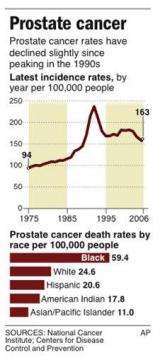
For American men, prostate cancer is the second-deadliest cancer after lung cancer. An estimated 192,000 new cases and 27,000 deaths from it occurred last year in the United States. But it is often a slow-growing cancer, and depending on a man's age, he may be more likely to die of something else.
Another problem with the PSA test is that an elevated or fast-rising PSA reading can indicate the presence of cancer, but can also be caused by something minor, such as an infection or an enlarged prostate. A biopsy is needed to confirm cancer, and that can cause unnecessary pain and fear.
The new recommendations could be "game changers" in two respects, said Dr. John Davis, a urologist who directs prostate cancer screening for the University of Texas M.D. Anderson Cancer Center in Houston.
First, it may mean many doctors will stop routinely giving the PSA test during regular physicals and will discuss it with their patients first, he said. About 41 percent of men 50 and older get annual prostate cancer screenings, he said.
Second, the guidelines could have a chilling effect on community screening clinics in which hundreds of men line up and get free, quick exams, Davis said.
That was the intent, said Dr. Andrew Wolf, a University of Virginia physician who led the group that wrote the new guidelines.
"Yes, the guideline was explicitly crafted to put a damper on those community prostate screening activities that do not offer men the opportunity to make an informed decision whether to screen," Wolf said.
Last year, the American Urological Association - a longtime proponent of regular prostate screening - backed off its call for annual tests after age 50. The group said men should be offered a baseline test at 40, with follow-ups based on each man's situation.
The group also has stood by the rectal exam as a standard part of screening, saying it can find cancer that the blood test does not.
The cancer society last issued guidelines in 2001, which said merely that doctors should offer screening and discuss the risks and benefits. The new guidelines back away even more, dropping the sentence that doctors should offer prostate screening.
Instead, the society said that some evidence indicates periodic screening can save lives but that there is uncertainty about the value of finding prostate cancer early. Screening should not take place unless the patient is fully informed of the trade-offs, the society said.
Men at average risk should get detailed information around age 50, the society said. Men at higher risk, including blacks and men with a father or brother who had prostate cancer before age 65, should get the information beginning at 45. Men with more than one close relative with prostate cancer before 65 should get such information at 40.
For men who want to be screened regularly, the new guidelines recommend every other year if the PSA reading is less than 2.5, a measure of prostate specific antigen. Annual tests are recommended for 2.5 or higher, and a 4 suggests consideration of a biopsy.
Early prostate cancer has no symptoms. Advanced disease may interfere with urination or cause blood in the urine. Many men with slow-growing cancers have been successfully treated after symptoms appear.
The society's new guidelines rankle Skip Lockwood, president and CEO of Zero - The Project to End Prostate Cancer, formerly known as the National Prostate Cancer Coalition.
Lockwood's group recommends annual PSA tests for men beginning at 45, and conducts mobile prostate cancer screening programs. The group provides information about the risks and benefits of screening, and connects men to follow-up care if needed, he said.
What bothers him most in the new guidance is "the certainty of its tone," Lockwood said.
"We acknowledge that the PSA test is lacking. I think nobody disagrees on that fact. I think that we all understand that this is not cut and dry - not an all-or-nothing situation," he said.
More information: Some patient decision aid Web sites:
©2010 The Associated Press. All rights reserved. This material may not be published, broadcast, rewritten or redistributed.


