France's crumbling sea walls no match for ocean
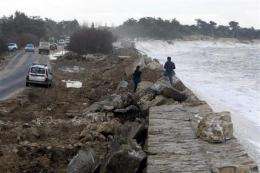
(AP) -- The moon was full, the wind roared, the tide was high and people died by the dozens. After a wall of ocean water engulfed picturesque towns along France's Atlantic coast, residents, officials and experts are all asking why.
Was it due to climate change? A freak storm fueled by hurricane-force winds? The result of human greed over desirable land or bungling actions by government officials?
All of the above.
Many observers point to the thousands of miles (kilometers) of sea walls in France, many too low, in severe disrepair or reportedly dating from the era of Napoleon. They also note the new houses cropping up behind them, tantalizingly close to the country's poorly protected but much beloved shoreline.
Environmental groups say the storm should be a wake-up call about the danger of weak sea defenses, for scientists are warning that climate change will bring even fiercer storms and rising seas in the years ahead.
At least 52 people were killed when the storm named Xynthia swept through France's southwestern coastal communities between 4 a.m. and 5 a.m. Sunday, surprising victims in their sleep.
On Wednesday, divers were still looking for bodies in the region's submerged homes.
Houses were ruined by the thousands and the livelihoods of many more were wiped out as oyster beds were destroyed, herd of cows drowned and fields of prized regional potatoes flooded with brackish salt water.
The damage stretched to the tony vacation island of Ile de Re but most of the dead were found on the French mainland, in the Vendee and Charente-Maritime regions, especially in two particularly vulnerable towns, L'Aiguillon-Sur-Mer and La Faute-Sur-Mer.
"I built this house with my own hands. I worked on it every weekend, during vacations," Roger Barteau, a retiree in La Faute-Sur-Mer, said of his inundated home on France-Info radio. "It tears your guts out."
"A small picturesque port that has conserved its authenticity" is how the local tourist office describes L'Aiguillon-Sur-Mer.
Not any more.
The town's sea walls - the only barrier between the surging Atlantic Ocean and the sea-level land - crumbled and salty water gushed forth, ripping up trees, coating the town with mud and debris and covering some homes to their rooftops.
A physicist who specializes in tides, Pierre Bouteloup, blamed a chain of events that he called an "extraordinary coincidence": a strong wind, enormous waves and, above all, very low atmospheric pressure drew the water even higher.
Others say human error clinched the disaster with chaotic urbanization in flood zones and a failure to maintain the country's aging sea walls.
France has up to 6,200 miles (10,000 kilometers) of sea walls, with some of them built in the 18th century, said Deputy Ecology Minister Chantal Jouanno. And about one tenth of them - 620 miles (1,000 kilometers) - "can be considered a risk," she said.
Sea walls were on the agenda Wednesday at President Nicolas Sarkozy's Cabinet meeting - and he ordered an immediate inspection of all such barriers in France, and urgent repairs.
The risks were known to the Vendee Equipment Department, which questioned coastal safety in an October 2008 report, citing in particular the fragile sea walls in L'Aiguillon-Sur-Mer and La Faute-Sur-Mer.
"There is no doubt about the vulnerability of the Vendee coast to marine submersion," the report said, calling for a risk prevention plan to prevent deaths and damage in the two towns, located on an estuary that leads to the Atlantic.
L'Aiguillon-Sur-Mer ordered a euro20,000 study on repairs to one sea wall last May, but it was not clear whether the study had been completed.
The French could possibly look north to their Dutch colleagues for expertise in flood defenses, for two-thirds of the Netherlands' 16 million people live below sea level.
The Netherlands' dikes system is under rolling, never-ending reviews to see whether standards should be raised in light of various threats. In 2008, the Netherlands announced more than euro100 billion (then-$140 billion) in new spending through the year 2100 to prepare for the effects of global warming.
France's national weather service issued alerts ahead of Sunday's storm, in which winds were clocked at up to 160 kilometers per hour (99 mph). But Meteo France doesn't deal with tides. On that full-moon night, the tide measured 105 to 108 on a scale of 20 to 120. The high winds and high tide created a potentially fatal combination.
Lax town planning completed the downward spiral. New homes have cropped up chaotically over the years, often near the water.
The government "cannot exonerate itself from examining the application of laws in flood zones," said Jean-Jacques Brot, the state's top representative in the Vendee.
Some say there is a tug of war between local officials and the state over construction permits in flood zones.
"Each time a house is built, it's money for the community," said Leon Gendre, the mayor of La Flotte-en-Re, an ancient town on the Ile de Re. "Money is running all this."
Jouanno said 643 French communities are in risky areas but only 46 have risk prevention plans defining zones where building is permitted, calling that "very insufficient."
The France Nature Environment group says the recent tragedy should serve as an "electroshock" to the nation and called for completely revamped risk planning that takes into account growing threats as global warming increases.
The group said by 2100, global warming will cause sea waters to rise by a yard (meter), allowing a small storm to do the same damage as Sunday's monster.
©2010 The Associated Press. All rights reserved. This material may not be published, broadcast, rewritten or redistributed.


