'Microrings' could nix wires for communications in homes, offices
March 3, 2010
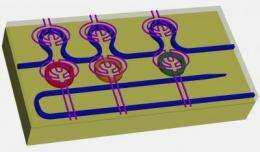
This diagram shows the design for new silicon "microring resonators," miniature devices used in a system that converts ultra fast laser pulses into bursts of radio-frequency signals. The innovation is a step toward making wires obsolete for communications in homes and offices. Such an advance could enable all communications, from high-definition television broadcasts to secure computer connections, to be transmitted from a single base station. The microring filter can be tuned by heating the rings. Credit: Purdue University, Minghao Qi
(PhysOrg.com) -- Purdue University researchers have developed a miniature device capable of converting ultrafast laser pulses into bursts of radio-frequency signals, a step toward making wires obsolete for communications in the homes and offices of the future.
Such an advance could enable all communications, from high-definition television broadcasts to secure computer connections, to be transmitted from a single base station, said Minghao Qi, an assistant professor of electrical and computer engineering.
"Of course, ideas about specific uses of our technology are futuristic and speculative, but we envision a single base station and everything else would be wireless," he said. "This base station would be sort of a computer by itself, perhaps a card inserted into one of the expansion slots in a central computer. The central computer would take charge of all the information processing, a single point of contact that interacts with the external world in receiving and sending information."
Ordinarily, the continuous waves of conventional radio-frequency transmissions encounter interference from stray signals reflecting off of the walls and objects inside a house or office. However, the pulsing nature of the signals produced by the new "chip-based spectral shaper" reduces the interference that normally plagues radio frequency communications, said Andrew Weiner, Purdue's Scifres Family Distinguished Professor of Electrical and Computer Engineering.
Each laser pulse lasts about 100 femtoseconds, or one-tenth of a trillionth of a second. These pulses are processed using "optical arbitrary waveform technology" pioneered by Purdue researchers led by Weiner.
Findings have appeared online in the journal Nature Photonics and were published in the February print issue of the magazine. The research is based at Purdue's Birck Nanotechnology Center in the university's Discovery Park.
"What enables this technology is that our devices generate ultrabroad bandwidth radio frequencies needed to transmit the high data rates required for high resolution displays," Weiner said.
Such a technology might eventually be developed to both receive and transmit signals.
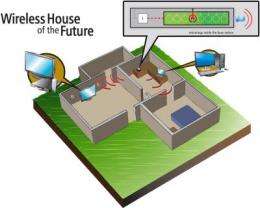
The wireless house of the future might use a system being developed at Purdue University that could eliminate wires for communications in homes, businesses and cars. The researchers designed and built a miniature device capable of converting ultra fast laser pulses into bursts of radio-frequency signals using innovative "microring resonators." Such an advance could enable all communications, from high-definition television broadcasts to secure computer connections, to be transmitted from a single base station. Credit: Purdue University, Michael Esposito
"But initially, industry will commercialize devices that only receive signals, for 'one-way' traffic, such as television sets, projectors, monitors and printers," Qi said. "This is because the sending unit for transmitting data is currently still a little bulky. Later, if the sending unit can be integrated into the devices, we could enjoy full two-way traffic, enabling the wireless operation of things like hard-disc drives and computers."
The approach also might be used for transmitting wireless signals inside cars.
The researchers first create laser pulses with specific "shapes" that characterize the changing intensity of light from the beginning to end of each pulse. The pulses are then converted into radio frequency signals.
A key factor making the advance potentially useful is that the pulses transmit radio frequencies of up to 60 gigahertz, a frequency included in the window of the radio spectrum not reserved for military communications.
The Federal Communications Commission does not require a license to transmit signals from 57-64 gigahertz. This unlicensed band also is permitted globally, meaning systems using 60 gigahertz could be compatible worldwide.
"There is only a very limited window for civil operations, and 60 gigahertz falls within this window," Qi said.
Ordinary computer chips have difficulty transmitting electronic signals at such a rapid frequency because of "timing jitter," or the uneven timing with which transistors open and close to process information.
This uneven "clock" timing, or synchronization, of transistors does not hinder ordinary computer chips, which have a speed of about 3 gigahertz. However, for devices switching on and off at 60 gigahertz, this jitter prevents proper signal processing.
Another complication is that the digital-to-analog converters needed to convert pulsing laser light into radio frequency signals will not work at such high frequencies.
To sidestep these limitations, researchers have previously created "bulk optics" systems, which use mirrors, lenses and other optical components arranged on a vibration-dampened table several feet long to convert and transmit the pulsed signals.
However, these systems are far too large to be practical.
Now, the Purdue researchers have miniaturized the technology small enough to fit on a computer chip.
"We shrank the size of the bulk optical setup by thousands of times," Qi said.
The system is programmable so that it could be instructed to produce and transmit only certain frequencies, he said.
The researchers fabricated tiny silicon "microring resonators," devices that filter out certain frequencies and allow others to pass. A series of the microrings were combined in a programmable "spectral shaper" 100 microns wide, or about the width of a human hair. Each of the microrings is about 10 microns in diameter.
The microring filter can be tuned by heating the rings, which causes them to change so that they filter different frequencies. The research is funded by the National Science Foundation, the Defense Threat Reduction Agency, and the National Security Science and Engineering Faculty Fellowship program from the Office of the Secretary of Defense.
Purdue filed a provisional patent in January for the technology, which is at least five years away from being ready for commercialization, Qi said.
More information: Ultrabroad-bandwidth arbitrary radio-frequency waveform generation with a silicon photonic chip-based spectral shaper, Maroof H. Khan et al., Nature Photonics.
-
New device for ultrafast optical communications
Mar 01, 2010 |
not rated yet |
0
-
Infineon Makes UMTS Phones Usable Worldwide
Jun 14, 2005 |
not rated yet |
0
-
Wireless optical transmission key to secure, safe and rapid indoor communications
Jan 27, 2010 |
not rated yet |
0
-
Undersea WiFi can be made faster, says researcher
Sep 03, 2007 |
not rated yet |
0
-
Graphene could lead to faster chips
Mar 19, 2009 |
not rated yet |
0
-
Engineers build first sub-10-nm carbon nanotube transistor
Feb 01, 2012 |
4.9 / 5 (30) |
30
-
Something old, something new: Evolution and the structural divergence of duplicate genes
Jan 31, 2012 |
4.6 / 5 (7) |
1
-
The hidden nanoworld of ice crystals: Revealing the dynamic behavior of quasi-liquid layers
Jan 30, 2012 |
5 / 5 (3) |
1
-
Stock market network reveals investor clustering
Jan 27, 2012 |
3.9 / 5 (23) |
8
-
Of microchemistry and molecules: Electronic microfluidic device synthesizes biocompatible probes
Jan 26, 2012 |
5 / 5 (1) |
0
-
Rubber production is likely to gradually reduce
3 hours ago
-
Help! Physics Momentum/Impulse problem!
3 hours ago
-
Gauss' law cubes, how to prove
5 hours ago
-
A grandfather pulls his granddaughter, whose mass is 20.5 kg
6 hours ago
-
what is significance of torque
7 hours ago
-
Difference between volume displaced fluid and volume of the object
7 hours ago
- More from Physics Forums - General Physics
More news stories
Explained: Sigma
It's a question that arises with virtually every major new finding in science or medicine: What makes a result reliable enough to be taken seriously? The answer has to do with statistical significance -- but ...
20 hours ago |
5 / 5 (12) |
30
Borexino Collaboration succeeds in spotting pep neutrinos emitted from the sun
(PhysOrg.com) -- To learn more about how the sun works, scientists study particles that are emitted from it into space due to thermonuclear reactions that occur inside; by applying known physics principles, ...
Physics research suggests new pathways for cancer progression
Observing that certain cancer cells may exhibit greater flexibility than normal cells, some scientists believe that this capability promotes rapid tumor growth. Now computer simulations developed by Boston University Biomedical ...
18 hours ago |
5 / 5 (1) |
0
Quantum physicist explains $100K offer for proof scaled-up quantum computing is impossible
(PhysOrg.com) -- MIT researcher Scott Aaronson has certainly riled the physics community with his offer this past Friday, of $100,000 to anyone who can prove that scaled-up quantum computing is impossible. ...
Physicists 'record' magnetic breakthrough
An international team of scientists has demonstrated a revolutionary new way of magnetic recording which will allow information to be processed hundreds of times faster than by current hard drive technology.
Feb 07, 2012 |
4.5 / 5 (39) |
14
|
'Dark plasmons' transmit energy
Microscopic channels of gold nanoparticles have the ability to transmit electromagnetic energy that starts as light and propagates via "dark plasmons," according to researchers at Rice University.
FDA-approved drug rapidly clears amyloid from the brain, reverses Alzheimer's symptoms in mice
Neuroscientists at Case Western Reserve University School of Medicine have made a dramatic breakthrough in their efforts to find a cure for Alzheimer's disease. The researchers' findings, published in the journal Science, show t ...
Hydrogen from acidic water: Researchers develop potential low cost alternative to platinum for splitting water
A technique for creating a new molecule that structurally and chemically replicates the active part of the widely used industrial catalyst molybdenite has been developed by researchers with the Lawrence Berkeley ...
Ultraviolet protection molecule in plants yields its secrets
Lying around in the sun all day is hazardous not just for humans but also for plants, which have no means of escape. Ultraviolet (UV) radiation from the sun can damage proteins and DNA inside cells, leading ...
Soraa LED light may dim 50-watt halogen rivals
(PhysOrg.com) -- Soraa, a Fremont, California company founded in 2008, this week launched its first product, a light that uses LEDS (light emitting diodes). The "Soraa LED MR16 lamp" is the "perfect" replacement ...
Anyone can learn to be more inventive, cognitive researcher says
There will always be a wild and unpredictable quality to creativity and invention, says Anthony McCaffrey, a cognitive psychology researcher at the University of Massachusetts Amherst, because an "Aha moment" is rare and ...

Mar 03, 2010
Rank: 1 / 5 (1)
Mar 03, 2010
Rank: 3 / 5 (1)
well thats good to hear, i guess there won't be any more american idol.
Mar 03, 2010
Rank: not rated yet
Mar 03, 2010
Rank: not rated yet
You just said the FCC BANNED television broadcasting. I'm so confused! Or maybe YOU are.
Mar 04, 2010
Rank: not rated yet
Doh, I did say Radio, what a dummy, of course radio is still broadcasting.