Air Force eyes mini-thrusters for use in satellite propulsion
March 3, 2010
Air Force eyes mini-thrusters for use in satellite propulsion

Enlarge

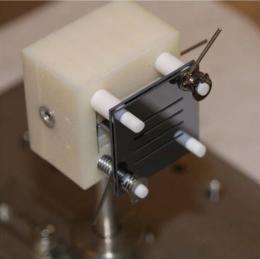
A prototype of a miniature electrospray thruster with four rows of ion emitters is shown here. The thruster is contained within two black plates each measuring about one square inch. Credit: Dr. Paulo Lozano, MIT

Mini-thrusters or miniature, electric propulsion systems are being developed, which could make it easier for the Air Force's small satellites, including the latest CubeSats, to perform space maneuvers and undertake formidable tasks like searching for planets beyond our solar system.

With Air Force Office of Scientific Research funding, researchers led by Dr. Paulo Lozano at Massachusetts Institute of Technology are considering the advantages of electric over more traditional chemical rocketry. As a result, they have discovered "ionic liquid ion sources" which are the core elements of the mini-thruster.

In addition to the benefits anticipated for small satellites, the technology may have applicability in completely different areas.

"Fast-moving ions coming out from the mini-thrusters can be used to etch semiconductors to create patterns in the nanometer scale, to fabricate or small mechanical devices," said Lozano.

The team is interested in the properties that allow advances in travel between different orbits in space and the ability for to self-destruct upon controlled re-entry, therefore preventing the creation of additional space debris.

Lozano predicts that he will have a mini-thruster prototype developed in about four or five months and he expects the technology to become a reality in the next two years. He plans to begin measuring the velocity of the ions and their energy as soon as the prototype is ready to determine the thrust and efficiency of the engine. Later this year, the team will begin looking at how to integrate mini-thrusters to flight hardware.

Provided by Air Force Office of Scientific Research

Filter


Move the slider to adjust rank threshold, so that you can hide some of the comments.


Display comments: newest first

sender
Mar 03, 2010

Rank: not rated yet
optical radiation pressure thrust would probably be a lot more renewable in solar space?
Rank 2 /5 (2 votes)
Relevant PhysicsForums posts
  • Calling function with no input argument
    created13 hours ago
  • Force free body diagram problem on gym equipment
    created14 hours ago
  • Empirical data regarding shower heads and water
    created22 hours ago
  • feed hold button on CNC lathe
    createdFeb 09, 2012
  • RFAC in Fortran
    createdFeb 09, 2012
  • dynamics 2/32
    createdFeb 08, 2012
  • More from Physics Forums - General Engineering

More news stories

Google users warned of threat to smartphone wallets

Users of Google smartphone wallets were being warned on Friday that there is a way to crack pass codes intended to thwart thieves from going on illicit shopping sprees.

Technology / Internet

created 7 hours ago | popularity 5 / 5 (2) | comments 0

Anonymous knocks CIA website offline (Update)

The website of the Central Intelligence Agency was inaccessible on Friday after the hacker group Anonymous claimed to have knocked it offline.

Technology / Internet

created 8 hours ago | popularity 5 / 5 (9) | comments 13

New error-correcting codes guarantee the fastest possible rate of data transmission

Error-correcting codes are one of the triumphs of the digital age. They’re a way of encoding information so that it can be transmitted across a communication channel — such as an optical fiber o ...

Technology / Computer Sciences

created 17 hours ago | popularity 4.9 / 5 (8) | comments 6 | with audio podcast

New power source discovered

(PhysOrg.com) -- Researchers at the Massachusetts Institute of Technology (MIT) and RMIT University have made a breakthrough in energy storage and power generation.

Technology / Energy & Green Tech

created 16 hours ago | popularity 4.8 / 5 (26) | comments 8 | with audio podcast

Small modular reactor design could be a 'SUPERSTAR'

(PhysOrg.com) -- Though most of today's nuclear reactors are cooled by water, we've long known that there are alternatives; in fact, the world's first nuclear-powered electricity in 1951 came from a reactor ...

Technology / Energy & Green Tech

created 16 hours ago | popularity 4.3 / 5 (12) | comments 22 | with audio podcast


Humans may have helped the decline of African rainforests 3000 years ago

(PhysOrg.com) -- Large areas of rainforests in Central Africa mysteriously disappeared over three thousand years ago, to be replaced by savannas. The prevailing theory has been that the cause was a change ...

Complex wiring of the nervous system may rely on a just a handful of genes and proteins

Researchers at the Salk Institute have discovered a startling feature of early brain development that helps to explain how complex neuron wiring patterns are programmed using just a handful of critical genes. ...

The power of estrogen -- male snakes attract other males

A new study has shown that boosting the estrogen levels of male garter snakes causes them to secrete the same pheromones that females use to attract suitors, and turned the males into just about the sexiest ...

Putting the squeeze on planets outside our solar system

(PhysOrg.com) -- Using high-powered lasers, scientists at Lawrence Livermore National Laboratory and collaborators discovered that molten magnesium silicate undergoes a phase change in the liquid state, abruptly ...

Could Venus be shifting gear?

(PhysOrg.com) -- ESA’s Venus Express spacecraft has discovered that our cloud-covered neighbour spins a little slower than previously measured. Peering through the dense atmosphere in the infrared, the ...

Fool's gold may prove an unlikely alternative to overexploited catalytic materials

Catalytic materials, which lower the energy barriers for chemical reactions, are used in everything from the commercial production of chemicals to catalytic converters in car engines. However, with current catalytic materials ...