NASA Mars Orbiter Speeds Past Data Milestone
March 3, 2010
NASA Mars Orbiter Speeds Past Data Milestone

Enlarge

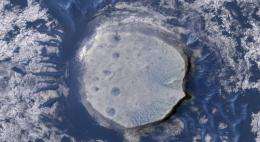
This view of an inverted crater in the Arabia Terra region of Mars is among the images taken by NASA's Mars Reconnaissance Orbiter in early 2010 as the spacecraft approached the 100-terabit milestone in total data returned. Image Credit: NASA/JPL-Caltech/University of Arizona

(PhysOrg.com) -- NASA's newest Mars orbiter, completing its fourth year at the Red Planet next week, has just passed a data-volume milestone unimaginable a generation ago and still difficult to fathom: 100 terabits.

That 100 trillion bits of information is more data than in 35 hours of uncompressed high-definition video. It's also more than three times the amount of data from all other deep-space missions combined -- not just the ones to Mars, but every mission that has flown past the orbit of Earth's moon.

"What is most impressive about all these data is not the sheer quantity, but the quality of what they tell us about our neighbor planet," said Mars Reconnaissance Orbiter Project Scientist Rich Zurek, of NASA's Jet Propulsion Laboratory, Pasadena, Calif. "The data from the orbiter's six instruments have given us a much deeper understanding of the diversity of environments on Mars today and how they have changed over time."

The spacecraft entered orbit around Mars on March 10, 2006, following an Aug. 12, 2005, launch from Florida. It completed its primary science phase in 2008 and continues investigations of Mars' surface, subsurface and atmosphere.

The orbiter sports a dish antenna 3 meters (10 feet) in diameter and uses it to pour data Earthward at up to 6 megabits per second. Its science instruments are three cameras, a spectrometer for identifying minerals, a ground-penetrating radar and an atmosphere sounder.

The capability to return enormous volumes of data enables these instruments to view Mars at unprecedented spatial resolutions. Half the planet has been covered at 6 meters (20 feet) per pixel, and nearly 1 percent of the planet has been observed at about 30 centimeters (1 foot) per pixel, sharp enough to discern objects the size of a desk. The radar, provided by Italy, has looked beneath the surface in 6,500 observing strips, sampling about half the planet.

Among the mission's major findings is that the action of water on and near the surface of Mars occurred for hundreds of millions of years. This activity was at least regional and possibly global in extent, though possibly intermittent. The spacecraft has also observed that signatures of a variety of watery environments, some acidic, some alkaline, increase the possibility that there are places on that could reveal evidence of past life, if it ever existed.

Provided by JPL/NASA (news : web)

4.2 /5 (6 votes)  

Filter


Move the slider to adjust rank threshold, so that you can hide some of the comments.


Display comments: newest first

deatopmg
Mar 03, 2010

Rank: not rated yet
can the 1% of the planet mapped at 30 cm/pixl be accessed by the public or is the quality downgraded before release?
ThanderMAX
Mar 04, 2010

Rank: not rated yet
can the 1% of the planet mapped at 30 cm/pixl be accessed by the public or is the quality downgraded before release?


We don't have gigabit internet connection at home , so we can't even view those gigabytes of data as in google earth
baudrunner
Mar 04, 2010

Rank: 2 / 5 (1)
There are so many great images of Mars, and not just by the Mars Orbiter, there are better hi-res cameras orbiting the red planet, that the average person actually gets bored looking at them all, if looking at them all were actually possible.
Hungry4info2
Mar 06, 2010

Rank: not rated yet
can the 1% of the planet mapped at 30 cm/pixl be accessed by the public or is the quality downgraded before release?


Yes.
http://hirise.lpl.arizona.edu/
Rank 4.2 /5 (6 votes)
Related Stories
Relevant PhysicsForums posts
  • Titan's lack of impact craters
    createdFeb 09, 2012
  • Real pictures of black hole eating a star?
    createdFeb 08, 2012
  • Hypothetical way to travel faster than light, but not technically exceed lightspeed
    createdFeb 06, 2012
  • How do scientists monitor the Sun's activity?
    createdFeb 05, 2012
  • Search patterns in observational studies
    createdFeb 05, 2012
  • Derivation of Pogson's law
    createdFeb 03, 2012
  • More from Physics Forums - General Astronomy

More news stories

Humans may have helped the decline of African rainforests 3000 years ago

(PhysOrg.com) -- Large areas of rainforests in Central Africa mysteriously disappeared over three thousand years ago, to be replaced by savannas. The prevailing theory has been that the cause was a change ...

Space & Earth / Environment

created 10 hours ago | popularity 5 / 5 (4) | comments 10 | with audio podcast report

Could Venus be shifting gear?

(PhysOrg.com) -- ESA’s Venus Express spacecraft has discovered that our cloud-covered neighbour spins a little slower than previously measured. Peering through the dense atmosphere in the infrared, the ...

Space & Earth / Space Exploration

created 6 hours ago | popularity 5 / 5 (5) | comments 7 | with audio podcast

Mars Science Laboratory computer issue resolved

(PhysOrg.com) -- Engineers have found the root cause of a computer reset that occurred two months ago on NASA's Mars Science Laboratory and have determined how to correct it.

Space & Earth / Space Exploration

created 7 hours ago | popularity 5 / 5 (5) | comments 3 | with audio podcast

Clam fields found at deep, low-temperature Mariana vents

(PhysOrg.com) -- Scientists have marveled at the unusual life forms thriving at high temperature hydrothermal vents of the deep ocean.

Space & Earth / Earth Sciences

created 7 hours ago | popularity not rated yet | comments 0 | with audio podcast

Two new moons for Jupiter

Advances in technology have lead to the discovery of new planets outside of our Solar System, and now even new moons in our own backyard.

Space & Earth / Space Exploration

created 6 hours ago | popularity not rated yet | comments 4


Complex wiring of the nervous system may rely on a just a handful of genes and proteins

Researchers at the Salk Institute have discovered a startling feature of early brain development that helps to explain how complex neuron wiring patterns are programmed using just a handful of critical genes. ...

The power of estrogen -- male snakes attract other males

A new study has shown that boosting the estrogen levels of male garter snakes causes them to secrete the same pheromones that females use to attract suitors, and turned the males into just about the sexiest ...

Human cognitive performance suffers following natural disasters, researchers find

Not surprisingly, victims of a natural disaster can experience stress and anxiety, but a new study indicates that it might also cause them to make more errors - some serious - in their daily lives. In their upcoming Human Fa ...

New error-correcting codes guarantee the fastest possible rate of data transmission

Error-correcting codes are one of the triumphs of the digital age. They’re a way of encoding information so that it can be transmitted across a communication channel — such as an optical fiber o ...

Both maternal and paternal age linked to autism

Older maternal and paternal age are jointly associated with having a child with autism, according to a recently published study led by researchers at The University of Texas Health Science Center at Houston (UTHealth).

Curry spice component may help slow prostate tumor growth

Curcumin, an active component of the Indian curry spice turmeric, may help slow down tumor growth in castration-resistant prostate cancer patients on androgen deprivation therapy (ADT), a study from researchers ...