Mineral studies advance antibacterial alternatives
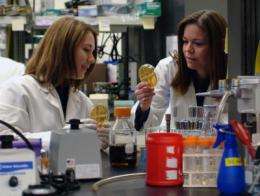
Alternative approaches to medicine are stock-in-trade in the ASU laboratory of microbiologist Shelley Haydel. So when ASU senior Jenny Koehl joined Haydel's investigative team seeking firsthand knowledge of how basic research is done, how drugs are tested and potential cures produced, she found it and much more.
With the guidance of Tanya Cunningham, a graduate student mentor, Koehl has helped advance understanding about the antibacterial activity of clay minerals and their ability to kill what the best antibiotics on the market can't touch.
Haydel's group, part of the School of Life Sciences, in the College of Liberals Arts and Sciences, and the Biodesign Institute at ASU, did the work in collaboration with Jack Summers, an inorganic chemist at Western Carolina University. They uncovered two factors that control the antibacterial activity. Their article "pH-dependent metal ion toxicity influences the antibacterial activity of two natural mineral mixtures" was published March 1 in the journal Public Library of Science (PLoS) ONE.
"This work sets a baseline from which to look for potential mechanisms of antibacterial action," said Cunningham, lead author, who is now a research technician with the Fred Hutchinson Cancer Research Center in Seattle.
"We need helpful alternatives, natural approaches to antibacterial cures, because there is bacterial resistance to drugs," Koehl said. "Knowing the mechanisms of action will help us develop our own topical treatments."
Clay has had a role in human health as ancient as man. However, specific identification of the mechanisms underlying this antibacterial activity has been elusive, until now.
The Haydel-Summers collaborative has added clarity to these distinctly muddy waters by screening more than 50 mineral mixtures (and aqueous extractions from them, known as leachates) marketed as health and cosmetic products using pathogens Escherichia coli, Salmonella enterica serovar Typhimurium, Staphylococcus aureus, methicillin-resistant S. aureus (MRSA), and Pseudomonas aeruginosa. Only two mineral mixtures of significantly different compositions (and their leachates) were discovered to possess antibacterial traits.
Clay minerals often are recognized as the slimy slurry of minerals that slicks rivers' banks. Understanding clay's structure is integral to answering questions about the mechanisms behind its antibacterial activity. Negatively charged surfaces attract positively charged elements, such as iron, copper, silver and other metals. In turn, water is absorbed between layers of the crystal structure creating a cation sandwich with aqueous filling or interlayer.
Antibacterial activity in leachates, extracted from the mineral mixtures, confirm that the antibacterial activity is chemically-based, rather than a result of physical interactions with microbes.
Because of the tendency of clay to attract multivalent ions, particularly metals, the scientists next examined the leachates' chemistry and antibacterial activity in the presence of chelators, which bind metals. The researchers also used thiourea, a hydroxyl radical scavenger, at various pH levels. Chelation of the minerals with ethylenediaminetetraacetic acid (EDTA) or desferrioxamine eliminated or reduced toxicity, respectively.
Further testing of the mineral leachates confirmed that there are higher concentrations of chemically-accessible metal ions in leachates from antibacterial samples than from non-bactericidal mineral samples.
In addition, acidic conditions were found to increase the availability of metal ions and their toxicity. Overall, these findings suggest a role of an acid soluble metal species, particularly iron or other sequestered metal cations, in mineral toxicity.
However, whatever advances the study puts forward also present researchers with further challenges. Acidity may complicate development of topical treatments, if neutral pH, least damaging to skin and tissue, also reduces the mineral's antibacterial action.
Another complicating factor, accentuated by the PLoS ONE study, is that chemical environments under which any particular clay can emerge can greatly influence its toxicity, adsorptive qualities and, according to their findings, its antibacterial effects.
"Because natural mineral mixtures can be variable, both mineralogically and chemically, we must continue to define specific chemical properties that influence the antibacterial effectiveness," Haydel said. "Our goal is to understand the details, so we can, in the future, perhaps generate mineral mixtures that mimic the chemical compositions and environment, so that the antibacterial activity can be controlled and ensured."
This work is about eliminating the unknowns," Koehl said. "We have more analysis to do, looking at the leachate composition, the action of the chelators and activity of the iron scavengers."
Koehl, who is working with Haydel as part of the School of Life Sciences Undergraduate Research (SOLUR) program, said of her experience: "Science is like an obstacle course. I've learned that when you come across problems in the laboratory, you have to be creative to work them out. This process has helped me be more critical, to be a thinking scientist, because I've had to analyze my own experiments and figure them out. This isn't just something that someone handed to me on paper in a classroom."
Studies are moving forward in other laboratories to develop structured clays for slow-release topical medical treatments, but there may be chemical schemes that come from Haydel's research, supported by the National Institutes of Health, that enhance their effectiveness.
"This study has given me an idea of how things move from idea to shelf," Koehl said. "One day, when I am a pharmacist, maybe I'll be selling this!"
Provided by Arizona State University


