A convincing mimic: Scientists report octopus imitating flounder in the Atlantic (w/ Video)
March 3, 2010
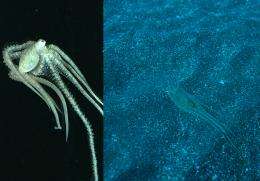
(Left) Macrotritopus defilippi in the aquarium; note the long thin arms characteristic of the species. Photo by John Forsythe. (Right) Macrotritopus defilippi swimming forward and mimicking the shape, speed, and behavior of flounder swimming. Photo by R. Hanlon.
(PhysOrg.com) -- On the open sand plains of the Caribbean seafloor, where soft-bodied animals are routinely exposed to predators, camouflage can be key to survival. Perhaps no group of animals is quite as adept at blending in with its surroundings as cephalopods, who along with relatives the cuttlefish and squid, have evolved a unique skin system that can instantaneously change their appearance.
In the February 2010 issue of The Biological Bulletin, MBL Senior Scientist and cephalopod expert Roger Hanlon and his colleagues report the exceptional camouflage capabilities of the Atlantic longarm octopus, Macrotritopus defilippi, whose strategy for avoiding predators includes expertly disguising itself as a flounder. While Hanlon and others have documented two other species of octopuses imitating flounder in Indonesian waters, this is the first report of flounder mimicry by an Atlantic octopus, and only the fourth convincing case of mimicry for cephalopods.
Comparing still photographs and video footage from five Caribbean locations collected over the last decade, Hanlon and co-authors, MBL graduate students Anya Watson and Alexandra Barbosa, observed uncanny similarities between the small and delicate octopus and the peacock flounder, Bothus lunatus, one of the most common sand dwellers in the Caribbean. They compared not only coloration, which in each animal resembled the sandy seafloor, but swimming speed and form.
This video is not supported by your browser at this time.
Video: Macrotritopus defilippi performing flounder mimicry. Video courtesy of R. Hanlon
Just like flounder, the octopuses contoured their bodies to hug the wavy seafloor, tapering their arms behind them. They also swam with the same fits and starts as flounder at the same speeds. Interestingly, the octopuses mimicked flounder only when swimming, when movement would compromise their camouflage. How well the animals blended in with their background differed. The octopus showed more highly controlled and rapid skin patterning than the flounder, whose camouflage was slower and less precise."We were equally impressed with the remarkable camouflage of this small octopus species even when it was stationary yet entirely exposed on top of the open sand," says Hanlon. "The apparent match in pattern, color, brightness, and even 3-dimensional skin texture was noteworthy even when compared to other changeable cephalopods. They also demonstrated an unusual form of disruptive camouflage."
So why do Atlantic longarm octopuses choose to imitate flounder as a way to avoid the threat of predators? More study of cephalopod mimicry is needed, but a possible explanation, according to Hanlon and his team, could be that predators who could easily take a bite out of the small, soft octopus might find a rigid flatfish like the flounder too much of a mouthful and avoid them.
More information: http://www.biolbull.org/
Provided by Marine Biological Laboratory
-
Now you see it, now you don't: Scientists unraveling the mystery of camouflage
Jan 15, 2009 |
not rated yet |
0
-
Stealth camouflage at night
Mar 09, 2007 |
not rated yet |
0
-
Octopus and kin inspire new camouflage strategies for military applications
Nov 12, 2007 |
not rated yet |
0
-
Study: Squid are masters of disguise
Sep 25, 2006 |
not rated yet |
0
-
Cretaceous octopus with ink and suckers -- the world's least likely fossils?
Mar 17, 2009 |
not rated yet |
0
-
Engineers build first sub-10-nm carbon nanotube transistor
Feb 01, 2012 |
4.9 / 5 (30) |
30
-
Something old, something new: Evolution and the structural divergence of duplicate genes
Jan 31, 2012 |
4.6 / 5 (7) |
1
-
The hidden nanoworld of ice crystals: Revealing the dynamic behavior of quasi-liquid layers
Jan 30, 2012 |
5 / 5 (3) |
1
-
Stock market network reveals investor clustering
Jan 27, 2012 |
3.9 / 5 (23) |
8
-
Of microchemistry and molecules: Electronic microfluidic device synthesizes biocompatible probes
Jan 26, 2012 |
5 / 5 (1) |
0
-
Pertubance in a model
6 hours ago
-
Cancer drugs and Alzheimer's, Oh my!
14 hours ago
-
Squishing cells
14 hours ago
-
Any books/articles for evolutionary stable strategy models in humans?
Feb 09, 2012
-
Science behind the bore feeling?
Feb 09, 2012
-
Homo Sapien vs. Chimpanzee - Divergence Timeline
Feb 09, 2012
- More from Physics Forums - Biology
More news stories
The power of estrogen -- male snakes attract other males
A new study has shown that boosting the estrogen levels of male garter snakes causes them to secrete the same pheromones that females use to attract suitors, and turned the males into just about the sexiest ...
4 hours ago |
not rated yet |
0
|
Grass to gas: Researchers' genome map speeds biofuel development
Researchers at the University of Georgia have taken a major step in the ongoing effort to find sources of cleaner, renewable energy by mapping the genomes of two originator cells of Miscanthus x giganteus, a large perenn ...
1 hour ago |
5 / 5 (2) |
0
|
Experts reveal how plants don't get sunburn
(PhysOrg.com) -- Experts at the University of Glasgow have discovered how plants survive the harmful rays of the sun.
4 hours ago |
5 / 5 (2) |
0
|
Protein libraries in a snap
(PhysOrg.com) -- A Rice University undergraduate will depart with not only a degree but also a possible patent for his invention of an efficient way to create protein libraries, an important component of biomolecular ...
7 hours ago |
5 / 5 (2) |
0
|
Miami battling invasion of giant African snails
No one knows how they got there. But an invasion of African giant snails has southern Florida in a panic over potential crop damage, disease and general yuckiness surrounding the slimy gastropods.
8 hours ago |
not rated yet |
2
Putting the squeeze on planets outside our solar system
(PhysOrg.com) -- Using high-powered lasers, scientists at Lawrence Livermore National Laboratory and collaborators discovered that molten magnesium silicate undergoes a phase change in the liquid state, abruptly ...
India probes Google over 'forex transactions'
Indian authorities are probing whether online giant Google broke domestic foreign-exchange transactions rules while shifting funds abroad, the Press Trust of India reported on Friday.
Germany freezes signing of disputed Internet pact
Germany on Friday halted the signing of a controversial international accord billed as a way to beat online piracy that has sparked angry protests, saying it needed more time to consider it.
Health experts, scientists to discuss bird flu studies
The World Health Organization said Friday it will meet next week to determine whether scientists can publish research on a bird flu virus that may be easily passed among humans.
Employers feel no love for unscrupulous practice of 'service sweethearting'
A new study led by two Florida State University marketing professors finds that some frontline service employees who are rewarded for hikes in customer loyalty and satisfaction also may engage in "service ...
Obama forges compromise birth control plan
US President Barack Obama Friday announced a compromise to defuse a row over access to birth control which prompted election-year Republican critics to claim he was waging a war on religion.