Small is beautiful: Japan's hand-made electric cars
March 4, 2010 by Karyn Poupee
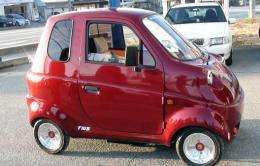
An environment-friendly car built by hand by a small family-run business at their garage-workshop in the snowy foothills of northwestern Toyama prefecture on February 24, 2010. While auto manufacturing giants spend millions to develop environmentally-friendly electric cars, one Japanese company has taken a more low-key approach, crafting hand-made "green" cars.
While auto manufacturing giants spend millions to develop environmentally-friendly electric cars, one Japanese company has taken a more low-key approach, crafting hand-made "green" cars.
Takeoka Jidosha Kogei may be the antithesis of the world's Hondas and Nissans. The family-run business makes its cars from scratch in a garage workshop in the snowy foothills in the northwest of the country.
There are no industrial robots or assembly lines in sight. Instead just a dozen mechanics crafting each model by hand, right up to the finishing touch of adding a set of beady headlights to their "Milieu" range.
The cars seem to owe much of their design to Japan's manga cartoon tradition -- their one-seater T-10 seems barely large enough for an adult driver, with just enough extra room left for a small pet, as requested by customers.
The box-shaped two-door car -- which is dubbed the "Eco-beagle" and comes in green, white, red and canary yellow -- has a relatively affordable price tag of 856,000 yen (9,600 dollars).
Company head Manabu Takeoka said he wants to change the image of minicars, which he said "are generally viewed as cars for the elderly, or for drivers who had their normal licences removed due to drunken driving".
"We've improved the shape of our latest model to make it cuter, to attract younger clients," he said.
Like other electric cars, it runs on a lithium-ion battery. It can also be charged from a conventional wall socket.
The latest model can drive up to 70 kilometres (45 miles) at 60 kilometres per hour when fully charged.
Takeoka's cars are aimed at rural households, which often have more than one car, as opposed to the cities, where more people opt for public transport to avoid the cost of parking.
The Takeoka lineup includes six models made from lightweight fibre-reinforced plastic, ranging from one- to four-seater cars. They measure less than three meters (10 feet) and weigh between 300 and 740 kilograms (660 to 1,600 pounds).
"People who buy our cars use them primarily to run errands or go shopping a few hundred metres from their homes. They don't need to charge the cars on the road if they already did so at home," said Takeoka.
Takeoka began its business in 1981 by building minicars for the disabled.
It started developing the electric cars in the 1990s with help from the local electricity company. Nearby Toyama University has since come on board, helping design the models.
The company also makes electric minicars specially designed for railway companies to inspect tunnels.
The electric cars may be a novelty, but they are unlikely to take the world by storm anytime soon, with sales currently at around 100 vehicles per year.
Asked whether there are plans to ramp up production, Takeoka exclaimed: "The company cannot build that many!"
(c) 2010 AFP
-
Tesla to unveil electric 5-seat sedan next week
Mar 19, 2009 |
not rated yet |
0
-
Finnish firms announce electric car plans
Aug 06, 2009 |
not rated yet |
0
-
Renault to test electric cars in Paris, Milan: company
Jul 02, 2009 |
not rated yet |
0
-
Taiwan, China may develop electric cars together
Nov 16, 2009 |
not rated yet |
0
-
Raptor: An Electric Car Nearly Anyone Would Want to Drive
Jul 09, 2009 |
not rated yet |
0
-
Engineers build first sub-10-nm carbon nanotube transistor
Feb 01, 2012 |
4.9 / 5 (30) |
30
-
Something old, something new: Evolution and the structural divergence of duplicate genes
Jan 31, 2012 |
4.6 / 5 (7) |
1
-
The hidden nanoworld of ice crystals: Revealing the dynamic behavior of quasi-liquid layers
Jan 30, 2012 |
5 / 5 (3) |
1
-
Stock market network reveals investor clustering
Jan 27, 2012 |
3.9 / 5 (23) |
8
-
Of microchemistry and molecules: Electronic microfluidic device synthesizes biocompatible probes
Jan 26, 2012 |
5 / 5 (1) |
0
-
Force free body diagram problem on gym equipment
1 hour ago
-
Empirical data regarding shower heads and water
9 hours ago
-
feed hold button on CNC lathe
Feb 09, 2012
-
RFAC in Fortran
Feb 09, 2012
-
dynamics 2/32
Feb 08, 2012
-
dynamics
Feb 08, 2012
- More from Physics Forums - General Engineering
More news stories
Netflix light on flicks as viewers soak up TV shows
Like most fresh faces that arrive in Hollywood, Netflix wanted to be a movie star. But now it's learning what many in Tinseltown have known for decades: Movies are sexy, but the real money is in television.
6 minutes ago |
not rated yet |
0
Sony's Hirai refuses to abandon dire TV business
Struggling Japanese entertainment giant Sony will not abandon its cash-bleeding television business, its incoming CEO says, but he acknowledges tough decisions lie ahead including over redundancies.
36 minutes ago |
not rated yet |
0
New error-correcting codes guarantee the fastest possible rate of data transmission
Error-correcting codes are one of the triumphs of the digital age. Theyre a way of encoding information so that it can be transmitted across a communication channel such as an optical fiber o ...
Technology / Computer Sciences
3 hours ago |
5 / 5 (3) |
2
|
Small modular reactor design could be a 'SUPERSTAR'
(PhysOrg.com) -- Though most of today's nuclear reactors are cooled by water, we've long known that there are alternatives; in fact, the world's first nuclear-powered electricity in 1951 came from a reactor ...
Technology / Energy & Green Tech
2 hours ago |
5 / 5 (4) |
9
|
Advanced power-grid model finds low-cost, low-carbon future in West
(PhysOrg.com) -- The least expensive way for the Western U.S. to reduce greenhouse gas emissions enough to help prevent the worst consequences of global warming is to replace coal with renewable and other ...
Technology / Energy & Green Tech
2 hours ago |
5 / 5 (1) |
3
|
Experts reveal how plants don't get sunburn
(PhysOrg.com) -- Experts at the University of Glasgow have discovered how plants survive the harmful rays of the sun.
Fool's gold may prove an unlikely alternative to overexploited catalytic materials
Catalytic materials, which lower the energy barriers for chemical reactions, are used in everything from the commercial production of chemicals to catalytic converters in car engines. However, with current catalytic materials ...
Curry spice component may help slow prostate tumor growth
Curcumin, an active component of the Indian curry spice turmeric, may help slow down tumor growth in castration-resistant prostate cancer patients on androgen deprivation therapy (ADT), a study from researchers ...
Unpicking HIV’s invisibility cloak
Drug researchers hunting for alternative ways to treat human immunodeficiency virus (HIV) infections may soon have a novel targetits camouflage coat. HIV hides inside a cloak unusually rich in a sugar ...
What lies beneath: Mapping hidden nanostructures
The ability to diagnose and predict the properties of materials is vital, particularly in the expanding field of nanotechnology. Electron and atom-probe microscopy can categorize atoms in thin sheets of material, ...
To avoid early labor and delivery, weight and diet changes not the answer
One of the strongest known risk factors for spontaneous or unexpected preterm birth any birth that occurs before the 37th week of pregnancy, most often without a known cause is already having had one. For women ...