Female dung beetles use horns to fight over manure
March 4, 2010 by Lin Edwards
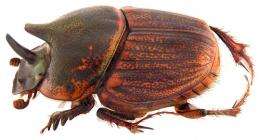
Dung beetle (Onthophagus sagittarius) Image credit: U.Schmidt.
(PhysOrg.com) -- Dung beetles are among the few species in which the females are more impressively equipped with armor than males, and a new study explains why: the females fight each other for the best manure and breeding sites.
University of Western Australia researchers, Prof. Leigh Simmons and Dr. Nicola Watson, studied the female dung beetle (Onthophagus sagittarius), which, as its name suggests, feeds on dung. When they arranged for the females to have to race each other to reach deposits of cow dung and access to egg-laying sites in tunnels beneath the dung, those with larger horns were able to gather more manure, and thus provide more of this valuable resource for supporting their young.
In a study published in the Proceedings of the Royal Society B, the researchers said competition between females for the use of breeding resources reduced the reproductive fitness of all the beetles, but smaller beetles were worse off than larger individuals. When matched for body size, the longest horns gave the greatest advantage in reproductive fitness, producing significantly more broods than beetles with shorter horns.
Dung beetles lay their eggs in balls of dung, which must be fresh for the beetles to use it and this is what leads to competition. Watson said there is a distinct advantage for females that can get to dung first and seize the best and freshest pieces. They have also been observed stealing dung from other females and replacing eggs with their own.
Dung beetles are also unusual in that the female dung beetles’ horns are of a different type to those of male beetles, and the scientists suggest this means they have evolved independently. Unlike male horns, they are not used for fighting off predators, defending territory, or competing for mates, but for fighting off other females competing with them for resources.
More information: Reproductive competition promotes the evolution of female weaponry, Nicola L. Watson, Leigh W. Simmons; Proceedings of the Royal Society B. doi:10.1098/rspb.2009.2335
© 2010 PhysOrg.com
-
Fossilized dung balls reveal secret ecology of lost world
Jul 15, 2009 |
not rated yet |
0
-
Sexual Encounters of the Third Kind: Darwin's Beetles Still Producing Surprises
Feb 06, 2009 |
not rated yet |
0
-
Why do males and females of some species look so different?
Dec 04, 2006 |
not rated yet |
0
-
Can't compete on dung? Try mating on apple pomace
Jun 24, 2009 |
not rated yet |
0
-
Armed beetles find a mate, whatever their size
Mar 27, 2008 |
not rated yet |
0
-
Engineers build first sub-10-nm carbon nanotube transistor
Feb 01, 2012 |
4.9 / 5 (30) |
30
-
Something old, something new: Evolution and the structural divergence of duplicate genes
Jan 31, 2012 |
4.6 / 5 (7) |
1
-
The hidden nanoworld of ice crystals: Revealing the dynamic behavior of quasi-liquid layers
Jan 30, 2012 |
5 / 5 (3) |
1
-
Stock market network reveals investor clustering
Jan 27, 2012 |
3.9 / 5 (23) |
8
-
Of microchemistry and molecules: Electronic microfluidic device synthesizes biocompatible probes
Jan 26, 2012 |
5 / 5 (1) |
0
-
Pertubance in a model
1 hour ago
-
Cancer drugs and Alzheimer's, Oh my!
9 hours ago
-
Squishing cells
9 hours ago
-
Any books/articles for evolutionary stable strategy models in humans?
21 hours ago
-
Science behind the bore feeling?
Feb 09, 2012
-
Homo Sapien vs. Chimpanzee - Divergence Timeline
Feb 09, 2012
- More from Physics Forums - Biology
More news stories
An eye for the tsetse fly
(PhysOrg.com) -- Geoffrey M. Attardo was one of those little boys who made pets of the spiders outside his bedroom window, feeding them and watching as they spun intricate webs. Age has not diminished his ...
45 minutes ago |
not rated yet |
0
Cure of ADPKD by selection for spontaneous genetic repair events in Pkd1-mutated iPS cells
A research group including Kyoto University researchers demonstrates that mouse iPS cells, in which genetic correction occurs spontaneously through mitotic recombination, is selectable from the population of genetically mutated ...
40 minutes ago |
not rated yet |
0
Miami battling invasion of giant African snails
No one knows how they got there. But an invasion of African giant snails has southern Florida in a panic over potential crop damage, disease and general yuckiness surrounding the slimy gastropods.
3 hours ago |
not rated yet |
1
Protein libraries in a snap
(PhysOrg.com) -- A Rice University undergraduate will depart with not only a degree but also a possible patent for his invention of an efficient way to create protein libraries, an important component of biomolecular ...
2 hours ago |
5 / 5 (1) |
0
|
Fighting crimes against biodiversity: How to catch a killer weed
Invasive species which have the potential to destroy biodiversity and influence global change could be tracked and controlled in the same way as wanted criminals, according to new research from Queen Mary, University of London.
4 hours ago |
not rated yet |
0
A frank discussion of the power law and linking correlation to causation
(PhysOrg.com) -- Michael Stumpf a mathematics professor at Imperial College in London, and Mason Porter a lecturer at Oxford have teamed together to write and publish a perspective piece in Science regarding the in ...
Mars Science Laboratory computer issue resolved
(PhysOrg.com) -- Engineers have found the root cause of a computer reset that occurred two months ago on NASA's Mars Science Laboratory and have determined how to correct it.
Advanced power-grid model finds low-cost, low-carbon future in West
(PhysOrg.com) -- The least expensive way for the Western U.S. to reduce greenhouse gas emissions enough to help prevent the worst consequences of global warming is to replace coal with renewable and other ...
Small modular reactor design could be a 'SUPERSTAR'
(PhysOrg.com) -- Though most of today's nuclear reactors are cooled by water, we've long known that there are alternatives; in fact, the world's first nuclear-powered electricity in 1951 came from a reactor ...
Clam fields found at deep, low-temperature Mariana vents
(PhysOrg.com) -- Scientists have marveled at the unusual life forms thriving at high temperature hydrothermal vents of the deep ocean.
Seeing colors in music, tasting flavors in shapes may happen in life's early months
Famed violinist Itzhak Perlman sees a deep forest green whenever he plays a B-flat on his Stradivarius' G string. The A on the E string is red.
Mar 04, 2010
Rank: not rated yet
Mar 10, 2010
Rank: 2 / 5 (1)