Engineering team developing helicopter that would investigate nuclear disasters
March 4, 2010
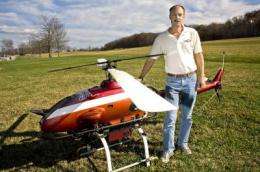
Kevin Kochersberger, a research associate professor with the Virginia Tech College of Engineering and director of the Virginia Tech Unmanned Systems Laboratory, and the autonomous helicopter. Credit: Virginia Tech Photo
Students at Virginia Tech's Unmanned Systems Laboratory are perfecting an autonomous helicopter they hope will never be used for its intended purpose. Roughly six feet long and weighing 200 pounds, the re-engineered aircraft is designed to fly into American cities blasted by a nuclear weapon or dirty bomb.
The helicopter's main mission would be to assist military investigators in the unthinkable: Enter an American city after a nuclear attack in order to detect radiation levels, map and photograph damage.
"It's for a worst-case scenario," said project leader Kevin Kochersberger, a research associate professor of mechanical engineering and director of the Virginia Tech Unmanned Systems Laboratory. His team consists of several graduate and undergraduate students from the mechanical engineering and electrical and computer engineering departments.
Kochersberger and his team re-engineered a remote-controlled Yamaha-built Unmanned Aerial Vehicle RMAX helicopter to fly in fully autonomous mode. They also created flight control software algorithms that will direct the helicopter to radioactive sources on its own accord. To carry out various missions, the researchers outfitted the helicopter with various "plug-and-play payloads" as the vehicle's weight capacity is limited. The payloads are easily loadable and unloadable boxes that fit snugly under the helicopter's main body, carrying devices that would detect radiation levels in the atmosphere and on the ground, and take video and still images of damage. Flight control software would allow the mission to be changed mid-flight.
One payload is unique: A miniature tray-like robot on treads that can be launched via a tether wire from the helicopter to collect evidence. The helicopter would hover over the robot, and pull it back via the wire. A student team is building this robot, which will boast not only "chunk" sampling capability, but also a miniature vacuum which could suck up dust and dirt.
The robot is expected to easily maneuver any terrain, including expected bomb craters, as part of its investigation, said Michael Rose, a graduate student in mechanical engineering, from Gilroy, Calif. The team plans to make the robot water proof, in the event that it comes across water - busted water mains, lakes, rain puddles, etc. "The electronics must be protected from the harmful elements," Rose said.
The group also designed a downward-looking stereo camera system mounted to the helicopter, to image affected areas. The cameras would allow for computerized 3-D terrain mapping of affected areas, an absolute necessity to understand the characteristics of the blast. It is expected that the helicopter will have night vision capabilities, and enhanced imaging technologies that improve vision through smoke and fog as the project progresses, Kochersberger said.
The project, already funded at $735,000 with an additional $650,000 allocated for 2010, is overseen by the U.S. Defense Threat Reduction Agency and spearheaded by the Department of Energy's Savannah River National Laboratory. Plans call for the helicopters to be mission-ready in three years. Department of Defense personnel already have visited Blacksburg to watch a demonstration as the craft zeroed in on a small, planted radioactive source at Kentland Farm, several miles from the Virginia Tech campus. More testing is underway, with another DoD demonstration planned for 2010 in Savannah, Ga.
-
Unmanned planes look for Katrina survivors
Sep 15, 2005 |
not rated yet |
0
-
Digital Advances Produce Improved Unmanned Aerial Vehicles
Jun 24, 2005 |
not rated yet |
0
-
Self-flying Stanford robocopter learn tricks though observation
Sep 18, 2008 |
not rated yet |
0
-
Spiraling Flight of Maple Tree Seeds Inspires New Surveillance Technology (w/ Video)
Oct 20, 2009 |
not rated yet |
0
-
In Brief: Iridium helps helicopter tracking
Apr 17, 2006 |
not rated yet |
0
-
Engineers build first sub-10-nm carbon nanotube transistor
Feb 01, 2012 |
4.9 / 5 (30) |
30
-
Something old, something new: Evolution and the structural divergence of duplicate genes
Jan 31, 2012 |
4.6 / 5 (7) |
1
-
The hidden nanoworld of ice crystals: Revealing the dynamic behavior of quasi-liquid layers
Jan 30, 2012 |
5 / 5 (3) |
1
-
Stock market network reveals investor clustering
Jan 27, 2012 |
3.9 / 5 (23) |
8
-
Of microchemistry and molecules: Electronic microfluidic device synthesizes biocompatible probes
Jan 26, 2012 |
5 / 5 (1) |
0
-
Empirical data regarding shower heads and water
2 hours ago
-
feed hold button on CNC lathe
22 hours ago
-
Mechanics of Solids ( Final exam question) please help!
Feb 09, 2012
-
RFAC in Fortran
Feb 09, 2012
-
dynamics 2/32
Feb 08, 2012
-
dynamics
Feb 08, 2012
- More from Physics Forums - General Engineering
More news stories
Soraa LED light may dim 50-watt halogen rivals
(PhysOrg.com) -- Soraa, a Fremont, California company founded in 2008, this week launched its first product, a light that uses LEDS (light emitting diodes). The "Soraa LED MR16 lamp" is the "perfect" replacement ...
Samsung can continue selling Galaxy tabs in Germany: court
South Korea's Samsung Electronics can continue to sell its Galaxy Tab 10.1N tablet computer in Germany, a German court ruled Thursday, rejecting a bid by arch-rival Apple to have them banned.
20 hours ago |
4 / 5 (4) |
3
Digital photos could put kids at risk
A study published in the International Journal of Electronic Security and Digital Forensics this month suggests that parents and carers could be putting children at risk if they upload digital photos that are automatically "geota ...
16 hours ago |
5 / 5 (1) |
3
Google launches Chrome browser for Android smartphones
With more and more people connecting to the Internet through a phone or a tablet instead of a PC, Google Inc. is bringing its fast-growing browser, Chrome, to the newest Android-powered mobile devices.
19 hours ago |
5 / 5 (5) |
0
Model analyzes shape-memory alloys for use in earthquake-resistant structures
Recent earthquake damage has exposed the vulnerability of existing structures to strong ground movement. At the Georgia Institute of Technology, researchers are analyzing shape-memory alloys for their potential ...
17 hours ago |
5 / 5 (1) |
0
|
'Dark plasmons' transmit energy
Microscopic channels of gold nanoparticles have the ability to transmit electromagnetic energy that starts as light and propagates via "dark plasmons," according to researchers at Rice University.
FDA-approved drug rapidly clears amyloid from the brain, reverses Alzheimer's symptoms in mice
Neuroscientists at Case Western Reserve University School of Medicine have made a dramatic breakthrough in their efforts to find a cure for Alzheimer's disease. The researchers' findings, published in the journal Science, show t ...
Hydrogen from acidic water: Researchers develop potential low cost alternative to platinum for splitting water
A technique for creating a new molecule that structurally and chemically replicates the active part of the widely used industrial catalyst molybdenite has been developed by researchers with the Lawrence Berkeley ...
Ultraviolet protection molecule in plants yields its secrets
Lying around in the sun all day is hazardous not just for humans but also for plants, which have no means of escape. Ultraviolet (UV) radiation from the sun can damage proteins and DNA inside cells, leading ...
Anyone can learn to be more inventive, cognitive researcher says
There will always be a wild and unpredictable quality to creativity and invention, says Anthony McCaffrey, a cognitive psychology researcher at the University of Massachusetts Amherst, because an "Aha moment" is rare and ...
Engineers find inspiration for new materials in Piranha-proof armor
(PhysOrg.com) -- Its a matchup worthy of a late-night cable movie: put a school of starving piranha and a 300-pound fish together, and who comes out the winner?
Mar 05, 2010
Rank: not rated yet