Phobos flyby success
March 4, 2010
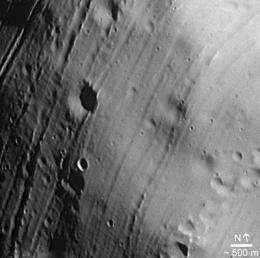
This image of Phobos's surface was obtained by the Super Resolution Channel (or SRC, a part of the High Resolution Stereo Camera experiment) on board ESA's Mars Express onAug. 3, 2008 (orbit 5889). The distance from the moon's centre was 656 km, and the image resolution is 6 m/pixel. The original image has been corrected for mirror distortion. Credit: ESA/ DLR/ FU Berlin (G. Neukum)
Mars Express encountered Phobos last night, smoothly skimming past at just 67 km, the closest any manmade object has ever approached Mars' enigmatic moon. The data collected could help unlock the origin of not just Phobos but other 'second generation' moons.
Something is not right about Phobos. It looks like a solid object but previous flybys have shown that it is not dense enough to be solid all the way through. Instead, it must be 25-35% porous. This has led planetary scientists to believe that it is little more than a 'rubble pile' circling Mars. Such a rubble pile would be composed of blocks both large and small resting together, with possibly large spaces between them where they do not fit easily together.
Last night's flyby was close enough to give scientists their most exquisite data yet about the gravitational field of Phobos. Mars Express locked onto the radio signal from Earth at around 21:20 CET (20:20 UT). The radio frequency oscillators on the ground are 100 000 times more stable than those on the spacecraft, so for this experiment, which required the best precision possible, the signal was sent up to Mars Express and then returned by the spacecraft to the ground.
The radio waves travel at the speed of light and took 6 minutes 34 seconds to travel from Earth to the spacecraft last night. So the round trip time was 13 minutes 8 seconds. Once the signal was received back at Earth, it was clearly strong and good. So strong that radio amateurs were also able to lock onto the signal, although their equipment would not be able to detect the subtle variations induced by the gravity of Phobos.
Now that the data are all collected, the analysis can begin. First will be an estimate of the density variation across the moon. This will tell scientists just how much of Phobos' interior is likely to be composed of voids.
"Phobos is probably a second-generation Solar System object," says Martin Pätzold, Universitat Koln, Cologne, Germany, and Principal Investigator of the Mars Radio Science (MaRS) experiment. Second generation means that it coalesced in orbit after Mars formed, rather than forming concurrently out of the same birth cloud as the Red Planet. There are other moons around other planets where this is thought to have been the case too, such as Amalthea around Jupiter.
Whatever the precise origin, Phobos will eventually crumble back into this disrupted state. It is gradually spiralling towards Mars and will eventually be pulled apart. "It came from debris, it will return to debris," says Pätzold. In the meantime, it is there to be studied and explored.
Last night's flyby was just one of a campaign of 12 Mars Express flybys taking place in February and March 2010. For the previous two, the radar was working, attempting to probe beneath the surface of the moon, looking for reflections from structures inside. In the coming flybys, the Mars Express camera will take over, providing high resolution pictures of the moon's surface.
-
Phobos flyby season starts again
Feb 16, 2010 |
not rated yet |
0
-
Mars Express heading for closest flyby of Phobos (w/ Video)
Mar 01, 2010 |
not rated yet |
0
-
Mars Express to rendezvous with Martian moon
Jul 16, 2008 |
not rated yet |
0
-
Scientists close in on the origin of Mars' larger moon
Oct 16, 2008 |
not rated yet |
0
-
Auspicious orbit marks run-up to Phobos flyby
Jan 29, 2010 |
not rated yet |
0
-
Engineers build first sub-10-nm carbon nanotube transistor
Feb 01, 2012 |
4.9 / 5 (31) |
30
-
Something old, something new: Evolution and the structural divergence of duplicate genes
Jan 31, 2012 |
4.6 / 5 (7) |
1
-
The hidden nanoworld of ice crystals: Revealing the dynamic behavior of quasi-liquid layers
Jan 30, 2012 |
5 / 5 (3) |
1
-
Stock market network reveals investor clustering
Jan 27, 2012 |
3.9 / 5 (23) |
8
-
Of microchemistry and molecules: Electronic microfluidic device synthesizes biocompatible probes
Jan 26, 2012 |
5 / 5 (1) |
0
-
Scale of the Universe
13 hours ago
-
Titan's lack of impact craters
Feb 09, 2012
-
Real pictures of black hole eating a star?
Feb 08, 2012
-
Hypothetical way to travel faster than light, but not technically exceed lightspeed
Feb 06, 2012
-
How do scientists monitor the Sun's activity?
Feb 05, 2012
-
Search patterns in observational studies
Feb 05, 2012
- More from Physics Forums - General Astronomy
More news stories
Humans may have helped the decline of African rainforests 3000 years ago
(PhysOrg.com) -- Large areas of rainforests in Central Africa mysteriously disappeared over three thousand years ago, to be replaced by savannas. The prevailing theory has been that the cause was a change ...
Could Venus be shifting gear?
(PhysOrg.com) -- ESAs Venus Express spacecraft has discovered that our cloud-covered neighbour spins a little slower than previously measured. Peering through the dense atmosphere in the infrared, the ...
Space & Earth / Space Exploration
20 hours ago |
5 / 5 (7) |
8
|
NASA budget will axe Mars deal with Europe: scientists
US President Barack Obama's budget proposal to be submitted next week for 2013 will cut NASA's budget by 20 percent and eliminate a major partnership with Europe on Mars exploration, scientists said Thursday.
Space & Earth / Space Exploration
23 hours ago |
5 / 5 (2) |
20
Mars Science Laboratory computer issue resolved
(PhysOrg.com) -- Engineers have found the root cause of a computer reset that occurred two months ago on NASA's Mars Science Laboratory and have determined how to correct it.
Space & Earth / Space Exploration
21 hours ago |
4.7 / 5 (6) |
4
|
Two new moons for Jupiter
Advances in technology have lead to the discovery of new planets outside of our Solar System, and now even new moons in our own backyard.
Space & Earth / Space Exploration
20 hours ago |
4 / 5 (1) |
7
Anonymous knocks CIA website offline (Update)
The website of the Central Intelligence Agency was inaccessible on Friday after the hacker group Anonymous claimed to have knocked it offline.
New error-correcting codes guarantee the fastest possible rate of data transmission
Error-correcting codes are one of the triumphs of the digital age. Theyre a way of encoding information so that it can be transmitted across a communication channel such as an optical fiber o ...
Small modular reactor design could be a 'SUPERSTAR'
(PhysOrg.com) -- Though most of today's nuclear reactors are cooled by water, we've long known that there are alternatives; in fact, the world's first nuclear-powered electricity in 1951 came from a reactor ...
New power source discovered
(PhysOrg.com) -- Researchers at the Massachusetts Institute of Technology (MIT) and RMIT University have made a breakthrough in energy storage and power generation.
The power of estrogen -- male snakes attract other males
A new study has shown that boosting the estrogen levels of male garter snakes causes them to secrete the same pheromones that females use to attract suitors, and turned the males into just about the sexiest ...
Google users warned of threat to smartphone wallets
Users of Google smartphone wallets were being warned on Friday that there is a way to crack pass codes intended to thwart thieves from going on illicit shopping sprees.
Mar 04, 2010
Rank: 3.5 / 5 (6)
What's the deal with all the banding/striation? Evidence of stratification? Seems unlikely that these are tracks plowed through a dusty, granular surface, if only because of their persistence over such large distances. Also, you would expect that if it formed by acretion, it would have been built- so to speak- from the inside out, rather than as some type of horizontally oriented "strata".
Just speculating.
Mar 04, 2010
Rank: 4.3 / 5 (3)
Mar 04, 2010
Rank: 2.5 / 5 (4)
Mar 05, 2010
Rank: 4 / 5 (2)
Putting astronauts on Phobos is infinitely easier than a manned landing on Mars due to this moon's minor gravity field, and Lockheed-Martin Corp. can do it in ten years, under NASA's supervision.