Avatar's New Twist on Plants
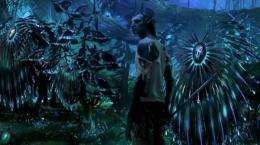
March 4, 2010The most striking feature of the warbonnet fern is the iridescent blue of the leaves, which contain abundant anthocyanin pigments. These pigments are light-reactive chemicals that reflect blue light and give color to the blue and purple flowers and fruit. The warbonnet fern is among the many bioluminescent flora of Pandora. Credit: James Cameron’s Avatar: The Game
Although they're not nominated for an Academy Award, plants play a central role in the blockbuster movie "Avatar." A botanist provided the science behind how these unusual organisms may have evolved.
The film "Avatar" takes viewers to a fictional moon, where the plants glow, shoot poison leaf tips and communicate. None of this fits exactly with our definition of "plant," but one botanist has pieced together an ecological back-story for how plants may have evolved on this strange world.
The moon Pandora is depicted as a lush rainforest that may remind some of Hawaii or Borneo. But the Earthlings who venture onto this exomoon are confronted with plants (not to mention animals) that behave in surprising ways.
"There's a balance of familiar and fanciful," says Jodie Holt, a plant physiologist from the University of California, Riverside. "I think if the organisms had been too bizarre, viewers would have dismissed them as unreal."
The plants were designed by director James Cameron and his graphic artists. However, during production, Holt was asked to provide some scientific justification for the imaginary world they were creating.
"The plants are fake, but the science is real," she says.
Besides advising the actress Sigourney Weaver on how to portray a botanist, Holt gave scientific names and descriptions to 55 of the most bizarre plants in the film. This catalog is included in a companion resource called "Pandorapedia."
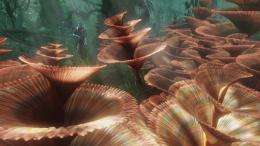
Helicoradian (also known as Loreyu, meaning "beautiful spiral") is a zooplantae (part animal, part plant) possessing a single leaf that responds to touch by coiling up and retracting to the ground. Its neuromuscular system makes it difficult for xenobiologists to classify. Helicoradia can grow to 6-8 meters (20-26 feet) in height and 2.5 meters (8.2 feet) across. Credit: James Cameron’s Avatar: The Game
What's in a nameOne the most captivating Pandoran flora is the "helicoradian" - an orange, spiraled plant that folds up and disappears when touched. Plants on earth do have touch sensitivity, says Holt, but here it has been greatly exaggerated.
"We usually only call something a plant if we poke it and it doesn't move away," she says.
In fact, Cameron invented his own term "plananimal" (or Zooplantae) for Pandoran life forms that blur the line between plant and animal.
However, no single characteristic distinguishes plants from other life kingdoms. We generally think of photosynthesis as the epitome of "plant-hood," but there are parasitic plants that don't photosynthesize their food and some non-plant bacteria that do.
Holt admits that the definition of plant has some wiggle room for whatever plant-like organisms may exist on other planets, but she herself is a novice to the imaginings of "exobotanists."
"If I had made up the plants, I would have been too constrained by what I know," she says.
Evolution solution
Holt didn't invent any new vegetation for the film, but she provided the film makers with scientific "cred."
"When describing a plant's appearance and characteristics, the overriding theme is plant evolution, so I asked for everything they had on the moon's environment that might select for certain traits," she says.
It turned out Cameron had thought through a lot of this already. He told her what the Pandoran soil and atmosphere contained and about the weak gravity but high magnetic fields.
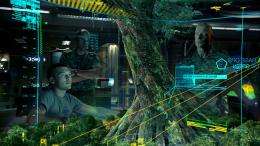
The name Hometree is misleading, as the structure is actually comprised of a grove of intertwined trees of the same species that have grown together, providing for mutual strength and structural reinforcement. This, coupled with Pandora's low gravity, is what accounts for the immense height of Hometree. Credit: James Cameron’s Avatar: The Game
From this, she was able to provide plausible explanations for the plant life. For example, the gigantism—exhibited by the humongous "Hometrees"—is likely the result of higher levels of atmospheric carbon dioxide and lower gravitational pull on Pandora in comparison to Earth.The glowing—or bioluminescence—of some plants might have been an adaption to long periods of darkness on Pandora, Holt reasoned. This light signal could attract pollinators.
However, Holt didn't think everything that the film makers dreamed up was credible. She was told early on that the Pandoran plants communicated with each other through nerves.
"I said no way," Holt recounts.
She advised them that a better explanation would be "signal transduction," which is seen in terrestrial plants when—for example—a root lacking water "tells" the leaves above to wilt. How this message is sent is unknown, but it may involve electrical signals or biochemical reactions involving small molecules.
"We don't know enough yet about signal transduction to say that Pandora's plants aren't using it," Holt says.
The film makers adopted this quasi-explanation: at one point in the movie Sigourney Weaver's character uses the term "signal transduction."
"That was my one line," Holt jokes.
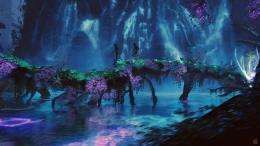
Most of Pandora's flora and fauna emit only one single color, often green, blue, indigo, or violet. There are exceptions like the Warbonnet Fern. Its leaves are illuminated by a broad band of red near their stems and by an iridescent blue near their tips. On Pandora, there is also a bioluminescent moss that is touch-sensitive. It will send out rings of blue-green light as a reaction to footsteps. Credit: James Cameron’s Avatar: The Game
Go greenBut for all its botanical inventiveness, the film didn't break any new ground with the color palette.
Nancy Kiang of the NASA Goddard Institute for Space Studies does research on the pigments that alien plants might use to best absorb a different spectrum of light coming from a star unlike our Sun. Her research shows that while plants on alien worlds could be green like they were in the movie, they could also be yellow, orange, black, or even near-infrared colors we couldn’t see.
"Plants on Earth are already so diverse, beautiful, and weird -- carnivorous plants, cacti, basketball-size seed pods, bioluminescent algae -- Pandora did not actually look all that exotic to me, especially, of course, since the plants were largely green,” says Kiang.
Plants look green to us because they reflect rather than absorb that light wavelength. Holt saw some early drawings that showed the plants being all blue, but she thinks that green was later adopted to make Pandora more appealing.
Kiang says that alien plants would probably not be blue, since plants prefer to absorb blue wavelengths. The exception to this rule might be if they are bombarded with a lot of light. In that situation, a plant might use sunscreen pigments to prevent its light-harvesting apparatus from getting overloaded, and excess blue light would be reflected.
“I suppose it would have been hard to watch the movie if it were shot in the light of a sun having a different spectral quality, so Cameron had to make an aesthetic decision,” Kiang says. “I'm glad he at least has provoked thought about how life might evolve differently on another planet.”
More information: Astrobiology Roadmap Goal 1: Habitable Planets -- http://astrobiolog … dmap/g1.html
Source: Astrobio.net
-
Clever plants chat over their own network
Sep 25, 2007 |
not rated yet |
0
-
Electric shocks boost plants' production of commercially useful chemicals
Mar 31, 2008 |
not rated yet |
0
-
Super plants may fight African hunger
May 24, 2006 |
not rated yet |
0
-
Rule reveals CO2 emissions of plant life
Jan 26, 2006 |
not rated yet |
0
-
Salt-tolerant gene found in simple plant nothing to sneeze at
Apr 07, 2008 |
not rated yet |
0
-
Engineers build first sub-10-nm carbon nanotube transistor
Feb 01, 2012 |
4.9 / 5 (30) |
30
-
Something old, something new: Evolution and the structural divergence of duplicate genes
Jan 31, 2012 |
4.6 / 5 (7) |
1
-
The hidden nanoworld of ice crystals: Revealing the dynamic behavior of quasi-liquid layers
Jan 30, 2012 |
5 / 5 (3) |
1
-
Stock market network reveals investor clustering
Jan 27, 2012 |
3.9 / 5 (23) |
8
-
Of microchemistry and molecules: Electronic microfluidic device synthesizes biocompatible probes
Jan 26, 2012 |
5 / 5 (1) |
0
-
Titan's lack of impact craters
22 hours ago
-
Real pictures of black hole eating a star?
Feb 08, 2012
-
Hypothetical way to travel faster than light, but not technically exceed lightspeed
Feb 06, 2012
-
How do scientists monitor the Sun's activity?
Feb 05, 2012
-
Search patterns in observational studies
Feb 05, 2012
-
Derivation of Pogson's law
Feb 03, 2012
- More from Physics Forums - General Astronomy
More news stories
Could Venus be shifting gear?
(PhysOrg.com) -- ESAs Venus Express spacecraft has discovered that our cloud-covered neighbour spins a little slower than previously measured. Peering through the dense atmosphere in the infrared, the ...
Space & Earth / Space Exploration
46 minutes ago |
5 / 5 (1) |
0
|
What does a nebula sound like?
What do things sound like out in the cosmos? Of course, sound waves cant travel through the vacuum of space; however, electromagnetic waves can. These electromagnetic waves can be recorded by devices called spectrographs ...
Space & Earth / Space Exploration
53 minutes ago |
5 / 5 (1) |
0
Two new moons for Jupiter
Advances in technology have lead to the discovery of new planets outside of our Solar System, and now even new moons in our own backyard.
Space & Earth / Space Exploration
51 minutes ago |
not rated yet |
2
Sandy streets over the Atlantic
Thick dust from the Sahara blowing over the ocean off the western coast of Africa encounters the islands of Cape Verde, forming a wake of swirling vortex streets visible by satellite.
Space & Earth / Earth Sciences
18 minutes ago |
not rated yet |
0
Humans may have helped the decline of African rainforests 3000 years ago
(PhysOrg.com) -- Large areas of rainforests in Central Africa mysteriously disappeared over three thousand years ago, to be replaced by savannas. The prevailing theory has been that the cause was a change ...
The power of estrogen -- male snakes attract other males
A new study has shown that boosting the estrogen levels of male garter snakes causes them to secrete the same pheromones that females use to attract suitors, and turned the males into just about the sexiest ...
Experts reveal how plants don't get sunburn
(PhysOrg.com) -- Experts at the University of Glasgow have discovered how plants survive the harmful rays of the sun.
Team isolates nerve cells involved in storing long term memory and gene proteins associated with them
(Medical Xpress) -- A research team in Taiwan has succeeded in isolating two nerve cells in fruit fly brains that are believed to be the major players in allowing for the formation of long term memories. Furthermore, ...
Measurements from high-energy collisions lead to better understanding of why meson particles disappear
For several years, physicists at the Relativistic Heavy Ion Collider (RHIC) at Brookhaven National Laboratory (BNL), USA, have studied an unusual state of matter called the quarkgluon plasma, which they ...
SLAC, Stanford team focuses on high-energy electrons to treat cancer
Accelerator physicists at SLAC and cancer specialists from Stanford are working on a new technology that could dramatically reduce the time needed for cancer radiation treatments. The team ran an initial experiment ...
News of plaque-clearing drug tops week of major advances against Alzheimer's disease
In the last eight days, scientists have delivered a powerful one-two punch in the fight to defeat Alzheimer's disease. At the same time, the White House and members of Congress are proposing increases in Alzheimer's research ...
Mar 05, 2010
Rank: not rated yet
They have 4 limbs while all the other animals on the planet have 6????