NASA's high-tech GOES-P weather satellite lifts off
March 5, 2010
NASA's high-tech GOES-P weather satellite lifts off

Enlarge

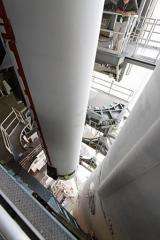
This NASA handout photo shows the mobile service tower at Launch Complex 37 on Cape Canaveral Air Force Station in Florida, a solid rocket booster for the Delta IV rocket, slated to launch NASA's GOES-P satellite as it is lowered toward the base of the rocket. NASA on Thursday launched the latest in its family of high-tech meteorological satellites.

NASA on Thursday launched the latest in its family of high-tech meteorological satellites, adding to a constellation of spacecraft that watch storm development and weather conditions on Earth.

The Geostationary Operational Environmental Satellite-P (GOES-P) lifted off from Cape Canaveral in Florida at 6:57 pm (2357 GMT) on a which will carry the weather-watching to its orbit around 22,000 miles (35,406 kilometers) above the Earth's surface.

"GOES-P is on its way into orbit to begin a 10-year mission to keep a watchful eye on our world," NASA said on the satellite's launch blog, noting that all systems were performing "exactly as expected."

Once it reaches its orbit, GOES-P will collect and send back to Earth data that will be used by scientists to monitor weather, make forecasts and issue warnings about meteorological incidents.

The satellite will also detect ocean and land temperatures, monitor space weather, relay communications and provide search-and-rescue support.

GOES-P is the latest in a long line of GOES satellites, the first of which was launched in 1975.

The satellite will drop its letter suffix for a number, becoming GOES-15 once it is in space.

The satellite is a joint project of the US space agency, NASA, and the National Oceanic and Atmospheric Administration (NOAA), which oversees the US National Weather Service.

The launch was carried out by United Launch Alliance, a joint venture of Boeing and .

GOES satellites are "the backbone of NOAA's severe weather forecasts, monitoring fast-changing conditions in the atmosphere that spawn hurricanes, tornadoes, floods and other hazards," said Steve Kirkner, GOES program manager at NASA's Goddard Space Flight Center in Maryland.

Instruments on board the latest in the GOES family include an imager that senses energy from areas of Earth, and a "sounder" that uses a scan system to gather data from which scientists can calculate temperatures, moisture profiles and ozone distribution.

The satellite also has a space environment monitor, which will beam real-time data to Earth about energetic particles in space that pose a risk to satellites and astronauts and can disrupt navigation and communications systems.

The space environment monitor includes an X-ray telescope that will measure solar X-ray emissions and the intensity and duration of solar flares, which can lead to changes in ionospheric conditions that disrupt radio communications and Global Positioning System (GPS) signals.

A key piece of equipment on GOES-15 is the Solar X-Ray Imager, which will capture an image of the sun's atmosphere every minute, providing forecasters with information they need to determine when to issue alerts of conditions that may harm space and ground systems.

(c) 2010 AFP


Rank 5 /5 (4 votes)
Related Stories
Relevant PhysicsForums posts
  • Scale of the Universe
    created13 hours ago
  • Titan's lack of impact craters
    createdFeb 09, 2012
  • Real pictures of black hole eating a star?
    createdFeb 08, 2012
  • Hypothetical way to travel faster than light, but not technically exceed lightspeed
    createdFeb 06, 2012
  • How do scientists monitor the Sun's activity?
    createdFeb 05, 2012
  • Search patterns in observational studies
    createdFeb 05, 2012
  • More from Physics Forums - General Astronomy

More news stories

Humans may have helped the decline of African rainforests 3000 years ago

(PhysOrg.com) -- Large areas of rainforests in Central Africa mysteriously disappeared over three thousand years ago, to be replaced by savannas. The prevailing theory has been that the cause was a change ...

Space & Earth / Environment

created Feb 10, 2012 | popularity 4.3 / 5 (13) | comments 13 | with audio podcast report

Could Venus be shifting gear?

(PhysOrg.com) -- ESA’s Venus Express spacecraft has discovered that our cloud-covered neighbour spins a little slower than previously measured. Peering through the dense atmosphere in the infrared, the ...

Space & Earth / Space Exploration

created 20 hours ago | popularity 5 / 5 (7) | comments 8 | with audio podcast

NASA budget will axe Mars deal with Europe: scientists

US President Barack Obama's budget proposal to be submitted next week for 2013 will cut NASA's budget by 20 percent and eliminate a major partnership with Europe on Mars exploration, scientists said Thursday.

Space & Earth / Space Exploration

created 23 hours ago | popularity 5 / 5 (2) | comments 20

Mars Science Laboratory computer issue resolved

(PhysOrg.com) -- Engineers have found the root cause of a computer reset that occurred two months ago on NASA's Mars Science Laboratory and have determined how to correct it.

Space & Earth / Space Exploration

created 21 hours ago | popularity 4.7 / 5 (6) | comments 4 | with audio podcast

Two new moons for Jupiter

Advances in technology have lead to the discovery of new planets outside of our Solar System, and now even new moons in our own backyard.

Space & Earth / Space Exploration

created 20 hours ago | popularity 4 / 5 (1) | comments 7


Anonymous knocks CIA website offline (Update)

The website of the Central Intelligence Agency was inaccessible on Friday after the hacker group Anonymous claimed to have knocked it offline.

New error-correcting codes guarantee the fastest possible rate of data transmission

Error-correcting codes are one of the triumphs of the digital age. They’re a way of encoding information so that it can be transmitted across a communication channel — such as an optical fiber o ...

Small modular reactor design could be a 'SUPERSTAR'

(PhysOrg.com) -- Though most of today's nuclear reactors are cooled by water, we've long known that there are alternatives; in fact, the world's first nuclear-powered electricity in 1951 came from a reactor ...

New power source discovered

(PhysOrg.com) -- Researchers at the Massachusetts Institute of Technology (MIT) and RMIT University have made a breakthrough in energy storage and power generation.

The power of estrogen -- male snakes attract other males

A new study has shown that boosting the estrogen levels of male garter snakes causes them to secrete the same pheromones that females use to attract suitors, and turned the males into just about the sexiest ...

Google users warned of threat to smartphone wallets

Users of Google smartphone wallets were being warned on Friday that there is a way to crack pass codes intended to thwart thieves from going on illicit shopping sprees.