Can a formula predict the outcome of a soccer match?
March 5, 2010 By Lisa Zyga feature
Can a formula predict the outcome of a soccer match?

Enlarge

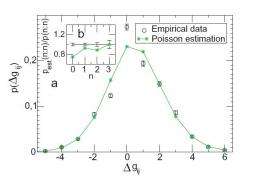
This figure compares the calculated goal distribution (green asterisks) with the actual values (open circles). The agreement is good except when the goal difference is -1, 0, or 1. In these cases, the real data shows a larger number of draws, balanced by a fewer number of matches with one goal difference. The disagreement may point to psychological effects that favor a draw. Image credit: A. Heuer, et al.

(PhysOrg.com) -- Soccer, like most sports, is a game full of surprises and lucky or unlucky breaks. After all, if it was easy to predict the winner of a soccer match, there wouldn’t be much reason to watch it. But a team of scientists says that soccer is actually a simple match in statistical terms. To demonstrate, they have derived a function that can predict the expected average outcome of a match in terms of the goal difference between the two competing teams.

In their study, A. Heuer, C. Müller, and O. Rubner, all physicists/chemists from the University of Münster in Germany, have analyzed on a statistical level. As the scientists explain, a soccer match is equivalent to two teams throwing dice. Rolling a 6 means “goal,” and the number of attempts of both teams is fixed at the beginning of the match, reflecting each team’s fitness in that season. The higher its level of fitness, the more chances a team has to score a goal.

How to determine each team’s fitness level is the main task of the scientists’ analysis. To do this, the researchers analyzed data from all soccer matches in the German Bundesliga between the 1977-’78 season and the 2007-’08 season (except for the 1991-’92 season). In this league, every team plays 34 matches per season.

“We attempted to apply typical approaches from the physics community (e.g. analysis of correlation functions, finite-size scaling) to the description of soccer results,” Heuer told PhysOrg.com. “The problem is very similar to the characterization of biased random walks.”

Based on the data, the scientists characterized team fitness as the goal difference within a game averaged over a season (in other words, the difference between number of goals scored and allowed by a team). The scientists’ analysis showed that goal difference is an even bigger influence on team fitness than the number of goals. In addition, based on previous results, the home advantage could be taken into account by a team-independent but season-dependent constant. Overall, the researchers found that a team’s fitness level remains constant throughout the season, although it changes between seasons.

Using team fitness values, the scientists derived a formula to estimate the expected value of the goal difference in a particular match. The actual number of goals in a match (just like rolling dice) could be described as Poissonian processes; the events occur randomly and, for the most part, independently of each other. Taking all analyzed matches into account, the goal distribution determined in this way agrees almost perfectly with the actual data.

“The three key results are (1) the observation of constant team fitness during a season, (2) the derivation of an equation which predicts the average outcome of a match, and (3) the observation that the actual goal distribution can be very well described by a Poisson distribution,” Heuer summarized.

Although the researchers’ equation was accurate in many areas, the researchers found that it became less accurate in cases where the goal difference was one or zero. Specifically, in the real data, there were more zeros (ties) than predicted by the equation, and fewer one-goal differences.

“The agreement with the actual data is perfect within statistical error if analyzing the goals per team,” Heuer said. “[However,] when analyzing the distribution of goal differences, one observes too many draws. This shows that the assumption of independent Poisson processes is not correct in cases where the goal difference is -1, 0, or 1. This points to interesting psychological effects, favoring a draw.”

As the researchers note, there are other random effects that influence goals. These effects include temporary injuries, fatigue, weather conditions that favor one time over another, red cards, and so-called self-affirmative effects - that is, the probability of scoring a is increased when a team has already scored one or more goals in that game. Although the influence of these effects is very difficult to predict, the researchers found that these effects have a much smaller overall impact on the final outcome of a match as compared to the typical fitness differences.

The analysis also has interesting effects on how we tend to view soccer matches, according to the researchers. For example, the media will often comment that a team that won or lost played particularly good or bad in that match. In contrast, the results here suggest that a team’s fitness level doesn’t change very much from match to match. Yet media reports (and fans) may have a strong tendency to judge a team’s based too much on the overall score, while ignoring the random effects that may have actually led to the overall score.

In addition to predicting the outcomes of soccer matches, the analysis could serve as a framework to classify different types of sports in terms of degree of competitiveness. For example, in sports with many points such as basketball, random effects are probably less pronounced, so that the stronger team has a better chance of winning than in sports with low-scoring games.

More information: A. Heuer, C. Muller, and O. Rubner. “Soccer: Is scoring goals a predictable Poissonian process?” Europhysics Letters, 89 (2010) 38007. Doi:10.1209/0295-5075/89/38007

Copyright 2010 PhysOrg.com.
All rights reserved. This material may not be published, broadcast, rewritten or redistributed in whole or part without the express written permission of PhysOrg.com.

2.8 /5 (21 votes)  

Filter


Move the slider to adjust rank threshold, so that you can hide some of the comments.


Display comments: newest first

acarrilho
Mar 05, 2010

Rank: 5 / 5 (2)
This is quite amazing... they're basically saying a team that scores more and suffers less is more likely to win... I'd never have guessed it.
OregonWind
Mar 05, 2010

Rank: not rated yet
As a soccer fan (and former amateur level player and coach) I would like to see that function applied to the upcoming WC for every match and see how that will behave.

"But a team of scientists says that soccer is actually a simple match in statistical terms."

It is not that simple if you know how the game is played in the field.

"As the researchers note, there are other random effects that influence goals. These effects include temporary injuries, fatigue, weather conditions that favor one time over another, red cards, and so-called self-affirmative effects..."

There are also additional human factors such as faking a foul or penalty or mistakes that the referees occasionally make during the game like wrong off-side call, nonexistent penalty, reversing fouls, etc. The impact on a game may be huge considering all the human factors and behavior.
moj85
Mar 05, 2010

Rank: not rated yet
Yes, it is simple, statistically, because there are only two possible outcomes: One team wins, or both teams draw.
eachus
Mar 05, 2010

Rank: not rated yet
Did these people do the study without watching a single game?

As a statistician I cringed when I read: "This points to interesting psychological effects, favoring a draw." In a one goal game, the team that is behind values an additional goal much more than giving up another goal. Vice-versa for the team that is ahead. It is not a psychological effect, the coach will often put in an extra defender or forward in a one-goal game, depending on whether his team is ahead or behind.

Also, in many leagues the standings are based on 3 points for a win, two for a draw. If that is the situation here, both coaches will favor preserving a draw over risking converting it to a win or loss. Converting a draw to a loss by aggressive tactics, or by putting in an extra striker in a tie game, is the sort of thing that will have a coach looking for a new position.
ry2k
Mar 06, 2010

Rank: not rated yet
Okay, but still I'll go watch that match.

Ryan
http://www.wyur.org/
rgw
Mar 06, 2010

Rank: not rated yet
Can a formula predict the outcome of a soccer match?
NO!
RolfRomeo
Mar 07, 2010

Rank: not rated yet

Also, in many leagues the standings are based on 3 points for a win, two for a draw. If that is the situation here, both coaches will favor preserving a draw over risking converting it to a win or loss. Converting a draw to a loss by aggressive tactics, or by putting in an extra striker in a tie game, is the sort of thing that will have a coach looking for a new position.


Admittedly I'm not a couch-athlete (nor a practitioner), but I'm fairly certain a tie is normally awarded a single point, not two. As you argue - there would be much less incentive to win if two points were awarded.
OregonWind
Mar 08, 2010

Rank: not rated yet
Right, RolfRomeo - A draw will be awarded with a single point in most leagues.

Maybe, there are leagues in the world where a draw is awarded two points.
Anarch157a
Mar 10, 2010

Rank: not rated yet
as a geek, i don't care much for football, but as a brasilian... it's a matter of national pride to say that this is a load of bunkum.

statistics may matter for games that are highly colective, like american footbal, but it matter pretty much nothing in regular football, where individual tallent can turn a loss into a win within a few minutes. or the pressure over key players can derail a teams campain. look at what happened to brasil in that fatefull match against argentina in the 1990 cup. one single brilliant move from maradonna gave them the victory, despite a mediocre performance of the rest of the team during the whole match.

or brasil's performance in 1998's cup in france, where we had the best campaign of the competition, just to lose the finals to the home team because ronaldo freaked out before the game.

to paraphrase forrest gump, "football is like a box of chocolates. you never know what the result is gonna be"
Rank 2.8 /5 (21 votes)
Relevant PhysicsForums posts

More news stories

Sonic Cradle lands spot in TED exhibition

A Simon Fraser University graduate student project that melds music, meditation and modern technology has landed a rare spot as an exhibit at TEDActive 2012 in Palm Springs, California this month.

Other Sciences / Other

created 1 hour ago | popularity not rated yet | comments 0

A frank discussion of the power law and linking correlation to causation

(PhysOrg.com) -- Michael Stumpf a mathematics professor at Imperial College in London, and Mason Porter a lecturer at Oxford have teamed together to write and publish a perspective piece in Science regarding the in ...

Other Sciences / Mathematics

created 5 hours ago | popularity 5 / 5 (1) | comments 2 | with audio podcast report

The question of life in the ancient world

There’s a general feeling that we don’t get the Greeks – ancient or modern. Many, including heads of state like Angela Merkel, visibly shake their head in exasperation, rightly or wrongly, at ...

Other Sciences / Archaeology & Fossils

created 4 hours ago | popularity 1 / 5 (1) | comments 2

Chilean miners' rescue capsule on show in London

The capsule used to rescue Chilean miners trapped underground for two months goes on display Saturday at the Science Museum in London -- the first time it has been seen in Europe.

Other Sciences / Other

created 3 hours ago | popularity not rated yet | comments 0

US workers are 'giving away the store,' costing firms billions

Nearly 70 percent of the nation's service employees give away free goods and services – from hamburgers to cable TV – costing companies billions of dollars a year, according to a groundbreaking study.

Other Sciences / Economics & Business

created 22 hours ago | popularity 4.5 / 5 (2) | comments 10


New understanding of DNA repair could eventually lead to cancer therapy

A research group in the Faculty of Medicine & Dentistry at the University of Alberta is hoping its latest discovery could one day be used to develop new therapies that target certain types of cancers.

Hovering not hard if you're top-heavy, researchers find

Top-heavy structures are more likely to maintain their balance while hovering in the air than are those that bear a lower center of gravity, researchers at New York University's Courant Institute of Mathematical Sciences ...

Grass to gas: Researchers' genome map speeds biofuel development

Researchers at the University of Georgia have taken a major step in the ongoing effort to find sources of cleaner, renewable energy by mapping the genomes of two originator cells of Miscanthus x giganteus, a large perenn ...

Night, weekend delivery OK for babies with birth defects

Weekday delivery is no better than night or weekend delivery for infants with birth defects, according to a new study presented today at The Pregnancy Meeting, the Society for Maternal-Fetal Medicine's annual conference. ...

Drug halts organ damage in inflammatory genetic disorder

A new study shows that Kineret (anakinra), a medication approved for the treatment of rheumatoid arthritis, is effective in stopping the progression of organ damage in people with neonatal-onset multisystem inflammatory disease ...

Cochlear implants may be safe, effective for organ transplant patients

Cochlear implants may be a safe, effective option for some organ transplant patients who've lost their hearing as an unfortunate consequence of their transplant-related drug regime, researchers report.