Remarkable new images show a 4-D view of the heart
March 5, 2010
Remarkable new images show a 4-D view of the heart

Enlarge

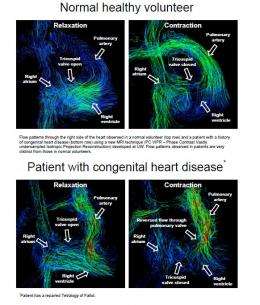
Four-dimensional images of the heart show the rate of blood flow.

(PhysOrg.com) -- What does the racing heart of someone in love - or on a fast treadmill - really look like? Researchers at the University of Wisconsin School of Medicine and Public Health (SMPH) now have pictures that are better than anything that's come before. With the new technology they've developed, the scientists produce remarkable images to measure how fast blood is flowing through various places in the heart and the major arteries around it.

Physicians given a preview are wowed by what they see, according to Dr. Oliver Wieben, a School of Medicine and Public Health medical physicist who has been working on the technology for several years, and Dr. Christopher Francois, a radiologist at the medical school who specializes in imaging.

Even lay people can appreciate the revealing colorful pictures.

In the images, blood flowing through the heart is seen as a bundle of long threads or filaments, color-coded to indicate the speed of the flow at various locations in the heart. Blue threads represent the relatively slow flow that occurs throughout the heart when it is relaxed, while green threads indicate blood flowing faster during contraction.

In patients with heart problems making abnormally fast, the threads appear red or yellow. In addition to flow velocity at various spots, the images show the direction the blood is flowing and the effect of any obstructions or deviations on blood flow, such as in patients with Tetralogy of Fallot, the condition snow boarder Shaun White had repaired as a child.

A 10-minute session in an is all it takes. Patients don't need to hold their breath, the procedure is completely non-invasive and it requires no contrast agent or general anesthesia. Squirmy children may need sedation to keep them still.

Physicians have measured blood velocity with standard MRIs for about 20 years, but it hasn't been optimal. To acquire the 20 to 30 slices that are usually needed to scan the entire heart with an MRI, it can take between 45 and 90 minutes. Since patients must not move during the procedure, younger patients often require general anesthesia, which isn't always desirable, especially for children with heart problems.

Ultrasound is another common technique used to look at blood flow in the heart, but the chest bone and other anatomy can make it hard to see some portions of the heart and vessels surrounding it.

What's more, ultrasound and MRI images are typically two-dimensional representations, at times 3-D. But the new technique supplies 4-D information-three spatial dimensions plus time as the fourth dimension.

The new technique is known as PC VIPR (Phase Contrast Vastly undersampled Isotropic Projection Reconstruction).

"In designing this, we threw out all the old rules of radiology and came up with a new way to acquire data that allows us to do the imaging much faster while still getting excellent quality," Wieben says. "We're also developing new ways to display the complex flow data on a 2-D monitor."

The Wisconsin scientists are excited about extending the technology to analyzing blood vessel walls as well. PC VIPR can be used to identify areas of weakening in the vessel wall or areas under increased stress, which can lead to aneurysms or build-up of damaging plaque.

The new technology will be particularly useful for adults and children with congenital heart disease, the most common birth defect.

"This is a new paradigm in cardiac imaging," says Francois. "It will allow physicians to see things they haven't seen before in all their complexity."

The technology is still in the research stage, but it has been tested on hundreds of volunteers and patients. Wieben and Francois hope it will be available for use in hospitals in three or four years.

Provided by University of Wisconsin-Madison (news : web)

4.8 /5 (12 votes)  

Filter


Move the slider to adjust rank threshold, so that you can hide some of the comments.


Display comments: newest first

tkjtkj
Mar 08, 2010

Rank: not rated yet
So, where is the video?? "4D" means VIDEO, as in MOVING PICTURES ... it does not mean 'time slices'
Again, physorg's dedication to omitting essential graphics is unblemished.
Rank 4.8 /5 (12 votes)
Relevant PhysicsForums posts
  • Is Everyday Technology Killing Us?
    createdFeb 08, 2012
  • Exercise and weight loss
    createdFeb 08, 2012
  • Why do we have head aches? Our brains can't feel anything.
    createdFeb 07, 2012
  • "The end of diseases" by David Agus, interview from Daily Show with Jon Stewart
    createdFeb 04, 2012
  • Oncolytic adenovirus
    createdFeb 04, 2012
  • Nutrition label stuffs and diets
    createdFeb 02, 2012
  • More from Physics Forums - Medical Sciences

More news stories

Antidepressants and pregnancy: Women must consider the impact of drugs on baby, and of depression on baby, themselves

Upon learning they are pregnant, most women dutifully nix the alcohol, sushi and caffeine. But what about antidepressants?

Medicine & Health / Medications

created 34 minutes ago | popularity not rated yet | comments 0

Both maternal and paternal age linked to autism

Older maternal and paternal age are jointly associated with having a child with autism, according to a recently published study led by researchers at The University of Texas Health Science Center at Houston (UTHealth).

Medicine & Health / Psychology & Psychiatry

created 4 minutes ago | popularity not rated yet | comments 0 | with audio podcast

Curry spice component may help slow prostate tumor growth

Curcumin, an active component of the Indian curry spice turmeric, may help slow down tumor growth in castration-resistant prostate cancer patients on androgen deprivation therapy (ADT), a study from researchers ...

Medicine & Health / Cancer

created 1 hour ago | popularity not rated yet | comments 0 | with audio podcast

Arthritic knees, but not hips, have robust repair response

Researchers at Duke University Medical Center used new tools they developed to analyze knees and hips and discovered that osteoarthritic knee joints are in a constant state of repair, while hip joints are not.

Medicine & Health / Diseases

created 1 hour ago | popularity not rated yet | comments 0 | with audio podcast

Team isolates nerve cells involved in storing long term memory and gene proteins associated with them

(Medical Xpress) -- A research team in Taiwan has succeeded in isolating two nerve cells in fruit fly brains that are believed to be the major players in allowing for the formation of long term memories. Furthermore, ...

Medicine & Health / Neuroscience

created 2 hours ago | popularity 5 / 5 (4) | comments 1 | with audio podcast report


Netflix light on flicks as viewers soak up TV shows

Like most fresh faces that arrive in Hollywood, Netflix wanted to be a movie star. But now it's learning what many in Tinseltown have known for decades: Movies are sexy, but the real money is in television.

Zuckerberg's focus drives Facebook's ascent

When Mark Zuckerberg showed up to rent Judy Fusco's Los Altos, Calif., house in the fall of 2004, soon after he'd arrived in Silicon Valley, the landlord was immediately struck by his confidence.

The power of estrogen -- male snakes attract other males

A new study has shown that boosting the estrogen levels of male garter snakes causes them to secrete the same pheromones that females use to attract suitors, and turned the males into just about the sexiest ...

Humans may have helped the decline of African rainforests 3000 years ago

(PhysOrg.com) -- Large areas of rainforests in Central Africa mysteriously disappeared over three thousand years ago, to be replaced by savannas. The prevailing theory has been that the cause was a change ...

Fool's gold may prove an unlikely alternative to overexploited catalytic materials

Catalytic materials, which lower the energy barriers for chemical reactions, are used in everything from the commercial production of chemicals to catalytic converters in car engines. However, with current catalytic materials ...

Experts reveal how plants don't get sunburn

(PhysOrg.com) -- Experts at the University of Glasgow have discovered how plants survive the harmful rays of the sun.