Researchers zero in on a way to switch off T-cells that cause leukemia
March 5, 2010 By Melissa Beattie-Moss
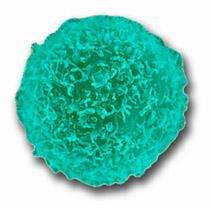
A human T-cell. Image: AJ Cann
(PhysOrg.com) -- Thanks to research that combines molecular biology with computer modeling, we may be several steps closer to winning the battle against a rare form of blood cancer known as large granular lymphocyte leukemia.
Thomas Loughran, director of Penn State Hershey Cancer Institute, and Réka Albert, professor of physics and biology at the University Park campus, worked together to better understand the molecular pathways and hundreds of genes and proteins inside a cell that determine its life cycle.
Their study, published in October 2008 in the Proceedings of the National Academy of Sciences (PNAS), suggests that there are two key proteins controlling "the on/off switch" in the malfunctioning killer-T cells that cause this type of leukemia. Says Albert, "Our model suggests that if we keep a specific signaling protein called NFxB in the ‘off’ state, we can reverse the disease."
The study, funded by the National Institutes of Health and the National Science Foundation, first took shape because Loughran and his colleagues at the Cancer Institute wanted to investigate why, in rare cases, the body’s normal immune response to fighting infection goes awry and causes disease.
In a normal immune system, explains Loughran, the body produces large numbers of a type of white blood cell called cytotoxic T-cells or killer T-cells. These cells are "programmed" by the body for a very narrow and specific mission: to kill infected cells and then die themselves.
Loughran said that occasionally, these killer cells fail to follow their scripted lifecycle.
"When these cells don’t die as expected, they expand gradually over time and start attacking the body itself," he said. "They can attack the joints to cause autoimmune diseases such as rheumatoid arthritis, and attack the bone marrow to cause leukemia."
Loughran knew that, to find answers, he’d need to zero in on the exact location of the malfunctioning signaling system. This system is the way cells send and receive instructions -- and a broken system might explain why some T-cells never receive the crucial "self-destruct" message. To unravel the mystery of these rogue killer-T cells, Loughran called on Albert to construct an intricate computer model of the signaling network involved in both the activation of the T-cells, as well as their programmed death.
Albert brought impressive knowledge to bear on the problem. A disciple of acclaimed network researcher Albert-Laszlo Barabasi and co-author with him of the concept now known as the Barabasi-Albert model -- she explains her work as an attempt "to find the mathematical model that will most accurately describe how a system changes over time."
When researchers are investigating a complex problem in a biological system, such as drought stress in plants or diseases in animals or people, a computational representation can help them predict likely outcomes, Albert said. In this case, "the biggest challenge for constructing the computational model was to think about the disease as a state that includes the deregulation of the signaling network that guides activation- induced cell death in T cells," she said.
It took several years of effort by a very talented graduate student, Ranran Zhang (the first author of the PNAS paper), guided by two mentors, to make this crucial step, said Albert.
"Afterward we were able to use methodology that my group has developed and used successfully in the context of other biological regulatory networks. Nevertheless, this is the most complex dynamic model we have constructed so far."
Among the billions of possibilities projected by the model, the researchers determined that two proteins -- IL-15 and PDGF -- appear to be crucial in keeping the T-cells alive and growing.
"You need the presence of both these proteins, as well as the signaling protein NFxB, to create conditions in which the cytotoxic T-cells can proliferate," said Loughran.
Essentially, Loughran said, "We are looking for the master control switches that keep these cells alive. When we used drugs to block NFxB in cells from leukemia patients, we found a significant increase in mortality among the abnormal T-cells."
Someday Loughran hopes our control of these "master switches" may allow us to turn off the long-lived killer T-cells that cause leukemia, as well as harness their errant behavior to combat other deadly infectious diseases.
-
Blocked signals to immune cells extend their life and contribute to progression of lupus
Feb 14, 2008 |
not rated yet |
0
-
Strengthening the tumor-fighting ability of T cells
Mar 24, 2008 |
not rated yet |
0
-
Gene therapy protocol activates immune system in patients with leukemia
Feb 11, 2008 |
not rated yet |
0
-
'Modular' Leukemia Drug Shows Promise In Early Testing
Jun 29, 2007 |
not rated yet |
0
-
Creating new life forms that may help eradicate cancer affecting women
Feb 26, 2007 |
not rated yet |
0
-
Engineers build first sub-10-nm carbon nanotube transistor
Feb 01, 2012 |
4.9 / 5 (31) |
30
-
Something old, something new: Evolution and the structural divergence of duplicate genes
Jan 31, 2012 |
4.6 / 5 (7) |
1
-
The hidden nanoworld of ice crystals: Revealing the dynamic behavior of quasi-liquid layers
Jan 30, 2012 |
5 / 5 (3) |
1
-
Stock market network reveals investor clustering
Jan 27, 2012 |
3.9 / 5 (23) |
8
-
Of microchemistry and molecules: Electronic microfluidic device synthesizes biocompatible probes
Jan 26, 2012 |
5 / 5 (1) |
0
-
Is Everyday Technology Killing Us?
Feb 08, 2012
-
Exercise and weight loss
Feb 08, 2012
-
Why do we have head aches? Our brains can't feel anything.
Feb 07, 2012
-
"The end of diseases" by David Agus, interview from Daily Show with Jon Stewart
Feb 04, 2012
-
Oncolytic adenovirus
Feb 04, 2012
-
Nutrition label stuffs and diets
Feb 02, 2012
- More from Physics Forums - Medical Sciences
More news stories
Complex wiring of the nervous system may rely on a just a handful of genes and proteins
Researchers at the Salk Institute have discovered a startling feature of early brain development that helps to explain how complex neuron wiring patterns are programmed using just a handful of critical genes. ...
1 hour ago |
5 / 5 (2) |
0
|
Curry spice component may help slow prostate tumor growth
Curcumin, an active component of the Indian curry spice turmeric, may help slow down tumor growth in castration-resistant prostate cancer patients on androgen deprivation therapy (ADT), a study from researchers ...
6 hours ago |
4.5 / 5 (4) |
0
|
Both maternal and paternal age linked to autism
Older maternal and paternal age are jointly associated with having a child with autism, according to a recently published study led by researchers at The University of Texas Health Science Center at Houston (UTHealth).
Medicine & Health / Psychology & Psychiatry
5 hours ago |
not rated yet |
0
|
Team isolates nerve cells involved in storing long term memory and gene proteins associated with them
(Medical Xpress) -- A research team in Taiwan has succeeded in isolating two nerve cells in fruit fly brains that are believed to be the major players in allowing for the formation of long term memories. Furthermore, ...
Seeing colors in music, tasting flavors in shapes may happen in life's early months
Famed violinist Itzhak Perlman sees a deep forest green whenever he plays a B-flat on his Stradivarius' G string. The A on the E string is red.
Medicine & Health / Psychology & Psychiatry
8 hours ago |
4.5 / 5 (2) |
1
|
NASA sees wide-eyed cyclone Jasmine
Cyclone Jasmine's eye has opened wider on NASA satellite imagery, as it moves through the Southern Pacific Ocean.
NASA sees Giovanna reach cyclone strength, threaten Madagascar
Tropical Storm 12S built up steam and became a cyclone on February 10, 2012 as NASA's Terra satellite passed overhead. Residents of east-central Madagascar should prepare for this cyclone to make landfall ...
CIA website offline, Anonymous takes credit
The website of the Central Intelligence Agency was unresponsive on Friday after the hacker group Anonymous claimed to have knocked it offline.
The power of estrogen -- male snakes attract other males
A new study has shown that boosting the estrogen levels of male garter snakes causes them to secrete the same pheromones that females use to attract suitors, and turned the males into just about the sexiest ...
New error-correcting codes guarantee the fastest possible rate of data transmission
Error-correcting codes are one of the triumphs of the digital age. Theyre a way of encoding information so that it can be transmitted across a communication channel such as an optical fiber o ...
Humans may have helped the decline of African rainforests 3000 years ago
(PhysOrg.com) -- Large areas of rainforests in Central Africa mysteriously disappeared over three thousand years ago, to be replaced by savannas. The prevailing theory has been that the cause was a change ...