MIT researchers discover new way of producing electricity
March 7, 2010 by David Chandler
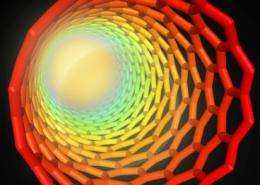
A carbon nanotube (shown in illustration) can produce a very rapid wave of power when it is coated by a layer of fuel and ignited, so that heat travels along the tube. Graphic: Christine Daniloff
(PhysOrg.com) -- A team of scientists at MIT have discovered a previously unknown phenomenon that can cause powerful waves of energy to shoot through minuscule wires known as carbon nanotubes. The discovery could lead to a new way of producing electricity, the researchers say.
The phenomenon, described as thermopower waves, “opens up a new area of energy research, which is rare,” says Michael Strano, MIT’s Charles and Hilda Roddey Associate Professor of Chemical Engineering, who was the senior author of a paper describing the new findings that appeared in Nature Materials on March 7. The lead author was Wonjoon Choi, a doctoral student in mechanical engineering.
Like a collection of flotsam propelled along the surface by waves traveling across the ocean, it turns out that a thermal wave — a moving pulse of heat — traveling along a microscopic wire can drive electrons along, creating an electrical current.
The key ingredient in the recipe is carbon nanotubes — submicroscopic hollow tubes made of a chicken-wire-like lattice of carbon atoms. These tubes, just a few billionths of a meter (nanometers) in diameter, are part of a family of novel carbon molecules, including buckyballs and graphene sheets, that have been the subject of intensive worldwide research over the last two decades.
A previously unknown phenomenon
In the new experiments, each of these electrically and thermally conductive nanotubes was coated with a layer of a reactive fuel that can produce heat by decomposing. This fuel was then ignited at one end of the nanotube using either a laser beam or a high-voltage spark, and the result was a fast-moving thermal wave traveling along the length of the carbon nanotube like a flame speeding along the length of a lit fuse. Heat from the fuel goes into the nanotube, where it travels thousands of times faster than in the fuel itself. As the heat feeds back to the fuel coating, a thermal wave is created that is guided along the nanotube. With a temperature of 3,000 Kelvin, this ring of heat speeds along the tube 10,000 times faster than the normal spread of this chemical reaction. The heating produced by that combustion, it turns out, also pushes electrons along the tube, creating a substantial electrical current.
Combustion waves — like this pulse of heat hurtling along a wire — “have been studied mathematically for more than 100 years,” Strano says, but he was the first to predict that such waves could be guided by a nanotube or nanowire and that this wave of heat could push an electrical current along that wire.
In the group’s initial experiments, Strano says, when they wired up the carbon nanotubes with their fuel coating in order to study the reaction, “lo and behold, we were really surprised by the size of the resulting voltage peak” that propagated along the wire.
After further development, the system now puts out energy, in proportion to its weight, about 100 times greater than an equivalent weight of lithium-ion battery.
The amount of power released, he says, is much greater than that predicted by thermoelectric calculations. While many semiconductor materials can produce an electric potential when heated, through something called the Seebeck effect, that effect is very weak in carbon. “There’s something else happening here,” he says. “We call it electron entrainment, since part of the current appears to scale with wave velocity.”
The thermal wave, he explains, appears to be entraining the electrical charge carriers (either electrons or electron holes) just as an ocean wave can pick up and carry a collection of debris along the surface. This important property is responsible for the high power produced by the system, Strano says.
Exploring possible applications
Because this is such a new discovery, he says, it’s hard to predict exactly what the practical applications will be. But he suggests that one possible application would be in enabling new kinds of ultra-small electronic devices — for example, devices the size of grains of rice, perhaps with sensors or treatment devices that could be injected into the body. Or it could lead to “environmental sensors that could be scattered like dust in the air,” he says.
In theory, he says, such devices could maintain their power indefinitely until used, unlike batteries whose charges leak away gradually as they sit unused. And while the individual nanowires are tiny, Strano suggests that they could be made in large arrays to supply significant amounts of power for larger devices.
The researchers also plan to pursue another aspect of their theory: that by using different kinds of reactive materials for the coating, the wave front could oscillate, thus producing an alternating current. That would open up a variety of possibilities, Strano says, because alternating current is the basis for radio waves such as cell phone transmissions, but present energy-storage systems all produce direct current. “Our theory predicted these oscillations before we began to observe them in our data,” he says.
Also, the present versions of the system have low efficiency, because a great deal of power is being given off as heat and light. The team plans to work on improving that.
• PhysOrg.com iPhone Apps
• PhysOrg.com Audio Podcasts / iTunes
• Join PhysOrg.com on Facebook!
• Follow PhysOrg.com on Twitter!
Provided by Massachusetts Institute of Technology (news : web)
-
Scientists Track Heat in Tiny Rolls of Carbon Atoms
Mar 02, 2009 |
not rated yet |
0
-
A traveling-wave engine to power deep space travel
Sep 17, 2004 |
not rated yet |
0
-
Space saving approach to satellite communications
Dec 05, 2005 |
not rated yet |
0
-
Virus battery could power cars, electronic devices
Apr 02, 2009 |
not rated yet |
0
-
Springs built from nanotubes could provide big power storage potential
Sep 21, 2009 |
not rated yet |
0
-
Engineers build first sub-10-nm carbon nanotube transistor
Feb 01, 2012 |
4.9 / 5 (28) |
26
-
Something old, something new: Evolution and the structural divergence of duplicate genes
Jan 31, 2012 |
4.6 / 5 (7) |
1
-
The hidden nanoworld of ice crystals: Revealing the dynamic behavior of quasi-liquid layers
Jan 30, 2012 |
5 / 5 (3) |
1
-
Stock market network reveals investor clustering
Jan 27, 2012 |
4 / 5 (22) |
8
-
Of microchemistry and molecules: Electronic microfluidic device synthesizes biocompatible probes
Jan 26, 2012 |
5 / 5 (1) |
0
-
Use Kirchoff's rules to determine I1, I2 and I3 for the following circuit:
4 hours ago
-
pendulum solution not working
6 hours ago
-
Basic Projectile with Wind
6 hours ago
-
Calculating pressure on a surface after reaching final velocity
7 hours ago
-
question about calculating work done
7 hours ago
-
Linear vs Non-linear waves
8 hours ago
- More from Physics Forums - General Physics
More news stories
Harnessing plasmonics, engineers weld nanowires with light
At the nano level, researchers at Stanford have discovered a new way to weld together meshes of tiny wires. Their work could lead to exciting new electronics and solar applications. To succeed, they called ...
18 hours ago |
4.8 / 5 (10) |
1
|
The right recipe: Engineering research improves laser detectors, batteries
Think of it as cooking with carbon spaghetti: A Kansas State University researcher is developing new ways to create and work with carbon nanotubes -- ultrasmall tubes that look like pieces of spaghetti or string.
Nanotechnology / Nanomaterials
17 hours ago |
5 / 5 (7) |
0
|
Nanorod-assembled order affects diffusion rate and direction
Some of the recent advancements in nanotechnology depend critically on how nanoparticles move and diffuse on a surface or in a fluid under non-ideal to extreme conditions. Georgia Tech has a team of researchers ...
Nanotechnology / Bio & Medicine
17 hours ago |
5 / 5 (2) |
0
|
The butterfly effect in nanotech medical diagnostics
Tiny metallic nanoparticles that shimmer in the light like the scales on a butterfly's wing are set to become the color-change components of a revolutionary new approach to point-of-care medical diagnostics, according to ...
Nanotechnology / Bio & Medicine
17 hours ago |
5 / 5 (4) |
0
Engineers build first sub-10-nm carbon nanotube transistor
(PhysOrg.com) -- Engineers have built the first carbon nanotube (CNT) transistor with a channel length below 10 nm, a size that is considered a requirement for computing technology in the next decade. Not ...
Our Amorphophallus is smaller: New plant species from Madagascar smells like roadkill
The famed "corpse flower" plant known for its giant size, rotten-meat odor and phallic shape has a new, smaller relative: A University of Utah botanist discovered a new species of Amorphophallus that i ...
Invasive alien predator causes rapid declines of European ladybirds
A new study provides compelling evidence that the arrival of the invasive non-native harlequin ladybird to mainland Europe and subsequent spread has led to a rapid decline in historically-widespread species ...
New findings highlight the benefit of exercise ECGs just as they are being scrapped
In the UK, the exercise electrocardiogram (ECG) is the most common initial test for the evaluation of stable chest pain and has been used widely for almost half a century. However, recent NICE guidelines recommend that it ...
Long-term study shows epilepsy surgery improves seizure control and quality of life
While epilepsy surgery is a safe and effective intervention for seizure control, medical therapy remains the more prominent treatment option for those with epilepsy. However, a new 26-year study reveals that following epilepsy ...
New DVT guidelines: No evidence to support 'economy class syndrome'
New evidence-based guidelines from the American College of Chest Physicians (ACCP) address the many risk factors for developing a deep vein thrombosis (DVT), or blood clot, as the result of long-distance travel. These risk ...
Obama to seek more Alzheimer's research money
(AP) -- The Obama administration wants to spend just over half a billion dollars on Alzheimer's research next year, hoping to battle back against what could become the defining disease of the aging baby-boom generation.
Mar 07, 2010
Rank: 3.3 / 5 (4)
Mar 07, 2010
Rank: 2.3 / 5 (16)
Some form of energy-either electric or thermal- has to be used to ignite the combustible coating.
So, are they saying that each one of these little "batteries" will also require another battery to ignite them? Absurd!
And who wants untold numbers of tubes of nanochickenwire floating around in the air, water, food, their own cells, even?
I also notice that there are no numbers, once again, PHYSORG!
Obviuosly, the current produced here is miniscule, but what would it be if it was scaled up to an equivalent mass or volume to a standard Li battery JUST FOR COMPARISON PURPOSES?
The only way I can conceptualize this working in a meaningful, useful way would be to continuously rotate a ring of this through a fireproof barrier, timing the rpm to the velocity of the combustion wavefront to conduct away the current just before extinguished, or with some sort of brush/pickup arrangement.
Anyone got a better, or at least more to the point operation concept?
Mar 07, 2010
Rank: 2.2 / 5 (6)
http://www.azonan...wsID=484
Mar 07, 2010
Rank: 3.2 / 5 (5)
Mar 07, 2010
Rank: 4.5 / 5 (4)
Too bad. If the temperature could be lowered, and some sort of a cyclical system implemented along Caliban's line of though, maybe this could form the foundation for a much more efficient and flexible internal combustion engine (whose output would be electricity rather than direct mechanical rotation.)
Mar 07, 2010
Rank: 2 / 5 (3)
I was wondering about the electrical output.
Mar 07, 2010
Rank: 2 / 5 (3)
Mar 07, 2010
Rank: 5 / 5 (3)
Which, in a round about way, was almost mentioned in the article.
Mar 08, 2010
Rank: 4.3 / 5 (9)
It must be nice to be so smart.
Mar 08, 2010
Rank: 3 / 5 (1)
Mar 08, 2010
Rank: not rated yet
Mar 08, 2010
Rank: not rated yet
I can think of one application: the industry should concentrate on massive paralleling of nanotubes into macrotubule arrays, then combining many of those in parallel to provide a new type of cathode for VASIMR type plasma rocket engines, requiring much less energy input to get more wattage ouput.
Mar 08, 2010
Rank: not rated yet
Mar 08, 2010
Rank: 5 / 5 (2)
Mar 09, 2010
Rank: 5 / 5 (1)
Mar 17, 2010
Rank: not rated yet
http://futurity.o...osphere/
Mar 23, 2010
Rank: not rated yet
In the article it was only mentioned that the speed of propagation is higher than what would be expected for a chemical reaction.
Nothing is mentioned about the power density.
30 kWh/kg = 108 MJ/kg
heat of combustion for gasoline is about 50 MJ/kg
heat of combustion of hydrogen is about 150 MJ/kg
heat of combustion of carbon is about 30 MJ/kg
http://en.wikiped...mbustion
So it's possible, but it would be interesting what the fuel is being used.
Also, we need to keep in mind that some of the energy comes from the laser or the spark that is used to spark the reaction.