Scientists transform polyethylene into a heat-conducting material
March 7, 2010 by David Chandler
Scientists transform polyethylene into a heat-conducting material

Enlarge

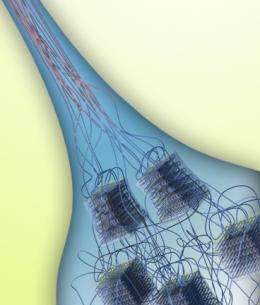
The new method involves pulling a thin thread of material (top) from a liquid solution (bottom), and in the process the individual polymer filaments, which start out as a tangled mass, become very highly aligned. Illustration courtesy of Gang Chen

Most polymers -- materials made of long, chain-like molecules -- are very good insulators for both heat and electricity. But an MIT team has found a way to transform the most widely used polymer, polyethylene, into a material that conducts heat just as well as most metals, yet remains an electrical insulator.

The new process causes the polymer to conduct heat very efficiently in just one direction, unlike metals, which conduct equally well in all directions. This may make the new material especially useful for applications where it is important to draw heat away from an object, such as a computer . The work is described in a paper published on March 7 in .

The key to the transformation was getting all the polymer molecules to line up the same way, rather than forming a chaotic tangled mass, as they normally do. The team did that by slowly drawing a polyethylene fiber out of a solution, using the finely controllable cantilever of an , which they also used to measure the properties of the resulting fiber.

This fiber was about 300 times more thermally conductive than normal along the direction of the individual fibers, says the team's leader, Gang Chen, the Carl Richard Soderberg Professor of Power Engineering and director of MIT's Pappalardo Micro and Nano Engineering Laboratories.

The high thermal conductivity could make such fibers useful for dissipating heat in many applications where metals are now used, such as solar hot water collectors, heat exchangers and electronics.

Chen explains that most attempts to create polymers with improved thermal conductivity have focused on adding in other materials, such as carbon nanotubes, but these have achieved only modest increases in conductivity because the interfaces between the two kinds of material tend to add thermal resistance. "The interfaces actually scatter heat, so you don't get much improvement," Chen says. But using this new method, the conductivity was enhanced so much that it was actually better than that of about half of all pure metals, including iron and platinum.

Producing the new fibers, in which the polymer molecules are all aligned instead of jumbled, required a two-stage process, explains graduate student Sheng Shen, the lead author of the paper. The polymer is initially heated and drawn out, then heated again to stretch it further. "Once it solidifies at room temperature, you can't do any large deformation," Shen says, "so we heat it up twice."
Scientists transform polyethylene into a heat-conducting material
Enlarge

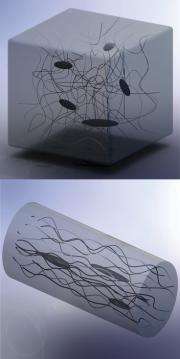
At top, an illustration of the tangled nature of the polymer filaments, with heat-stopping voids indicated as dark blobs. When drawn and heated into a thin thread (bottom), the molecules line up and the voids are compressed, making the material a good conductor. Credits - Illustration courtesy of Gang Chen

Even greater gains are likely to be possible as the technique is improved, says Chen, noting that the results achieved so far already represent the highest thermal conductivity ever seen in any polymer material. Already, the degree of conductivity they produce, if such fibers could be made in quantity, could provide a cheaper alternative to metals used for heat transfer in many applications, especially ones where the directional characteristics would come in handy, such as heat-exchanger fins (like the coils on the back of a refrigerator or in an air conditioner), cell-phone casings or the plastic packaging for computer chips. Other applications might be devised that take advantage of the material's unusual combination of with light weight, chemical stability and electrical insulation.

So far, the team has just produced individual fibers in a laboratory setting, Chen says, but "we're hoping that down the road, we can scale up to a macro scale," producing whole sheets of material with the same properties.

Ravi Prasher, an engineer at Intel, says that "the quality of the work from Prof. Chen's group has always been phenomenal," and adds that "this is a very significant finding" that could have many applications in electronics. The remaining question, he says, is "how scalable is the manufacturing of these fibers? How easy is it to integrate these fibers in real-world applications?"

More information: Shen S, Henry A, Tong J, Zheng R, Gang Chen G. Polyethylene nanofibres with very high thermal conductivities. Nature Materials. 7 March 2010.

Provided by Massachusetts Institute of Technology (news : web)

4.4 /5 (9 votes)  

Filter


Move the slider to adjust rank threshold, so that you can hide some of the comments.


Display comments: newest first

dirk_bruere
Mar 07, 2010

Rank: not rated yet
Isn't that how Dyneema is made, by drawing out the polyethylene?
http://en.wikiped...ethylene
JoelF
Mar 08, 2010

Rank: not rated yet
Polyethylene's melting point is too low for heat transfer in solar applications. Polypropylene and polyurethane would be more promising materials for solar if they lend themselves to the same stretching process.
Rank 4.4 /5 (9 votes)
Relevant PhysicsForums posts
  • Stoichiometry
    created1 hour ago
  • Boiling and melting point of impure substances
    created2 hours ago
  • Safe nitrogen compound to decompose a 500 deg C in a furnace?
    created9 hours ago
  • [ask]electron inside drinking water
    createdFeb 08, 2012
  • How to avoid formation of Lithium Chromate ???
    createdFeb 08, 2012
  • how to choose a reduced or oxidated form in a redox
    createdFeb 08, 2012
  • More from Physics Forums - Chemistry

More news stories

Hydrogen from acidic water: Researchers develop potential low cost alternative to platinum for splitting water

A technique for creating a new molecule that structurally and chemically replicates the active part of the widely used industrial catalyst molybdenite has been developed by researchers with the Lawrence Berkeley ...

Chemistry / Materials Science

created 12 hours ago | popularity 5 / 5 (10) | comments 11 | with audio podcast

Flexible paper robots

(PhysOrg.com) -- These inexpensive robots can stretch, bend and twist under control, and lift objects up to 120 times their own weight. Being soft, they can apply gentle and even pressure, and adapt to varied ...

Chemistry / Materials Science

created 10 hours ago | popularity 5 / 5 (5) | comments 2 | with audio podcast

Engineers find inspiration for new materials in Piranha-proof armor

(PhysOrg.com) -- It’s a matchup worthy of a late-night cable movie: put a school of starving piranha and a 300-pound fish together, and who comes out the winner?

Chemistry / Materials Science

created 19 hours ago | popularity 4.3 / 5 (3) | comments 2 | with audio podcast

New method makes culture of complex tissue possible in any lab

Scientists at the University of California, San Diego have developed a new method for making scaffolds for culturing tissue in three-dimensional arrangements that mimic those in the body. This advance, published online in ...

Chemistry / Biochemistry

created 9 hours ago | popularity 5 / 5 (4) | comments 0 | with audio podcast

Materials that shrink when heated

One common reason that people with fillings experience toothache is that their fillings expand at a different rate to the original tooth when, for example, drinking a hot drink. Contrary to intuition, however, ...

Chemistry / Materials Science

created 11 hours ago | popularity 5 / 5 (2) | comments 1


'Dark plasmons' transmit energy

Microscopic channels of gold nanoparticles have the ability to transmit electromagnetic energy that starts as light and propagates via "dark plasmons," according to researchers at Rice University.

FDA-approved drug rapidly clears amyloid from the brain, reverses Alzheimer's symptoms in mice

Neuroscientists at Case Western Reserve University School of Medicine have made a dramatic breakthrough in their efforts to find a cure for Alzheimer's disease. The researchers' findings, published in the journal Science, show t ...

Ultraviolet protection molecule in plants yields its secrets

Lying around in the sun all day is hazardous not just for humans but also for plants, which have no means of escape. Ultraviolet (UV) radiation from the sun can damage proteins and DNA inside cells, leading ...

Soraa LED light may dim 50-watt halogen rivals

(PhysOrg.com) -- Soraa, a Fremont, California company founded in 2008, this week launched its first product, a light that uses LEDS (light emitting diodes). The "Soraa LED MR16 lamp" is the "perfect" replacement ...

Anyone can learn to be more inventive, cognitive researcher says

There will always be a wild and unpredictable quality to creativity and invention, says Anthony McCaffrey, a cognitive psychology researcher at the University of Massachusetts Amherst, because an "Aha moment" is rare and ...

Researchers weigh in on ethics of H5N1 research

(Medical Xpress) -- In a commentary on the biosecurity controversy surrounding publication of bird flu research details, a bioethicist and a vaccine expert at Johns Hopkins reaffirm that "all scientists have an affirmativ ...