Einstein's theory of relativity on display for first time
March 7, 2010 by Gavin Rabinowitz
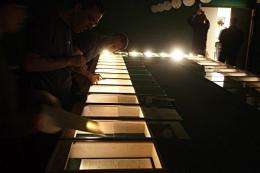
Employees prepare an exhibition showcasing the original manuscript of Albert Einstein's General Theory of Relativity at the Israeli Academy of Sciences and Humanities in Jerusalem. In a darkened room in Jerusalem, the world was given a rare glimpse Sunday into the mind of Albert Einstein as he worked to unlock the secrets of the universe.
In a darkened room in Jerusalem, the world was given a rare glimpse Sunday into the mind of Albert Einstein as he worked to unlock the secrets of the universe.
The display of 46 pages, each handwritten by the famed scientist, marks the first time the complete, original manuscript of his landmark "General Theory of Relativity" has been presented in public.
The exhibit, which opened on Sunday night, forms part of the 50th anniversary celebrations of the Israeli Academy of Sciences and Humanities and coincides with Einstein's birthday on March 14.
Like a shrine to science, the pages form a rectangle in the centre of an otherwise barren room, each one encapsulated in its own pine casing and illuminated by the faintest of light, to preserve the fragile paper.
"It speaks for itself and it is exhibited like a work of art," said curator Hanoch Gutfreund, struggling to contain the emotion evoked by the work.
Page after page is filled with Einstein's spidery handwriting and the mathematical formulas. Parts are underlined, others crossed out and rewritten as he strove to perfect what Gutfreund called his "most important intellectual achievement."
"One can almost look over Einstein's shoulder while he was at work," he said. "The comments that are added to numerous pages shed light on Einstein's basic ideas, the challenges he faced and the difficulties he encountered."
Written in Einstein's home in Berlin in 1916 and donated to Jerusalem's Hebrew University during its inauguration in 1925, the document redefined mankind's understanding of the fabric of our existence -- space, time and gravity.
"It is the basis of our understanding of the universe, it is the basis of modern research in cosmology, the structure of the universe and the expansion of the universe," Gutfreund told AFP.
To preserve the document and prevent the paper and ink from decaying, the pages have been displayed in a specially darkened room, with carefully controlled humidity and temperature, said Timna Elper, head of the laboratory for preserving and restoring documents at the National Library of Israel.
"This is the first time we are displaying the whole thing. Some pages have been displayed in the past but not the whole document," she said as she monitored the exhibit on a computer screen, the picture filmed with special night-vision cameras.
Curators would only agree to a three-week display of the priceless document, which was transported to the academy in an armoured truck from its repository at the national library.
The work revolutionised scientists' understanding of the universe and underpinned a century of major discoveries by theorising, among other things, that the flow of time was affected by the force of gravity.
Clocks will run faster the further they are from a large gravitational source and run slower when closer.
This has practical applications that allowed the development of space-age technologies, including the ability to track the exact paths of satellites and determine our own locations through Global Positioning Systems (GPS).
Gutfreund said the display also served to highlight "the connection between Albert Einstein and the Hebrew University and the Jewish people."
Einstein, who was born in 1879 and won the Nobel Prize for physics in 1921 before fleeing Nazi Germany for the US in the 1930s, helped to establish the university during the early days of the British-ruled Palestine mandate.
He later declined an offer to become Israel's president in 1952 but willed all of his papers to the Hebrew University, before his death in 1955 in the United States.
The exhibition runs until March 25.
(c) 2010 AFP
-
Watson Lecture: Exploring Einstein's Legacy
Nov 15, 2005 |
not rated yet |
0
-
Researcher Investigates the Basis of Einstein's First Approximation in the Theory of Relativity
Jul 15, 2009 |
not rated yet |
0
-
Honouring Einstein in the 21st Century
Sep 03, 2005 |
not rated yet |
0
-
Einstein doctorate up for auction
Mar 06, 2009 |
not rated yet |
0
-
Participant Total for Grassroots Astrophysics Project Einstein@Home to Exceed 55,000 On Einstein's Birthday
Mar 11, 2005 |
not rated yet |
0
-
Engineers build first sub-10-nm carbon nanotube transistor
Feb 01, 2012 |
4.9 / 5 (30) |
30
-
Something old, something new: Evolution and the structural divergence of duplicate genes
Jan 31, 2012 |
4.6 / 5 (7) |
1
-
The hidden nanoworld of ice crystals: Revealing the dynamic behavior of quasi-liquid layers
Jan 30, 2012 |
5 / 5 (3) |
1
-
Stock market network reveals investor clustering
Jan 27, 2012 |
3.9 / 5 (23) |
8
-
Of microchemistry and molecules: Electronic microfluidic device synthesizes biocompatible probes
Jan 26, 2012 |
5 / 5 (1) |
0
-
Worked Physics Examples
1 hour ago
-
electrostatic induction in a conductor should be immpossible
2 hours ago
-
Help! Physics Momentum/Impulse problem!
5 hours ago
-
Gauss' law cubes, how to prove
7 hours ago
-
A grandfather pulls his granddaughter, whose mass is 20.5 kg
8 hours ago
-
what is significance of torque
8 hours ago
- More from Physics Forums - General Physics
More news stories
Explained: Sigma
It's a question that arises with virtually every major new finding in science or medicine: What makes a result reliable enough to be taken seriously? The answer has to do with statistical significance -- but ...
22 hours ago |
5 / 5 (13) |
32
Borexino Collaboration succeeds in spotting pep neutrinos emitted from the sun
(PhysOrg.com) -- To learn more about how the sun works, scientists study particles that are emitted from it into space due to thermonuclear reactions that occur inside; by applying known physics principles, ...
Physics research suggests new pathways for cancer progression
Observing that certain cancer cells may exhibit greater flexibility than normal cells, some scientists believe that this capability promotes rapid tumor growth. Now computer simulations developed by Boston University Biomedical ...
20 hours ago |
5 / 5 (1) |
0
Quantum physicist explains $100K offer for proof scaled-up quantum computing is impossible
(PhysOrg.com) -- MIT researcher Scott Aaronson has certainly riled the physics community with his offer this past Friday, of $100,000 to anyone who can prove that scaled-up quantum computing is impossible. ...
Physicists 'record' magnetic breakthrough
An international team of scientists has demonstrated a revolutionary new way of magnetic recording which will allow information to be processed hundreds of times faster than by current hard drive technology.
Feb 07, 2012 |
4.5 / 5 (39) |
14
|
Humans may have helped the decline of African rainforests 3000 years ago
(PhysOrg.com) -- Large areas of rainforests in Central Africa mysteriously disappeared over three thousand years ago, to be replaced by savannas. The prevailing theory has been that the cause was a change ...
Japan scientist makes 'Avatar' robot
A Japanese-developed robot that mimics the movements of its human controller is bringing the Hollywood blockbuster "Avatar" one step closer to reality.
Sleep breathing machine shows clear benefits in children with sleep apnea
Children and adolescents with obstructive sleep apnea had substantial improvements in attention, anxiety and quality of life after treatment with positive airway pressure (PAP)a nighttime therapy in which a machine ...
Neurologic improvement detected in rats receiving stem cell transplant
In a study to be presented today at the Society for Maternal-Fetal Medicine's annual meeting, The Pregnancy Meeting, in Dallas, Texas, researchers will report that early transplantation of human placenta-derived mesenchymal ...
Miami battling invasion of giant African snails
No one knows how they got there. But an invasion of African giant snails has southern Florida in a panic over potential crop damage, disease and general yuckiness surrounding the slimy gastropods.
NASA budget will axe Mars deal with Europe: scientists
US President Barack Obama's budget proposal to be submitted next week for 2013 will cut NASA's budget by 20 percent and eliminate a major partnership with Europe on Mars exploration, scientists said Thursday.
Mar 07, 2010
Rank: 3.4 / 5 (5)
Bit much there! Certainly these papers are of some historical importance - but physics has gone far beyond Mr. Einstein's beginnings.
Newtons paper were not completely investigated until the 1930s, and somehow we managed to progress without them.
Methinks that Mr. Einstein would have been the last one to want to be deified or even Sainted.
Mar 07, 2010
Rank: 3 / 5 (2)
http://www.spring...4gq5qy1/
Mar 07, 2010
Rank: 1 / 5 (1)
Mar 07, 2010
Rank: 5 / 5 (2)
Mar 07, 2010
Rank: 5 / 5 (2)
Thats what they want you to believe
Mar 08, 2010
Rank: 5 / 5 (3)
Good catch, Spinoza ... all those years grinding lenses have been put good utility. -:)
Mar 08, 2010
Rank: 5 / 5 (2)
Mar 08, 2010
Rank: 5 / 5 (2)
http://en.wikiped...agnetism
which is now used as approximation of GR, but some people argument that in fact it should be the other way (like http://www.mrelat...tdm5.pdf ).
It also naturally unifies with electromagnetism while considering dynamics of local rotations in 4D (5th section of http://arxiv.org/...0.2724v1 )
Mar 08, 2010
Rank: 3 / 5 (2)
Mar 08, 2010
Rank: 5 / 5 (2)
Obviously, the difference between time of death reported (1955 and 1976) remains one of proximity to gravitational source.
Mar 08, 2010
Rank: 3 / 5 (2)
1) Light energy is spreading in waves through vacuum in the same way, like energy waves through elastic particle environments. It would mean, vacuum is formed by elastic particle environment, too.
2) Helium atoms never freeze at the normal pressure, they're in the eternal movement like pollen grain suspended in particle environment (a "Brownian noise"). It would mean, vacuum is formed by particle environment, too.
3) Short energy waves are dispersing by particle environment under formation of vortex pairs. Whereas short light waves interact with vacuum under formation of particle-antiparticle pairs.
4) Short wavelength light is dispersed by fluctuations of particle environment. Short wavelength gamma radiation is dispersed by CMB noise, which manifest itself as so-called GZK limit...
With such robust evidence string theorists would be happy, while explaining the motivations of their theory.
Mar 08, 2010
Rank: 3 / 5 (2)
Mar 09, 2010
Rank: 5 / 5 (1)
yet again, you strike with nonsensical blather. It's SOOOOO easy to disprove aether wave theory. I went to Zephir's website...your units don't even match up!!!! I found like 3 errors within the first page! Just read up on GR and SR and you'll understand it all - without the silliness of Aether!!! Just STOP your nonsense please!!!!
Mar 09, 2010
Rank: 1 / 5 (1)
You're apparently relativist, that's all. I admit, dense aether theory is incredibly silly - but why the hell it was never considered seriously by generations of clever scientists, after then? This is, what makes aether theory tricky - the professional blindness of so many people involved. Now we should reconsider mankind intelligence seriously.
Anyway, can you explain
A) how to disprove luminiferous aether model, if it's so easy for you (frankly I dunno, how to do that - despite I'm thinking about it during last five years).
B) how to explain the fact, massive object is curving space-time around it by gravity?
Please avoid common blurbs about equivalence of gravity field and space-time curvature - we all know about it. My question is, why such thing just happens there.
Mar 10, 2010
Rank: not rated yet
In this way, despite the official postulates used, general relativity is still borrowing gravitational constant and inverse square law from four hundred years old Newton law.