Stardust spacecraft may have found cosmic dust
March 8, 2010 by Lin Edwards Stardust

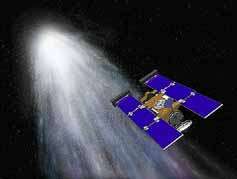
NASA's Stardust gathered material from the tail of a comet in January 2004 and returned to earth in January 2006.

(PhysOrg.com) -- The first specks of interstellar dust may have been found by NASA's Stardust spacecraft during its seven-year-long voyage. Interstellar dust is believed to form from gas ejected from stars, which condenses to form tiny specks or grains. These then flow through space and contain the heavy atoms that are thought to form the building blocks of stars and planets.

Stardust was launched on its 4.8 billion kilometer mission with the primary goal of collecting dust from the in 2004, and returning it to Earth for scientific analysis, but its secondary goal was to collect particles of the interstellar dust stream passing through our Solar System. To collect the dust, the spacecraft had a Interstellar Dust Collector (SIDC), which was basically a retractable arm with cells filled with a porous substance called aerogel, designed to trap .

The spacecraft and its samples of dust returned to Earth early in 2006, and scientists investigating the samples have now reported two different kinds of dust grains among the samples, which may be interstellar dust. The team involved members of the public in investigating the aerogel collection, using an Internet application called Stardust@ Home, which allows interested people to use a virtual microscope to the millions of images.

The first particle was found by Bruce Hudson of Ontario, Canada, and is known as particle 30. He called the particle Orion. The scientists then found the second grain, which Hudson named Sirius, and have identified in all 28 impact ‘tracks’ in the aerogel collector. Most of the tracks were at angles that suggested they were particles of debris from collisions with the solar panels on the spacecraft, but seven had ambiguous trajectories, with particle 30 among these.

Hudson had suffered a stroke in 2003, and thought the Stardust@Home project would be a productive way of using his time. He spent up to 15 hours each day for a year scanning pictures, taking five seconds per slide. He was one of around 27,000 volunteers who checked the 71 million images of material captured in the Stardust collection cells.

Leader of the team, Dr Andrew Westphal, of the University of California at Berkeley, announced the findings during a Lunar and Planetary Science Conference (LPSC) in Texas. He said two particles hit the aerogel together, and were two components of the same particle, but were very different from each other. Dr Westphal said if the particles do turn out to be interstellar dust, it is more heterogeneous than previously thought.

Westphal said the findings are preliminary and could be a false alarm. The analyses on the particles are being done with great care to avoid damaging the particles, which he said would take $300 million to replace. He said the material was fine-grained and has an elemental composition consistent with that expected for , although it contains other elements which are surprising but not inconsistent. Elements found in the dust so far include magnesium, iron, aluminum, nickel, copper, manganese, chromium and gallium.

The results are published in the journal American Mineralogist. In January 2006, the spacecraft Stardust returned its sample capsule to Earth, but it remains in space and is currently nearly half-way through a journey to reach the Tempel 1.

© 2010 PhysOrg.com


Rate this story - 4.4 /5 (8 votes)

Rank Filter

Move the slider to adjust rank threshold, so that you can hide some of the comments.


Display comments: newest first

  • omatumr - Mar 08, 2010
    • Rank: 2.5 / 5 (2)
    Elements and their isotopes were only partially mixed when the Solar System formed out of supernova debris. That is why it is impossible to identify particles of interstellar dust passing through our Solar System.

    That is also why Jupiter contains excess Xe-136 from the r-process ["Isotopic ratios in Jupiter confirm intra-solar diffusion", Meteoritics and Planetary Science 33, A97, abstract 5011 (1998)]
    http://www.lpi.us...5011.pdf

March 8, 2010 all stories

Comments: 1

4.4 /5 (8 votes)


  • hide
  • Related Stories

  • Stardust Finds A Gem Of A Space Particle
    created Feb 28, 2006 | popularity not rated yet | comments 0
  • UW astronomer hits cosmic paydirt with Stardust
    created Jan 18, 2006 | popularity not rated yet | comments 0
  • Stardust Findings May Alter View of Comet Formation
    created Mar 14, 2006 | popularity not rated yet | comments 0
  • Seeing stardust: New image shows speck of comet dust from NASA mission
    created Feb 03, 2006 | popularity not rated yet | comments 0
  • Stardust Logs A Decade Under The Stars
    created Feb 09, 2009 | popularity not rated yet | comments 0


  • hide
  • Relevant PhysicsForums posts

  • Rogue black holes?!
    created 20 hours ago
  • HLX-1 brightest ultra-luminous X-ray source known.
    created Sep 09, 2010
  • Telling time with Jupiters moons?
    created Sep 08, 2010
  • Matter in Space-time
    created Sep 07, 2010
  • More from Physics Forums - General Astronomy

Other News

Early exit for hot Jupiter due to deadly tides

Early exit for hot Jupiter due to deadly tides

Space & Earth / Astronomy

created 6 hours ago | popularity 5 / 5 (4) | comments 0 | with audio podcast

(PhysOrg.com) -- Bad news for planet hunters: most of the "hot Jupiters" that astronomers have been searching for in star clusters were likely destroyed long ago by their stars. In a paper accepted for publication ...


Making massive stars

Making massive stars

Space & Earth / Astronomy

created 5 hours ago | popularity 5 / 5 (1) | comments 3 | with audio podcast

Massive stars -- those with more than about eight times the mass of the sun -- are arguably the most important actors in the universe. Much hotter and more luminous than the sun, they live only hundreds of ...


Colonization of Mars might be microbes away

Colonization of Mars might be microbes away

Space & Earth / Space Exploration

created 6 hours ago | popularity 4.7 / 5 (3) | comments 0 | with audio podcast

Tiny rock-eating microbes could mine precious extraterrestrial resources from Mars and pave the way for the first human colonists. Just don't expect them to transform the red planet's surface into a new Earth ...


Accessing the Risk of Arsenic Ingestion with Mineralogy

Accessing the risk of arsenic ingestion with mineralogy

Space & Earth / Environment

created 6 hours ago | popularity not rated yet | comments 0 | with audio podcast

Canadian researchers working at Brookhaven's National Synchrotron Light Source (NSLS) have created a method for determining how much of the arsenic in soil tailings -- byproducts of the mining industry -- ...


Objects impacting Jupiter detected first by amateur astronomers

Objects impacting Jupiter detected first by amateur astronomers

Space & Earth / Astronomy

created 7 hours ago | popularity 5 / 5 (5) | comments 0 | with audio podcast

(PhysOrg.com) -- Amateur astronomers using backyard telescopes were the first to detect two small objects that burned up in Jupiter’s atmosphere on June 3 and Aug. 20.