Single photon solid-state memory for telecommunications
March 8, 2010 By Miranda Marquit feature
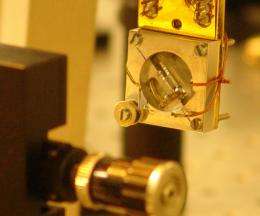
Cold finger of the cryostat

Enlarge

Cold finger of the cryostat with the erbium-doped crystal in which the light pulses were stored. The crystal is at the center of the circle at an angle of 45°. You can see two of the four electrodes attached to the crystal used to control the atomic coherences (the two parallel silver stripes also at an angle of 45°). Image source: University of Geneva

(PhysOrg.com) -- One of the issues associated with quantum information schemes revolves around the ability to develop quantum memories that allow for the retrieval of information on demand. Overcoming this issue is especially important for the advancement of long distance telecommunications. In order to use quantum means to send information over long distance, it is necessary to implement quantum repeaters so that data is not destroyed due to the absorption loss in optical fibers.

These quantum repeaters require some sort of solid-state memory at the single level. And, thanks to a recent experiment at the University of Geneva in Switzerland, it’s possible that quantum information science is a little closer to application. “We were able to show how to store and retrieve, on demand, weak light pulses at the single photon level with a wavelengths optimized for fiber transmission. This provides a direct way to interface photons used for quantum communication with a ,” Björn Lauritzen tells PhysOrg.com. Lauritzen and his colleagues present their work in Physical Review Letters: “Telecommunication-Wavelength Solid-State Memory at the Single Photon Level.”

“We managed to reduce the noise involved with this technique as well,” Lauritzen says. “What we have shown is a proof of principle that you can create a solid-state quantum memory for photons at telecommunication wavelengths, and this should be quite helpful in long distance .”

Lauritzen and his peers used an yttrium orthosilicate crystal doped with erbium ions to store light pulses on the single-photon level. The memory uses a photon echo technique based on controlled reversible inhomogenous broadening. “First, we prepared the crystal through optical pumping,” Lauritzen explains. “We prepared a narrow absorption line, which we artificially broadened using an external electrical field. When we sent in a weak pulse of light, which then was collectively absorbed by the ensemble of ions, and a de-phasing took place. We can reverse it by flipping the polarity of the electrical field.”

With this method, it was possible for the Geneva team to retrieve the information it had sent in originally when it wished. “This method is especially good for quantum repeaters, providing quantum memory at telecommunication wavelengths, making it possible to send quantum over distances not possible now.”

Other applications are also possible, according to Lauritzen. “This method could also provide a single photon source,” he says. “If you can retrieve the photon on demand, you can build up a source of photons, and command the emission of one at a time. This could be useful in a number of science experiments that require a single photon source.”

The results are also interesting in terms of materials research. Exploring the properties of rare earth metals, like the erbium used to dope the crystal in the experiment, could provide some insight into new methods and techniques for future applications. “This might stimulate some materials research, especially with erbium,” Lauritzen insists.

For now, though, Lauritzen is interested in improving this technique for communication purposes. “We’re working on memory based on atomic frequency combs, as well as testing out different conditions, such as temperature and influence of the magnetic field, to see whether we can reduce losses due to an absorbing background to increase efficiency and really make long distance quantum possible.”

More information: Björn Lauritzen, et. al., “Telecommunication-Wavelength Solid-State Memory at the Single Photon Level,” Physical Review Letters (2010). Available online: http://link.aps.or … t.104.080502

Copyright 2010 PhysOrg.com.
All rights reserved. This material may not be published, broadcast, rewritten or redistributed in whole or part without the express written permission of PhysOrg.com.

4.6 /5 (20 votes)  

Filter


Move the slider to adjust rank threshold, so that you can hide some of the comments.


Display comments: newest first

holoman
Mar 08, 2010

Rank: 5 / 5 (1)
This is a well known physics term called "photon induced field poling".
rgw
Mar 08, 2010

Rank: 1 / 5 (1)
This is a well known physics term called "photon induced field poling".

This is not real because it is not in the Bible
enantiomer2000
Mar 08, 2010

Rank: 4 / 5 (1)
Not only does god play dice, but the dice are loaded.
dan42day
Mar 08, 2010

Rank: 4 / 5 (1)
So, if you put a satellite half way between earth and alpha centauri, and it was capable of entangling huge numbers of photon pairs beaming one of each pair toward earth and the other to AC, could a probe send data back from AC instantaneously by altering the entangled property of the photons in the beam?

This assumes of course that the beams would begin propagating about 2.5 years before they would become useful.
Ashish_Kotwal
Mar 11, 2010

Rank: not rated yet
this is must be possibility for high speed (in fact super high speed)broadband net connection and televisual conferencing in this case the down load speed on net must go up to 256 or 512 Mb/s or 1Gb/s
coz i don't think so there will be any loses optical fiber and also there will be possibility for only one or two net provider overall the globe
again
in this case this kinda net + P2P shearing(torrents) = the person will able to fill 1tb HDD in only 3 weeks with all useful stuffs
Rank 4.6 /5 (20 votes)
Relevant PhysicsForums posts
  • Need help with Heat Transfer Problem...
    created5 hours ago
  • Coils
    created11 hours ago
  • Force on rope during a rope swing
    created14 hours ago
  • Lorentz force
    created15 hours ago
  • How is refractive index a function of frequency?
    created17 hours ago
  • Precession at LOW angular velocity
    created17 hours ago
  • More from Physics Forums - Classical Physics

More news stories

Renowned physicist invents microscope that can peer at living brain cells

(PhysOrg.com) -- Ever since scientists began studying the brain, they’ve wanted to get a better look at what was going on. Researchers have poked and prodded and looked at dead cells under electron microscopes, ...

Physics / General Physics

created 11 hours ago | popularity 5 / 5 (12) | comments 5 | with audio podcast report

New kind of high-temperature photonic crystal could someday power everything from smartphones to spacecraft

A team of MIT researchers has developed a way of making a high-temperature version of a kind of materials called photonic crystals, using metals such as tungsten or tantalum. The new materials — which ...

Physics / Optics & Photonics

created 15 hours ago | popularity 5 / 5 (11) | comments 4 | with audio podcast

Searching for a solid that flows like a liquid

(PhysOrg.com) -- A series of neutron scattering experiments at Oak Ridge National Laboratory and other research centers is exploring the key question about a long-sought quantum state of matter called supersolidity: ...

Physics / Quantum Physics

created 12 hours ago | popularity 3 / 5 (1) | comments 7 | with audio podcast

Optics get magnetic powers

For decades, scientists have studied a class of materials called ‘multiferroics’ in which static electric and magnetic structures are coupled to each other. This allows capabilities such as controlling ...

Physics / General Physics

created 12 hours ago | popularity 5 / 5 (1) | comments 0

Manipulating the texture of magnetism

Knowing how to control the combined magnetic properties of interacting electrons will provide the basis to develop an important tool for advancing spintronics: a technology that aims to harness these properties ...

Physics / General Physics

created 13 hours ago | popularity 5 / 5 (2) | comments 0


Whole exome sequencing identifies cause of metabolic disease

Sequencing a patient's entire genome to discover the source of his or her disease is not routine – yet. But geneticists are getting close.

Amazon fungi found that eat polyurethane, even without oxygen

(PhysOrg.com) -- Until now polyurethane has been considered non-biodegradable, but a group of students from Yale University in the US has found fungi that will not only eat and digest it, they will do so even in the absence ...

Hearing metaphors activates brain regions involved in sensory experience

When a friend tells you she had a rough day, do you feel sandpaper under your fingers? The brain may be replaying sensory experiences to help understand common metaphors, new research suggests.

Scientists chart high-precision map of Milky Way's magnetic fields

(PhysOrg.com) -- Scientists at the Naval Research Laboratory (NRL) are part of an international team that has pooled their radio observations into a database, producing the highest precision map to date of ...

Discovery of extremely long-lived proteins may provide insight into cell aging

One of the big mysteries in biology is why cells age. Now scientists at the Salk Institute for Biological Studies report that they have discovered a weakness in a component of brain cells that may explain ...

Researchers weigh methods to more accurately measure genome sequencing

Lost in the euphoria of the 2003 announcement that the human genome had been sequenced was a fundamental question: how can we be sure that an individual's genome has been read correctly?