How to see through opaque materials
March 8, 2010
How to see through opaque materials

Enlarge

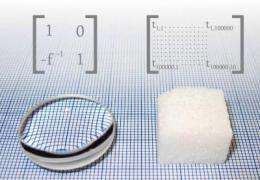
Knowing enough about the way light is scattered through materials would allow physicists to see through opaque substances, such as the sugar cube on the right. In addition, physicists could use information characterizing an opaque material to put it to work as a high quality optical component, comparable to the glass lens show on the left. Credit: American Physical Society

New experiments show that it's possible to focus light through opaque materials and detect objects hidden behind them, provided you know enough about the material.

Materials such as paper, paint, and are opaque because the that passes through them is scattered in complicated and seemingly random ways.

A new experiment conducted by researchers at the City of Paris Industrial Physics and Chemistry Higher Educational Institution (ESPCI) has shown that it's possible to focus light through opaque materials and detect objects hidden behind them, provided you know enough about the material. The experiment is reported in the current issue of , and is the subject of Viewpoint in APS Physics by Elbert van Putten and Allard Moskof the University of Twente.

In order to demonstrate their approach to characterize opaque substances, the researchers first passed light through a layer of zinc oxide, which is a common component of white paints. By studying the way the changed as it encountered the material, they were able to produce a called a transmission matrix, which included over 65,000 numbers describing the way that the layer affected light. They could then use the matrix to tailor a beam of light specifically to pass through the layer and focus on the other side. Alternatively, they could measure light emerging from the opaque material, and use the matrix to assemble of an image of an object behind it.

In effect, the experiment shows that an opaque material could serve as a high quality optical element comparable to a conventional lens, once a sufficiently detailed transmission matrix is constructed. In addition to allowing us to peer through paper or paint, and into cells, the technique opens up the possibility that opaque materials might be good optical elements in nano-scale devices, at levels where the construction of transparent lenses and other components is particularly challenging.

More information: Measuring the Transmission Matrix in Optics: An Approach to the Study and Control of Light Propagation in Disordered Media, S. M. Popoff, G. Lerosey, R. Carminati, M. Fink, A. C. Boccara, and S. Gigan, Phys. Rev. Lett. 104, 100601 (2010) - Published March 08, 2010, Download PDF (free)

Provided by American Physical Society

4.5 /5 (13 votes)  

Filter


Move the slider to adjust rank threshold, so that you can hide some of the comments.


Display comments: newest first

seneca
Mar 08, 2010

Rank: not rated yet
If it's possible to reconstruct sharp image from blurred copy, and in thick layers every dispersion leads to approximately same result, I'd expect, it should be possible to reconstruct image even without knowledge of exact transmission matrix.

http://www.stanfo...dex.html
fuzz54
Mar 08, 2010

Rank: 5 / 5 (2)
Now we'll never know where the security cameras are.
Parsec
Mar 09, 2010

Rank: 5 / 5 (2)
My guess is that this will only work with very thin, very simple materials. The matrix will get enormous with more complex or thicker materials.
KBK
Mar 09, 2010

Rank: 3 / 5 (2)
It also shows potential in millennia old stories about differing materials, crystals, how they are used as energetic focusing and/or resonating devices for 'unseen energies'. What kind? Look up Nikolai Kozyrev's 'superluminal waves'. He found waves that are emanating from massive stellar (and similar) objects which penetrate anything and everything..but are 'time invariant', ie, instantaneous by any known measurement.

Only aluminum, he found, blocks it. He tried the entire table of elements. This means you have your organized and penetrating wave..and then your other materials for focusing and modification. Suddenly and finally... the crystal stuff of the 'new agers' takes on some form of sense.

Remember the fundamental purpose of science. Science is to 'define the unknown', it is not dogmatism to 'reject the unwanted'. A very important and fundamental distinction which some of us need to remember, in a universe where we understand only a few percent of all that is out there.
NameIsNotNick
Mar 09, 2010

Rank: 5 / 5 (1)
Remember the fundamental purpose of science. Science is to 'define the unknown', it is not dogmatism to 'reject the unwanted'.

I respectfully disagree. Science is a method that permits us to understand the physical world as we know it and make testable predictions. It has absolutely nothing to say about the "unknown". That's the purview of religion, mythology and pseudoscience.
Riverbill
Mar 09, 2010

Rank: not rated yet
Provided your science has no political, religious or financial implications.
Rank 4.5 /5 (13 votes)
Relevant PhysicsForums posts
  • excited U-236 decay time in the U235 fission chain
    created4 hours ago
  • Polar catastrophe?
    created7 hours ago
  • Large scale field sonication
    created10 hours ago
  • states and energy of paired electrons in BCS
    createdFeb 08, 2012
  • difference between longitudinal and transverse refractive indices
    createdFeb 08, 2012
  • Monte Carlo simulation
    createdFeb 07, 2012
  • More from Physics Forums - Atomic, Solid State, Comp. Physics

More news stories

Borexino Collaboration succeeds in spotting pep neutrinos emitted from the sun

(PhysOrg.com) -- To learn more about how the sun works, scientists study particles that are emitted from it into space due to thermonuclear reactions that occur inside; by applying known physics principles, ...

Physics / General Physics

created 15 hours ago | popularity 4.6 / 5 (7) | comments 0 | with audio podcast report

Explained: Sigma

It's a question that arises with virtually every major new finding in science or medicine: What makes a result reliable enough to be taken seriously? The answer has to do with statistical significance -- but ...

Physics / General Physics

created 15 hours ago | popularity 5 / 5 (10) | comments 25

Physics research suggests new pathways for cancer progression

Observing that certain cancer cells may exhibit greater flexibility than normal cells, some scientists believe that this capability promotes rapid tumor growth. Now computer simulations developed by Boston University Biomedical ...

Physics / General Physics

created 12 hours ago | popularity 5 / 5 (1) | comments 0

Quantum physicist explains $100K offer for proof scaled-up quantum computing is impossible

(PhysOrg.com) -- MIT researcher Scott Aaronson has certainly riled the physics community with his offer this past Friday, of $100,000 to anyone who can prove that scaled-up quantum computing is impossible. ...

Physics / Quantum Physics

created Feb 08, 2012 | popularity 4.1 / 5 (11) | comments 31 | with audio podcast weblog

Physicists build highly efficient 'no-waste' laser

A team of University of California, San Diego researchers has built the smallest room-temperature nanolaser to date, as well as an even more startling device: a highly efficient, "thresholdless" laser that ...

Physics / General Physics

created Feb 08, 2012 | popularity 4.9 / 5 (20) | comments 5 | with audio podcast


'Dark plasmons' transmit energy

Microscopic channels of gold nanoparticles have the ability to transmit electromagnetic energy that starts as light and propagates via "dark plasmons," according to researchers at Rice University.

Hydrogen from acidic water: Researchers develop potential low cost alternative to platinum for splitting water

A technique for creating a new molecule that structurally and chemically replicates the active part of the widely used industrial catalyst molybdenite has been developed by researchers with the Lawrence Berkeley ...

Ultraviolet protection molecule in plants yields its secrets

Lying around in the sun all day is hazardous not just for humans but also for plants, which have no means of escape. Ultraviolet (UV) radiation from the sun can damage proteins and DNA inside cells, leading ...

FDA-approved drug rapidly clears amyloid from the brain, reverses Alzheimer's symptoms in mice

Neuroscientists at Case Western Reserve University School of Medicine have made a dramatic breakthrough in their efforts to find a cure for Alzheimer's disease. The researchers' findings, published in the journal Science, show t ...

Anyone can learn to be more inventive, cognitive researcher says

There will always be a wild and unpredictable quality to creativity and invention, says Anthony McCaffrey, a cognitive psychology researcher at the University of Massachusetts Amherst, because an "Aha moment" is rare and ...

Cell biologists describes mechanism by which some people may be more susceptible to colon cancer

An international research team led by cell biologists at the University of California, Riverside has uncovered a new insight into colon cancer, the third leading cause of cancer-related deaths in the United ...