Biochemist researching computer models of protein structure that help high school, college students
March 8, 2010
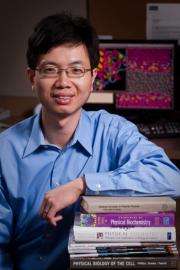
Jianhan Chen is an assistant professor of biochemistry at Kansas State University.
An award from the National Science Foundation will boost a Kansas State University professor's contribution to the study of proteins while also helping college and high school science teachers learn more about computational and structural biology.
Jianhan Chen, an assistant professor of biochemistry, is receiving more than $670,000 as a CAREER Award from the National Science Foundation. CAREER is the foundation's most prestigious award for junior faculty to support early career development activities of teacher-scholars who most effectively integrate research and education within the context of the organization's mission.
"The CAREER award is a great honor," Chen said. "I am really glad that I will be able to focus more on establishing a strong research program and providing useful educational and training opportunities to the campus and community."
Chen will use the award to develop new methods for effective modeling of proteins and to study a novel class of functional proteins known as intrinsically disordered proteins. This type of protein plays fundamental roles in crucial areas, such as cellular signaling and regulation, and it is frequently involved in such human diseases as neurodegenerative diseases and cancer. Chen said that this research can provide fundamental knowledge of the structure, interaction and control of intrinsically disordered proteins, and such knowledge will help to assess and manage related human diseases.
"Dr. Chen's project for his CAREER award is a great addition to the biochemistry department's program in physical biochemistry," said Mike Kanost, who heads the department. "He will be carrying out innovative research in computational biochemistry aimed at solving very interesting problems in protein structure and dynamics. And his education and outreach activities supported by the grant will promote learning of simulation methods for biochemistry by our students and by high school science teachers."
Chen's project also involves incorporating new biomolecular modeling tools in classes and training projects for college and high school students. Part of this will be accomplished through two-day summer workshops for college and high school teachers, particularly instructors from southern Kansas community colleges with many Hispanic students
Chen's research focus at K-State is on computational biochemistry and biophysics. His lab uses computer modeling as a primary tool to understand how biomolecules perform their biological functions, via stable 3-D structures, or equally important, lack of stable structures.
Chen earned a master's degree and doctorate from the University of California at Irvine and a bachelor's degree from the University of Science and Technology of China. He was a postdoctoral researcher at the Scripps Research Institute in LaJolla, Calif., before joining the faculty at K-State in 2007.
He was named a K-State Wakonse Fellow in 2009 and has earned two Innovative Research Awards from K-State's Terry C. Johnson Center for Basic Cancer Research.
-
K-State's chemists to develop new 'lab-on-a-chip' technologies
Feb 01, 2006 |
not rated yet |
0
-
Solving the mystery of DNA repair
Jul 15, 2009 |
not rated yet |
0
-
Understanding heat flow at the nanoscale is the goal of new project
Mar 16, 2006 |
not rated yet |
0
-
UD scientist wins NSF career award for tissue engineering research
Apr 20, 2007 |
not rated yet |
0
-
'Rusting' Also Describes How Methamphetamine Harms
Sep 27, 2007 |
not rated yet |
0
-
Engineers build first sub-10-nm carbon nanotube transistor
Feb 01, 2012 |
4.9 / 5 (31) |
30
-
Something old, something new: Evolution and the structural divergence of duplicate genes
Jan 31, 2012 |
4.6 / 5 (7) |
1
-
The hidden nanoworld of ice crystals: Revealing the dynamic behavior of quasi-liquid layers
Jan 30, 2012 |
5 / 5 (3) |
1
-
Stock market network reveals investor clustering
Jan 27, 2012 |
3.9 / 5 (23) |
8
-
Of microchemistry and molecules: Electronic microfluidic device synthesizes biocompatible probes
Jan 26, 2012 |
5 / 5 (1) |
0
-
Stoichiometry
Feb 10, 2012
-
Boiling and melting point of impure substances
Feb 10, 2012
-
Safe nitrogen compound to decompose a 500 deg C in a furnace?
Feb 09, 2012
-
[ask]electron inside drinking water
Feb 08, 2012
-
How to avoid formation of Lithium Chromate ???
Feb 08, 2012
-
how to choose a reduced or oxidated form in a redox
Feb 08, 2012
- More from Physics Forums - Chemistry
More news stories
Fool's gold may prove an unlikely alternative to overexploited catalytic materials
Catalytic materials, which lower the energy barriers for chemical reactions, are used in everything from the commercial production of chemicals to catalytic converters in car engines. However, with current catalytic materials ...
15 hours ago |
4.4 / 5 (8) |
5
|
Unpicking HIV’s invisibility cloak
Drug researchers hunting for alternative ways to treat human immunodeficiency virus (HIV) infections may soon have a novel targetits camouflage coat. HIV hides inside a cloak unusually rich in a sugar ...
15 hours ago |
5 / 5 (5) |
0
Hydrogen from acidic water: Researchers develop potential low cost alternative to platinum for splitting water
A technique for creating a new molecule that structurally and chemically replicates the active part of the widely used industrial catalyst molybdenite has been developed by researchers with the Lawrence Berkeley ...
Feb 09, 2012 |
4.8 / 5 (14) |
15
|
No entry without protein recycling: Researchers discover new coherence in enzyme transport
The group of Prof. Dr. Ralf Erdmann at the Ruhr-Universität Bochum, Germany, discovered a connection of peroxisomal protein import and receptor export. In the Journal of Biological Chemistry, they disclo ...
15 hours ago |
not rated yet |
0
Under the microscope #7
In this video Dr Ingrid Graz shows us a thin layer of gold on top of rubber. Cracks in the gold allow it to stretch and we can use this for stretchable electronics.
17 hours ago |
not rated yet |
0
Anonymous knocks CIA website offline (Update)
The website of the Central Intelligence Agency was inaccessible on Friday after the hacker group Anonymous claimed to have knocked it offline.
Google users warned of threat to smartphone wallets
Users of Google smartphone wallets were being warned on Friday that there is a way to crack pass codes intended to thwart thieves from going on illicit shopping sprees.
New error-correcting codes guarantee the fastest possible rate of data transmission
Error-correcting codes are one of the triumphs of the digital age. Theyre a way of encoding information so that it can be transmitted across a communication channel such as an optical fiber o ...
Humans may have helped the decline of African rainforests 3000 years ago
(PhysOrg.com) -- Large areas of rainforests in Central Africa mysteriously disappeared over three thousand years ago, to be replaced by savannas. The prevailing theory has been that the cause was a change ...
New power source discovered
(PhysOrg.com) -- Researchers at the Massachusetts Institute of Technology (MIT) and RMIT University have made a breakthrough in energy storage and power generation.
Small modular reactor design could be a 'SUPERSTAR'
(PhysOrg.com) -- Though most of today's nuclear reactors are cooled by water, we've long known that there are alternatives; in fact, the world's first nuclear-powered electricity in 1951 came from a reactor ...