Most extreme white dwarf binary system found with orbit of just 5 minutes
March 8, 2010
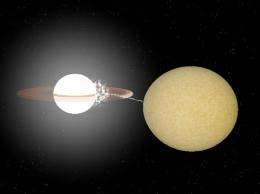
(PhysOrg.com) -- An international team of astronomers, including Professor Tom Marsh and Dr Danny Steeghs from the University of Warwick, have shown that the two stars in the binary HM Cancri definitely revolve around each other in a mere 5.4 minutes. This makes HM Cancri the binary star with by far the shortest known orbital period. It is also the smallest known binary. The binary system is no larger than 8 times the diameter of the Earth which is the equivalent of no more than a quarter of the distance from the Earth to the Moon.
The binary system consists of two white dwarfs. These are the burnt- out cinders of stars such as our Sun, and contain a highly condensed form of helium, carbon and oxygen. The two white dwarfs in HM Cancri are so close together that mass is flowing from one star to the other. HM Cancri was first noticed as an X-ray source in 1999 showing a 5.4 minutes periodicity but for a long time it has remained unclear whether this period also indicated the actual orbital period of the system. It was so short that astronomers were reluctant to accept the possibility without solid proof.
The team of astronomers, led by Dr Gijs Roelofs of the Harvard-Smithsonian Center of Astrophysics, and including Professor Tom Marsh and Dr Danny Steeghs at the University of Warwick in the UK, have now used the world's largest telescope, the Keck telescope on Hawaii, to prove that the 5.4 minute period is indeed the binary period of the system. This has been done by detecting the velocity variations in the spectral lines in the light of HM Cancri. These velocity variations are induced by the Doppler effect, caused by the orbital motion of the two stars revolving around each other. The Doppler effect causes the lines to periodically shift from blue to red and back.
The observations of HM Cancri were an ultimate challenge due to the extremely short period that needed to be resolved and the faintness of the binary system. At a distance of close to 16,000 light years from Earth, the binary shines at a brightness no more than one millionth of the faintest stars visible to the naked eye.
Professor Tom Marsh from the University of Warwick said; “This is an intriguing system in a number of ways: it has an extremely short period; mass flows from one star and crashes down onto the equator of the other in a region comparable in size to the English Midlands where it liberates more than the Sun's entire power in X-rays. It could also be a strong emitter of gravitational waves which may one day be detected from this type of star system.”
Dr Danny Steeghs of the University of Warwick, said " A few years ago we proposed that HM Cancri was indeed an interacting binary consisting of two white dwarfs and that the 5.4 minute period was the orbital period. It is very gratifying to see this model confirmed by our observations, especially since earlier attempts had been thwarted by bad weather."
The article describing the observations of HM Cancri entitled 'Spectroscopic Evidence For a 5.4 Minute Orbital Period in HM Cancri' will be published in the Astrophysical Journal Letters of March 10, 2010
"This type of observations is really at the limit of what is currently possible. Not only does one need the biggest telescopes in the world, but they also have to be equipped with the best instruments available", explains Professor Paul Groot of the Radboud University Nijmegen in the Netherlands.
"The binary HM Cancri is a real challenge for our understanding of stellar and binary evolution," adds Dr Gijs Nelemans of the Radboud University."We know the system must have come from two normal stars that somehow spiralled together in two earlier episodes of mass transfer, but the physics of this process is very poorly known. The system is also a big opportunity for general relativity. It must be one of the most copious emitters of gravitational waves. These distortions of space-time we hope to detect directly with the future LISA satellite, and HM Cancri will be a cornerstone system for this mission."
-
Stars Flood Space with Gravitational Waves
May 30, 2005 |
not rated yet |
0
-
Unusual Binary Star: White Dwarf With a Cool Companion
Mar 23, 2006 |
not rated yet |
0
-
The missing link in the evolution of magnetic cataclysmic stars?
Sep 14, 2007 |
not rated yet |
0
-
White dwarf and ultra-cool dwarf keep their distance
Apr 18, 2007 |
not rated yet |
0
-
Two Neptune-size Planets Outside Our Solar System
Aug 31, 2004 |
not rated yet |
0
-
Engineers build first sub-10-nm carbon nanotube transistor
Feb 01, 2012 |
4.9 / 5 (30) |
30
-
Something old, something new: Evolution and the structural divergence of duplicate genes
Jan 31, 2012 |
4.6 / 5 (7) |
1
-
The hidden nanoworld of ice crystals: Revealing the dynamic behavior of quasi-liquid layers
Jan 30, 2012 |
5 / 5 (3) |
1
-
Stock market network reveals investor clustering
Jan 27, 2012 |
3.9 / 5 (23) |
8
-
Of microchemistry and molecules: Electronic microfluidic device synthesizes biocompatible probes
Jan 26, 2012 |
5 / 5 (1) |
0
-
Titan's lack of impact craters
22 hours ago
-
Real pictures of black hole eating a star?
Feb 08, 2012
-
Hypothetical way to travel faster than light, but not technically exceed lightspeed
Feb 06, 2012
-
How do scientists monitor the Sun's activity?
Feb 05, 2012
-
Search patterns in observational studies
Feb 05, 2012
-
Derivation of Pogson's law
Feb 03, 2012
- More from Physics Forums - General Astronomy
More news stories
Could Venus be shifting gear?
(PhysOrg.com) -- ESAs Venus Express spacecraft has discovered that our cloud-covered neighbour spins a little slower than previously measured. Peering through the dense atmosphere in the infrared, the ...
Space & Earth / Space Exploration
46 minutes ago |
5 / 5 (1) |
0
|
What does a nebula sound like?
What do things sound like out in the cosmos? Of course, sound waves cant travel through the vacuum of space; however, electromagnetic waves can. These electromagnetic waves can be recorded by devices called spectrographs ...
Space & Earth / Space Exploration
53 minutes ago |
5 / 5 (1) |
0
Two new moons for Jupiter
Advances in technology have lead to the discovery of new planets outside of our Solar System, and now even new moons in our own backyard.
Space & Earth / Space Exploration
51 minutes ago |
not rated yet |
2
Sandy streets over the Atlantic
Thick dust from the Sahara blowing over the ocean off the western coast of Africa encounters the islands of Cape Verde, forming a wake of swirling vortex streets visible by satellite.
Space & Earth / Earth Sciences
18 minutes ago |
not rated yet |
0
Humans may have helped the decline of African rainforests 3000 years ago
(PhysOrg.com) -- Large areas of rainforests in Central Africa mysteriously disappeared over three thousand years ago, to be replaced by savannas. The prevailing theory has been that the cause was a change ...
The power of estrogen -- male snakes attract other males
A new study has shown that boosting the estrogen levels of male garter snakes causes them to secrete the same pheromones that females use to attract suitors, and turned the males into just about the sexiest ...
Experts reveal how plants don't get sunburn
(PhysOrg.com) -- Experts at the University of Glasgow have discovered how plants survive the harmful rays of the sun.
Team isolates nerve cells involved in storing long term memory and gene proteins associated with them
(Medical Xpress) -- A research team in Taiwan has succeeded in isolating two nerve cells in fruit fly brains that are believed to be the major players in allowing for the formation of long term memories. Furthermore, ...
Measurements from high-energy collisions lead to better understanding of why meson particles disappear
For several years, physicists at the Relativistic Heavy Ion Collider (RHIC) at Brookhaven National Laboratory (BNL), USA, have studied an unusual state of matter called the quarkgluon plasma, which they ...
SLAC, Stanford team focuses on high-energy electrons to treat cancer
Accelerator physicists at SLAC and cancer specialists from Stanford are working on a new technology that could dramatically reduce the time needed for cancer radiation treatments. The team ran an initial experiment ...
News of plaque-clearing drug tops week of major advances against Alzheimer's disease
In the last eight days, scientists have delivered a powerful one-two punch in the fight to defeat Alzheimer's disease. At the same time, the White House and members of Congress are proposing increases in Alzheimer's research ...
Mar 08, 2010
Rank: 1 / 5 (2)
Mar 08, 2010
Rank: not rated yet
Mar 08, 2010
Rank: 3 / 5 (2)
Mar 09, 2010
Rank: 5 / 5 (1)
Mar 09, 2010
Rank: not rated yet
Mar 09, 2010
Rank: not rated yet
Mar 09, 2010
Rank: not rated yet
No, pulsars are neutron stars with strong emissions from their magnetic poles.
This 5.4 d periodicity is the orbital period of the binary, not the rotation period of a pulsar.
Not for this system, though it is possible in others. This is a degenerate white dwarf binary. The orbital period will continue shrinking until the two have merged because the mass transfer acts on the donor star and it looses orbital energy.
Mar 09, 2010
Rank: not rated yet
Mar 09, 2010
Rank: not rated yet
It shouldn't because the mass will flow from the body with less gravity (mass) to the one with more.
At best the flow will cease at some time in the futurte when all volatile mass from the smaller body has been sucked up by the larger one.
Since stars don't really contain any solid parts that shouldn't happen so the bigger partner will eventually acquire all the mass.
Mar 09, 2010
Rank: not rated yet
While it's not a black hole, the gravity still is too large to escape with any non-sci-fi starship.
Mar 09, 2010
Rank: not rated yet
Mar 09, 2010
Rank: not rated yet
I believe you would need to know the mass of each star to calculate their relative speed. I guessing its between 10 and 100 times the 315 km/s.
Mar 09, 2010
Rank: 1 / 5 (1)
Mar 09, 2010
Rank: not rated yet
Mar 09, 2010
Rank: not rated yet
Mar 09, 2010
Rank: not rated yet
Yeah you have to be careful what you write around here. Can't be too clever with your responses, or the admins won't get the reference and erase it.
Now, to do the same as you did:
A 5 minute rotation is pretty insane. That's probably the only celestial body with any property that short, seems like it should have ripped itself apart. What will happen as one star consumes the other? Would the period slow down and stop, leaving the remaining star in one spot (relative to the rest of the system)?
Mar 09, 2010
Rank: not rated yet
Mar 11, 2010
Rank: 5 / 5 (1)
It is still debated whether or not mass is transferring.
Nice results, however it seems that it was already known since 8 years.
Look here
http://www.eso.or...eso0211/
Mar 11, 2010
Rank: not rated yet
True... though a white dwarf is actually more similar to a crystal rather than a gas sphere... it has only a small fraction which is volatile.
Two died stars in a binary are thought to evolve towards smaller orbital separation and will continue to shrink until the two stars will hit each other....
Actually these two objects have masses which are a fraction of that of the Sun within a sphere with radius similar to that of the Earth. You can still escape from the white dwarf surface though not easy.