Like little golden assassins, 'smart' nanoparticles identify, target and kill cancer cells
March 8, 2010 by Anne Ju
Like little golden assassins, 'smart' nanoparticles identify, target and kill cancer cells

Enlarge

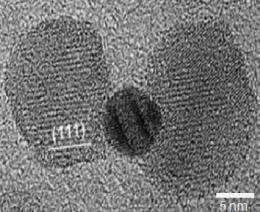
A transmission electron microscope image of a gold hybrid nanoparticle that could be used to treat cancer. The gold in the middle is surrounded by two pieces of iron oxide. (Dickson Kirui)

Another weapon in the arsenal against cancer: Nanoparticles that identify, target and kill specific cancer cells while leaving healthy cells alone.

Led by Carl Batt, the Liberty Hyde Bailey Professor of Food Science, the researchers synthesized nanoparticles - shaped something like a dumbbell - made of gold sandwiched between two pieces of . They then attached , which target a molecule found only in colorectal cancer cells, to the particles. Once bound, the nanoparticles are engulfed by the cancer cells.

To kill the cells, the researchers use a near-infrared laser, which is a wavelength that doesn't harm normal tissue at the levels used, but the radiation is absorbed by the gold in the nanoparticles. This causes the cancer cells to heat up and die.

"This is a so-called 'smart' therapy," Batt said. "To be a smart therapy, it should be targeted, and it should have some ability to be activated only when it's there and then kills just the cancer cells."

The goal, said lead author and biomedical graduate student Dickson Kirui, is to improve the technology and make it suitable for testing in a human clinical trial. The researchers are now working on a similar experiment targeting cells.

"If, down the line, you could clinically just target the cancer cells, you could then spare the health surrounding cells from being harmed - that is the critical thing," Kirui said.

Gold has potential as a material key to fighting cancer in future smart therapies. It is biocompatible, inert and relatively easy to tweak chemically. By changing the size and shape of the gold particle, Kirui and colleagues can tune them to respond to different wavelengths of energy.

Once taken up by the researchers' gold particles, the are destroyed by heat - just a few degrees above normal body temperature - while the surrounding tissue is left unharmed. Such a low-power laser does not have any effect on surrounding cells because that particular wavelength does not heat up cells if they are not loaded up with , the researchers explained.

Using iron oxide - which is basically rust - as the other parts of the particles might one day allow scientists to also track the progress of cancer treatments using magnetic resonance imaging, Kirui said, by taking advantage of the particles' magnetic properties.

More information: The research is reported in the Feb. 15 online edition of the journal Nanotechnology.

Provided by Cornell University (news : web)

4.2 /5 (14 votes)  

Filter


Move the slider to adjust rank threshold, so that you can hide some of the comments.


Display comments: newest first

fixer
Mar 08, 2010

Rank: 5 / 5 (1)
A better idea, forget the gold and the lasers and just use the iron oxide!
Cheap, available and deadly, read all about it here.
http://www.artbio...ome.html

Another example of blinkered scientists totally unaware of the world around them.
Supermegadope
Mar 08, 2010

Rank: 5 / 5 (2)
"If, down the line, you could clinically just target the cancer cells, you could then spare the health surrounding cells from being harmed - that is the critical thing," Kirui said.

I have been hearing about this for at least 4 years, we know that they are able to kill cancer cells. In 4 years there has been no progress just targeting cancer cells?
Tangent2
Mar 08, 2010

Rank: 5 / 5 (2)
I agree with you Supermegadope, this has been trumpeted for a long time now with no new insights or advancements. I first heard about the prospect of using gold nanoparticles in conjunction with an infrared laser to heat them up and destroy the cells they bind to with antibodies back in 1994. It has been over 15 years now and we are still in the same place, trumpeting the latest confirmation (YES WE KNOW IT WORKS!) and going nowhere fast. Ridiculous.
Bloodoflamb
Mar 08, 2010

Rank: 5 / 5 (1)
A former graduate student in the research group that I joined at the beginning of this semester showed that people who were claiming to have created nanoparticle iron oxide cores with gold shells had not actually properly characterized their properties, including whether their particles were actually gold shelled and not just solid gold nanoparticles. There is also a lack of long-term stability characterization of gold nanoparticles, due to the fact that they undergo a process known as Oswald ripening, where smaller particles are broken apart and then subsumed by larger particles due to the higher surface energy of the smaller particles.

@fixer: Gold-coated iron-oxide nanoparticles have more uses than just killing cancer cells, by the way. The fact that one can excite a plasmon resonance within the gold shell provides us the opportunity to characterize the dielectric properties of every part of a biological cell.
fixer
Mar 09, 2010

Rank: not rated yet
Everything worthwile in cancer research goes nowhere fast.
Too much money changes hands TREATING cancer, no one makes money CURING cancer.
A bottle of Artemisinin costs about $65.00 and thats it!
No chemo, no surgery and no radiotherapy = NO MONEY.

No chemist worth his salt is going to give up his meal ticket willingly, I refer you again to the original release.
http://www.physor...379.html
MicrobiologystDreamer
Mar 13, 2010

Rank: not rated yet
like the links that fixer share......
Rank 4.2 /5 (14 votes)
Related Stories
Relevant PhysicsForums posts
  • Pertubance in a model
    created4 hours ago
  • Cancer drugs and Alzheimer's, Oh my!
    created12 hours ago
  • Squishing cells
    created12 hours ago
  • Any books/articles for evolutionary stable strategy models in humans?
    createdFeb 09, 2012
  • Science behind the bore feeling?
    createdFeb 09, 2012
  • Homo Sapien vs. Chimpanzee - Divergence Timeline
    createdFeb 09, 2012
  • More from Physics Forums - Biology

More news stories

What lies beneath: Mapping hidden nanostructures

The ability to diagnose and predict the properties of materials is vital, particularly in the expanding field of nanotechnology. Electron and atom-probe microscopy can categorize atoms in thin sheets of material, ...

Nanotechnology / Nanophysics

created 2 hours ago | popularity 5 / 5 (1) | comments 0

'Dark plasmons' transmit energy

Microscopic channels of gold nanoparticles have the ability to transmit electromagnetic energy that starts as light and propagates via "dark plasmons," according to researchers at Rice University.

Nanotechnology / Nanophysics

created 18 hours ago | popularity 5 / 5 (6) | comments 0 | with audio podcast

Nanotube therapy takes aim at breast cancer stem cells

Wake Forest Baptist Medical Center researchers have again proven that injecting multiwalled carbon nanotubes (MWCNTs) into tumors and heating them with a quick, 30-second laser treatment can kill them.

Nanotechnology / Bio & Medicine

created 23 hours ago | popularity 5 / 5 (1) | comments 0 | with audio podcast

New kind of solar cell could capture significantly more energy than current cells

New solar cells could increase the maximum efficiency of solar panels by over 25%, according to scientists from the University of Cambridge.

Nanotechnology / Nanophysics

created Feb 08, 2012 | popularity 4.5 / 5 (11) | comments 14 | with audio podcast

Nanoshell whispering galleries improve thin solar panels

Visitors to Statuary Hall in the U.S. Capitol Building may have experienced a curious acoustic feature that allows a person to whisper softly at one side of the cavernous, half-domed room and for another on ...

Nanotechnology / Nanomaterials

created Feb 07, 2012 | popularity 4.3 / 5 (6) | comments 6 | with audio podcast


New understanding of DNA repair could eventually lead to cancer therapy

A research group in the Faculty of Medicine & Dentistry at the University of Alberta is hoping its latest discovery could one day be used to develop new therapies that target certain types of cancers.

Zuckerberg's focus drives Facebook's ascent

When Mark Zuckerberg showed up to rent Judy Fusco's Los Altos, Calif., house in the fall of 2004, soon after he'd arrived in Silicon Valley, the landlord was immediately struck by his confidence.

Antidepressants and pregnancy: Women must consider the impact of drugs on baby, and of depression on baby, themselves

Upon learning they are pregnant, most women dutifully nix the alcohol, sushi and caffeine. But what about antidepressants?

Both maternal and paternal age linked to autism

Older maternal and paternal age are jointly associated with having a child with autism, according to a recently published study led by researchers at The University of Texas Health Science Center at Houston (UTHealth).

Night, weekend delivery OK for babies with birth defects

Weekday delivery is no better than night or weekend delivery for infants with birth defects, according to a new study presented today at The Pregnancy Meeting, the Society for Maternal-Fetal Medicine's annual conference. ...

From virginity to Viagra

Americans will spend more than $17 billion on Valentine's Day, but far less on programs like sex education for adolescents. The editors of the new book, Sex for Life, From Virginity to Viagra, How Sexuality Changes Throughout ...