Gone With the Galactic Wind: 10 Years of Chandra X-ray Observations Reveal Galaxy Secrets
March 8, 2010
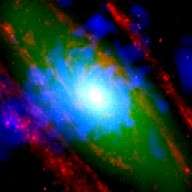
Chandra X-ray telescope image
(PhysOrg.com) -- When NASA launched its Chandra X-ray observing telescope into orbit in 1999, astronomers didn’t know much about the galactic winds made of wispy, multi-million-degree gas clouds that stream out from normal galaxies like our own, because they are “diffuse, gentle and unspectacular” compared to far more dramatic emanations of starbursts, recalls astronomer Q. Daniel Wang of the University of Massachusetts Amherst.
But direct observation by the Chandra orbiting telescope have changed all that and led to “the first characterization of the spatial, thermal, chemical and kinetic properties of the gas in our galaxy,” Wang states. Chandra data show, among other things, that though seemingly as ephemeral as fog, the outflowing hot gas from normal galaxies exerts a very powerful feedback force on the surroundings, preventing or slowing the infall of intergalactic gas due to gravity. “This discovery is a new key to our understanding of how galaxies work, especially how they lose mass and energy, that was not possible before Chandra,” he adds.
The astronomer catalogs the new knowledge in an article published this week in the early online edition of Proceedings of the National Academy of Sciences. Because his group has made extensive use of Chandra data, he was asked to write a review celebrating the instrument’s 10-year anniversary.
As Wang explains, galaxies like our own are made of visible stars and gas but investigating this matter and its properties using only visible light reveals only a small fraction of material actually present. “The hot gas is very hard to detect because of its low density, hence weak radiation, compared to black holes and neutron stars that accrete from their companions, which tend to overwhelm X-ray emissions from a galaxy,” he adds.
“By X-raying galaxies, we can see the invisible, and with the Chandra instrument we can detect gas that emits or absorbs X-rays, as well as such exotic objects as black holes and neutron stars that tend to emit primarily in X-rays.” X-ray tomography by the high-spectral resolution Chandra instrument has given astronomers the unprecedented opportunity to examine the amount, distribution and composition of the hot gas against bright background sources.
It has also helped to yield clues to the mystery of why there is not enough hot gas present inside or in the immediate vicinity of galaxies as predicted by current theory, in particular elements synthesized and ejected by stars. In fact, says Wang, “we find that the bulk of energy expected from the supernovae is missing as well. We conclude that this missing energy is gone with the wind, a galactic wind that blows matter to much larger regions around galaxies than previously understood.”
“Indeed, we find direct evidence for such winds and outflows in nearby galaxies. This uses another well-known capability of the Chandra, the exquisite spatial resolution, which allows us to detect discrete X-ray sources and to remove them cleanly when mapping X-ray emission in and around galaxies. The outflows are called galactic feedback, which can have profound impact on the ecosystem of the galaxies.”
“These results, compared with detailed simulations, now enable us to study how the feedback regulates the formation and evolution of galaxies,” Wang says.
Provided by University of Massachusetts Amherst (news : web)
-
Chandra Sheds Light on Galaxy Collision
Mar 29, 2007 |
not rated yet |
0
-
NGC 5746: Detection of hot halo gets theory out of hot water
Feb 03, 2006 |
not rated yet |
0
-
Chandra catches early phase of cosmic assembly
Aug 15, 2004 |
not rated yet |
0
-
Chandra finds evidence for quasar ignition
Mar 23, 2006 |
not rated yet |
0
-
Galaxy Collision Switches on Black Hole
Dec 10, 2009 |
not rated yet |
0
-
Engineers build first sub-10-nm carbon nanotube transistor
Feb 01, 2012 |
4.9 / 5 (30) |
30
-
Something old, something new: Evolution and the structural divergence of duplicate genes
Jan 31, 2012 |
4.6 / 5 (7) |
1
-
The hidden nanoworld of ice crystals: Revealing the dynamic behavior of quasi-liquid layers
Jan 30, 2012 |
5 / 5 (3) |
1
-
Stock market network reveals investor clustering
Jan 27, 2012 |
3.9 / 5 (23) |
8
-
Of microchemistry and molecules: Electronic microfluidic device synthesizes biocompatible probes
Jan 26, 2012 |
5 / 5 (1) |
0
-
Titan's lack of impact craters
15 hours ago
-
Real pictures of black hole eating a star?
Feb 08, 2012
-
Hypothetical way to travel faster than light, but not technically exceed lightspeed
Feb 06, 2012
-
How do scientists monitor the Sun's activity?
Feb 05, 2012
-
Search patterns in observational studies
Feb 05, 2012
-
Derivation of Pogson's law
Feb 03, 2012
- More from Physics Forums - General Astronomy
More news stories
Deconstructing a mystery: What caused Snowmaggedon?
In the quiet after the storms, streets and cars had all but disappeared under piles of snow. The U.S. Postal Service suspended service for the first time in 30 years. Snow plows struggled to push the evidence ...
Space & Earth / Earth Sciences
10 hours ago |
4.7 / 5 (3) |
1
|
New views show old NASA Mars landers
(PhysOrg.com) -- The High Resolution Imaging Science Experiment (HiRISE) camera on NASA's Mars Reconnaissance Orbiter recorded a scene on Jan. 29, 2012, that includes the first color image from orbit showing ...
Space & Earth / Space Exploration
18 hours ago |
4.9 / 5 (7) |
7
|
Ocean microbe communities changing, but long-term environmental impact is unclear
As oceans warm due to climate change, water layers will mix less and affect the microbes and plankton that pump carbon out of the atmosphere but researchers say it's still unclear whether these processes ...
Space & Earth / Earth Sciences
12 hours ago |
5 / 5 (2) |
2
|
Researchers create 3-D laser maps that show how earthquake changes landscape
Geologists have a new tool to study how earthquakes change the landscape down to a few inches, and it's giving them insight into how earthquake faults behave. In the Feb. 10 issue of the journal Science, a team ...
Space & Earth / Earth Sciences
12 hours ago |
5 / 5 (4) |
0
|
Black holes and star formation
(PhysOrg.com) -- It has long been recognized that galaxy mergers or even close interactions can play a vital role in shaping the morphology of galaxies. One way they can do so, it is thought, is by triggering ...
17 hours ago |
4.1 / 5 (7) |
5
|
'Dark plasmons' transmit energy
Microscopic channels of gold nanoparticles have the ability to transmit electromagnetic energy that starts as light and propagates via "dark plasmons," according to researchers at Rice University.
FDA-approved drug rapidly clears amyloid from the brain, reverses Alzheimer's symptoms in mice
Neuroscientists at Case Western Reserve University School of Medicine have made a dramatic breakthrough in their efforts to find a cure for Alzheimer's disease. The researchers' findings, published in the journal Science, show t ...
Hydrogen from acidic water: Researchers develop potential low cost alternative to platinum for splitting water
A technique for creating a new molecule that structurally and chemically replicates the active part of the widely used industrial catalyst molybdenite has been developed by researchers with the Lawrence Berkeley ...
Ultraviolet protection molecule in plants yields its secrets
Lying around in the sun all day is hazardous not just for humans but also for plants, which have no means of escape. Ultraviolet (UV) radiation from the sun can damage proteins and DNA inside cells, leading ...
Anyone can learn to be more inventive, cognitive researcher says
There will always be a wild and unpredictable quality to creativity and invention, says Anthony McCaffrey, a cognitive psychology researcher at the University of Massachusetts Amherst, because an "Aha moment" is rare and ...
Soraa LED light may dim 50-watt halogen rivals
(PhysOrg.com) -- Soraa, a Fremont, California company founded in 2008, this week launched its first product, a light that uses LEDS (light emitting diodes). The "Soraa LED MR16 lamp" is the "perfect" replacement ...