How smart are killer whales? Orcas have 2nd-biggest brains of all marine mammals
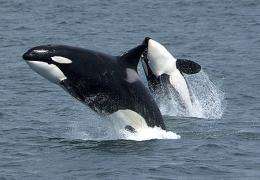
Neuroscientist Lori Marino and a team of researchers explored the brain of a dead killer whale with an MRI and found an astounding potential for intelligence.
Killer whales, or orcas, have the second-biggest brains among all ocean mammals, weighing as much as 15 pounds. It's not clear whether they are as well-endowed with memory cells as humans, but scientists have found they are amazingly well-wired for sensing and analyzing their watery, three-dimensional environment.
Scientists are trying to better understand how killer whales are able to learn local dialects, teach one another specialized methods of hunting and pass on behaviors that can persist for generations -- longer possibly than seen with any other species except humans.
These researchers have yet to find evidence that an orca in the wild has ever killed a person. But they aren't surprised that the world's biggest, most powerful and possibly smartest predator, captured and kept for years in a tank, cut off from the influences of an extended family, could have a fatal encounter with a human.
Human interaction with captive killer whales has come under scrutiny since Feb. 24, when a large male orca with a checkered past killed a trainer at SeaWorld Orlando by dragging her into a tank.
"I'm not trying to second-guess what was in this particular whale's mind," said Marino, part of the Neuroscience and Behavioral Biology Program at Emory University in Atlanta. "But, certainly, if we are talking about whether killer whales have the wherewithal and the cognitive capacity to intentionally strike out at someone, or to be angry, or to really know what they are doing, I would have to say the answer is yes."
Years of tediously difficult research has given scientists some understanding of killer whales -- but also has made them aware of how little they know about the creatures.
For starters, there's puzzlement over exactly how to categorize them.
They swim the world's oceans -- they are more widely distributed than any whale, dolphin or porpoise -- in at least three distinct populations. There are fish-eating orcas that stay in one area, flesh-eaters that wander more widely along coasts, and a third group that roams the deep-blue waters.
The three groups have starkly different diets, languages, hunting techniques and manners of behaving around other marine life, and they don't seem to interact much with one another.
"If they didn't have the same paint jobs, you'd call them different species," said Brad Hanson, a National Oceanic and Atmospheric Administration biologist in Seattle.
Yet the orcas' DNA tells a different story. Instead of the world's varied populations having genetics that spread outward like a tree with several main branches, theirs is but a single, nearly straight trunk, except for a mismatched pair of genes here and there.
"It's very, very strange," said Hanson, who participated in research that led to the listing of resident whales in waters off the Northwestern U.S. as endangered.
If genetic variety isn't what makes these killer-whale groups so different, scientists suspect, their enormous brains might be the telltale factor.
Bigger animals typically have bigger masses of brain cells. But scientists use brain-weight-to-body-weight ratios as a rough measure of intelligence. By that measure, human brains, by comparison, are seven times average. Orcas' brains are 2 1/2 times average -- similar to those of chimpanzees.
But scientist think that looking just at the brain-body ratio seriously underestimates the thinking power of larger marine mammals. In other words, orcas might be even much smarter than the size of their big brain suggests.
Hal Whitehead, a biology professor at Dalhousie University in Nova Scotia, awakened the world of cetacean research in 2001 when he co-authored a controversial paper that suggested no species other than humans are as "cultural" as orcas.
"Culture is about learning from others," Whitehead said. "A cultural species starts behaving differently than a species where everything is determined genetically."
One example of a killer-whale culture, he said, is the teaching of a particularly difficult and dangerous hunting technique observed by researchers on Antarctic islands. They watched as mothers repeatedly pushed their young onto beaches in pursuit of seals and sometimes had to drag their stranded young back into the water.
"They have their way of doing things, which they've learned from their mother and their other relatives," Whitehead said.
"Killer whales also are quite conservative animals," he added. "If this is the way they do things, then they are quite loath to do it another way."
That last point, he said, is important to consider when it comes to orcas held in captivity.
"That's pretty tough for any cultural animal, especially one from a conservative culture," Whitehead said.
Equally remarkable to researchers is the orca's ability to communicate with whistles and pulsed calls, and to "see" by making a clicking sound that works like sonar.
Many cetaceans -- whales, dolphins and porpoises included -- have these abilities to some degree. But orcas learn local and complex languages that are retained for many generations. And their bio-sonar, or echolocation, abilities also amaze researchers.
Professor Whitlow Au, of the University of Hawaii's Marine Mammal Research Program, finished a study recently adding to evidence that orcas can use their bio-sonar not just to find fish in murky water and not just to single out salmon, but to identify their favorite meal: Chinook salmon.
"They can recognize Chinook salmon from a long ways away," said Au, who put the distance at roughly half a football field. "They are able to use their bio-sonar to detect and track and eventually catch them."
Sam Ridgway, a neurobiologist and research veterinarian at San Diego's National Marine Mammal Foundation, which works for the Navy, said the orca brain has a relatively smaller amount of cerebral cortex -- the gray matter involved in memory, attention and thought -- than the human brain does. But it has large-diameter myelinated axons, which carry nerve impulses.
"It's analogous to a computer that has maybe less memory but bigger wires," said Ridgway, who puts a high value on being able to work with orcas in captivity. "The bigger the axon, the faster the nerve impulses travel."
Patrick Hof, vice chairman of the Department of Neuroscience at New York's Mount Sinai School of Medicine, summed up the orca noodle as a "big brain, a really big brain" with enormous capacity.
But whether that capacity creates the potential for intentionally killing a human is something for which there is "no scientific knowledge to prove," he said.
"It's a wild animal to begin with, and it has predatory behaviors that are well-known," Hof said. "It is possible that, in a situation of stress or captivity or stress related to captivity, some of the natural behavior might be expressed."
Marino, the Emory neuroscientist, wonders about the extent to which a captive orca could grow frustrated with being cut off from the cultural richness of living among an extended family -- grandparents through calves -- and the environmental richness of swimming the world's oceans.
"Living in a tank and having to splash people with your tail every day for 27 years would make anyone go nuts," Marino said.
(c) 2010, The Orlando Sentinel (Fla.).
Distributed by McClatchy-Tribune Information Services.


