S.Korea unveils 'recharging road' for eco-friendly buses
March 9, 2010
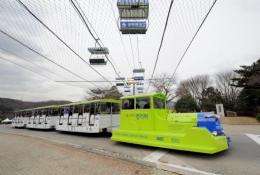
The Online Electric Vehicle (OLEV), towing three buses, went into service at an amusement park in southern Seoul

Enlarge

The Online Electric Vehicle (OLEV), towing three carriages, runs along a blue line under which power strips are buried for recharging, at an amusement park in Gwacheon, south of Seoul. S.Korean researchers launched an environmentally-friendly public transport system using a "recharging road" -- with a vehicle sucking power magnetically from buried electric strips.

South Korean researchers Tuesday launched an environmentally friendly public transport system using a "recharging road" -- with a vehicle sucking power magnetically from buried electric strips.

The Online Electric Vehicle (OLEV), towing three buses, went into service at an amusement park in southern Seoul. If the prototype proves successful, there are plans to try it out on a bus route in the capital.

The Korea Advanced Institute of Science and Technology (KAIST), which developed the system, says OLEV needs a only one-fifth the size of conventional and eliminates the need for major recharging.

It also avoids the need for overhead wires used to conventional trams or trolley buses.

Guests including Seoul mayor Oh Se-Hoon and KAIST president Suh Nam-Pyo were given a 2.2-kilometre (1.4-mile) ride Tuesday around the zoo at Seoul Grand Park.

Recharging strips have been installed in four segments totalling some 400 metres along the route.

Pick-up equipment underneath OLEV collects power through non-contact magnetic charging from strips buried under the road surface. It then distributes the power either to drive the vehicle or for battery storage.

If the system is used on Seoul bus routes, underground power lines would have to be installed on only 20 percent of the route at places like stops, parking places and intersections, KAIST said in a statement.

The technology was first developed in a project involving the University of California (Berkeley) but KAIST said that produced no tangible results.

The state-funded institute says it has applied for more than 120 patents in connection with OLEV, which it describes as safe, clean and economical.

"Of all the world's electric vehicles, this is the most economical system," Suh told reporters, adding the operating cost is only about one-third of ordinary electric vehicles.

"The potential for application (of this technology to systems) is limitless. I dare say this is one of the most significant technical gains in the 21st century," Suh said.

Suh said KAIST plans to use OLEVs to shuttle delegates at the G20 summit which Seoul will host in November.

Project director Cho Song-Ho said technical breakthroughs included an improved way of transmitting power to the pick-up device on the vehicle chassis.

Cho said a gap of at least 11 centimetres (4.4 inches) was needed to take account of bumpy roads, while OLEV can suck power across a gap of up to 25 cm.

Given a normal gap, the vehicle can turn more than 70 percent of the charge into energy for the vehicle, he said.

(c) 2010 AFP

4.8 /5 (5 votes)  

Filter


Move the slider to adjust rank threshold, so that you can hide some of the comments.


Display comments: newest first

finitesolutions
Mar 09, 2010

Rank: 2 / 5 (1)
Perfect! This needs to be scaled up to highways and the future will be electric. Now we have a big electricity generating problem.
ThomasS
Mar 09, 2010

Rank: not rated yet
I wonder how complex the subsurface structure would be. I imagine at least some effort is made to radiate power upwards instead of in all directions. If its simple, we can just melt open slices of existing tarmac roads and put it in. Less batteries, less infrastructure (charging stations), this sounds good.
Nik_2213
Mar 09, 2010

Rank: not rated yet
Thanks for this: I needed something so neat for a throw-away line in a sci-fi tale-- Look, no wires !!
Helix
Mar 11, 2010

Rank: not rated yet
When something sounds too good to be true, it usually is. Has anyone looked into the health issues related to this kind of a system. Without knowing the details, I can only speculate, but electromagnetic induction seems like the likeliest method for achieving the claimed power transfer. I shudder to think if the horrific levels of EMR that must be required.

Having said that, it's probably a step in the right direction, and might be feasible in densely populated areas or on routes with heavy traffic. But the idea of having widely available recharging facilities to avoid a huge battery load sounds like a good idea.

And what's wrong with a "big electricity generating problem"? At least electric energy can be generated at stationary plants and provide a means of powering vehicles by some means other than internal combustion engines, whose efficiencies top out in the low 20% range -- pathetic when compared to efficiencies of electric distribution systems.
Rank 4.8 /5 (5 votes)
Relevant PhysicsForums posts
  • dynamics 2/32
    created2 hours ago
  • dynamics
    created2 hours ago
  • Vibration Absorbtion Problem
    created7 hours ago
  • Does anyone make a small high temperature and high pressure pump?
    created13 hours ago
  • Strange indexing in Fortran Code
    createdFeb 07, 2012
  • Car Port post load calculation
    createdFeb 07, 2012
  • More from Physics Forums - General Engineering

More news stories

Windows 8 preview set for February 29

Microsoft on Wednesday revealed plans to unveil a test version of its latest Windows computer operating software later this month.

Technology / Software

created 7 hours ago | popularity 3.8 / 5 (4) | comments 5

Solar start-ups set new efficiency records

(PhysOrg.com) -- Although Alta Devices and Semprius make different types of solar panels, both start-ups have been breaking records in the past few days. Santa Clara, Calif.-based Alta Devices announced that ...

Technology / Energy & Green Tech

created 17 hours ago | popularity 4.9 / 5 (12) | comments 11 | with audio podcast report

Groupon fails to turn profit as revenue grows

Daily deals site Groupon on Wednesday issued its first earnings report as a publicly traded company, saying it failed to turn a profit despite revenue nearly tripling from a year earlier.

Technology / Business

created 5 hours ago | popularity not rated yet | comments 0

Lawsuit seeks to block Google's privacy changes

(AP) -- A consumer watchdog group is suing the Federal Trade Commission in an attempt to prevent Google from making sweeping changes to its privacy policies next month.

Technology / Internet

created 5 hours ago | popularity not rated yet | comments 0

Romanian accused of hacking NASA-JPL computers

(AP) -- The Los Angeles U.S. attorney's office says a federal grand jury has indicted a Romanian citizen on charges he hacked into 25 climate-research computers at NASA's Jet Propulsion Laboratory in Pasadena.

Technology / Internet

created 5 hours ago | popularity not rated yet | comments 0


Astronomy team discovers nearby dwarf galaxy

(PhysOrg.com) -- A team led by UCLA research astronomer Michael Rich has used a unique telescope to discover a previously unknown companion to the nearby galaxy NGC 4449, which is some 12.5 million light years ...

Amasia: As next supercontinent forms, Arctic Ocean, Caribbean will vanish first

(PhysOrg.com) -- Geologists at Yale University have proposed a new theory to describe the formation of supercontinents, the epic process by which Earth’s major continental blocks combine into a single ...

Why are there so few fish in the Earth's oceans?

(PhysOrg.com) -- A Stony Brook University researcher has found that, contrary to popular belief, there are not plenty of fish in the sea.

Transparent iron? For the first time, an experiment shows that atomic nuclei can become transparent

At the high-brilliance synchrotron light source PETRA III, a team of DESY scientists headed by Dr. Ralf Röhlsberger has succeeded in making atomic nuclei transparent with the help of X-ray light. At the ...

Physicists build highly efficient 'no-waste' laser

A team of University of California, San Diego researchers has built the smallest room-temperature nanolaser to date, as well as an even more startling device: a highly efficient, "thresholdless" laser that ...

Scientists strengthen memory by stimulating key site in brain

Ever gone to the movies and forgotten where you parked the car? New UCLA research may one day help you improve your memory.