IBM, Stanford cite advance in plastic recycling (w/ Video)
March 9, 2010
IBM, Stanford cite advance in plastic recycling

Enlarge

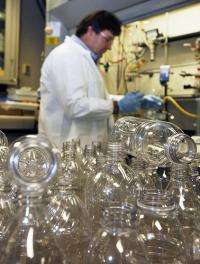
IBM Organocatalysis,Green Chemistry Breakthrough - Jim Hedrick, a researcher at IBM’s Research facility in San Jose, CA, works on new formulas that could make it easier to recycle the 13 billion plastic bottles disposed of each year globally. IBM and Stanford University scientists announced on Weds., March 10, 2010 a chemistry breakthrough that could lead to new environmentally-sustainable plastics which promise to significantly reduce waste and pollution. (Monica M. Davey/Feature Photo Service for IBM).

In a paper published in the American Chemical Society journal, Macromolecules, scientists from IBM and Stanford University detail discoveries that could lead to the development of new types of biodegradable, biocompatible plastics. The result of a multi-year research effort, the breakthrough also could lead to a new recycling process that has the potential to significantly increase the ability to recycle and reuse common PET and plant-based plastics in the future. Today’s announcement may have sustainability implications across a wide range of industries including biodegradable plastics, plastics recycling, healthcare and microelectronics.

IBM and Stanford scientists are pioneering the application of organocatalysis to green polymer chemistry, which represents a fundamental shift in the field. This discovery and new approach using organic catalysts could lead to well-defined, biodegradable molecules made from renewable resources in an environmentally responsible way.

“We're exploring new methods of applying technology and our expertise in materials science to create a sustainable, environmentally sound future,” said Josephine Cheng, IBM Fellow and vice president, IBM Research - Almaden. “The development of new families of organic catalysts brings more versatility to green chemistry and opens the door for novel applications, such as making biodegradable plastics, improving the recycling process and drug delivery.”

This video is not supported by your browser at this time.

Disposable plastic bottles are among the most vexing environmental challenges. More than 13 billion plastic bottles are disposed of each year. While plastics are recyclable, the resulting materials are limited to “second generation reuse” only. This means the materials made from recycled plastic bottles are disposed in landfills. In the United States, up to 63 pounds of plastic packaging per-person is disposed of each year, instead of being repeatedly recycled. The IBM-Stanford breakthrough in green chemistry could lead to a new recycling process that reverses the polymerization process to regenerate monomers in their original state, reducing waste and pollution significantly.

IBM also is collaborating with scientists from King Abdulaziz City for Science and Technology (KACST) to develop the recycling process for polyethylene terephthalate (PET) plastics, which is a common plastic used in containers for food, beverages and other liquids.

These breakthroughs also hold promise for biomedical applications. For example, many effective drugs that are designed to target cancer cells are often so potent that they attack cancerous and healthy cells alike. The use of organocatalysis could help in the design of custom polymers that may aid in delivering drugs to a specific cell or region.

The paper, Organocatalysis: Opportunities and Challenges for Polymer Synthesis, outlines how and why organocatalysis provides new opportunities for the preparation of sustainable plastics. Through the introduction of organic catalysis to synthetic polymer chemistry, scientists have developed a broadly applicable technology with demonstrations in a diverse range of polymerization techniques and monomer types.

A major focus of their efforts has been on ring-opening polymerization, a strategy dominated by metal oxide or metal hydroxide catalysts. They have shown that organic catalysts both exhibit activities that rival the most active metal-based catalysts, and provide access to polymer architectures that are difficult to access by conventional approaches.

The paper outlines the development of several new families of highly active, environmentally benign organic catalysts for the conversion of renewable resources to products that exhibit cost/performance characteristics comparable to existing materials.

The paper also describes recycling or degradation strategies that would enable a "closed-loop" life cycle for materials that meet the needs of the marketplace while helping to minimize the environmental footprint left for future generations.

Additionally, the team has developed a new strategy for the synthesis of high molecular weight cyclic polyesters and the generation of new families of biocompatible polymers for biomedical applications.

Source: IBM

3.4 /5 (5 votes)  

Rank 3.4 /5 (5 votes)
Related Stories
Relevant PhysicsForums posts
  • Safe nitrogen compound to decompose a 500 deg C in a furnace?
    created7 hours ago
  • [ask]electron inside drinking water
    createdFeb 08, 2012
  • How to avoid formation of Lithium Chromate ???
    createdFeb 08, 2012
  • how to choose a reduced or oxidated form in a redox
    createdFeb 08, 2012
  • Mesomeric effect in acids.
    createdFeb 08, 2012
  • Looking for a safe endothermic chemical reaction
    createdFeb 07, 2012
  • More from Physics Forums - Chemistry

More news stories

Hydrogen from acidic water: Researchers develop potential low cost alternative to platinum for splitting water

A technique for creating a new molecule that structurally and chemically replicates the active part of the widely used industrial catalyst molybdenite has been developed by researchers with the Lawrence Berkeley ...

Chemistry / Materials Science

created 10 hours ago | popularity 5 / 5 (10) | comments 11 | with audio podcast

Flexible paper robots

(PhysOrg.com) -- These inexpensive robots can stretch, bend and twist under control, and lift objects up to 120 times their own weight. Being soft, they can apply gentle and even pressure, and adapt to varied ...

Chemistry / Materials Science

created 8 hours ago | popularity 5 / 5 (5) | comments 2 | with audio podcast

New method makes culture of complex tissue possible in any lab

Scientists at the University of California, San Diego have developed a new method for making scaffolds for culturing tissue in three-dimensional arrangements that mimic those in the body. This advance, published online in ...

Chemistry / Biochemistry

created 7 hours ago | popularity 5 / 5 (3) | comments 0 | with audio podcast

Engineers find inspiration for new materials in Piranha-proof armor

(PhysOrg.com) -- It’s a matchup worthy of a late-night cable movie: put a school of starving piranha and a 300-pound fish together, and who comes out the winner?

Chemistry / Materials Science

created 17 hours ago | popularity 4.3 / 5 (3) | comments 2 | with audio podcast

Materials that shrink when heated

One common reason that people with fillings experience toothache is that their fillings expand at a different rate to the original tooth when, for example, drinking a hot drink. Contrary to intuition, however, ...

Chemistry / Materials Science

created 9 hours ago | popularity 5 / 5 (1) | comments 1


'Dark plasmons' transmit energy

Microscopic channels of gold nanoparticles have the ability to transmit electromagnetic energy that starts as light and propagates via "dark plasmons," according to researchers at Rice University.

FDA-approved drug rapidly clears amyloid from the brain, reverses Alzheimer's symptoms in mice

Neuroscientists at Case Western Reserve University School of Medicine have made a dramatic breakthrough in their efforts to find a cure for Alzheimer's disease. The researchers' findings, published in the journal Science, show t ...

Ultraviolet protection molecule in plants yields its secrets

Lying around in the sun all day is hazardous not just for humans but also for plants, which have no means of escape. Ultraviolet (UV) radiation from the sun can damage proteins and DNA inside cells, leading ...

Anyone can learn to be more inventive, cognitive researcher says

There will always be a wild and unpredictable quality to creativity and invention, says Anthony McCaffrey, a cognitive psychology researcher at the University of Massachusetts Amherst, because an "Aha moment" is rare and ...

Soraa LED light may dim 50-watt halogen rivals

(PhysOrg.com) -- Soraa, a Fremont, California company founded in 2008, this week launched its first product, a light that uses LEDS (light emitting diodes). The "Soraa LED MR16 lamp" is the "perfect" replacement ...

Cell biologists describes mechanism by which some people may be more susceptible to colon cancer

An international research team led by cell biologists at the University of California, Riverside has uncovered a new insight into colon cancer, the third leading cause of cancer-related deaths in the United ...