Energizer Duo battery charger hides a Trojan
March 9, 2010 by Lin Edwards report
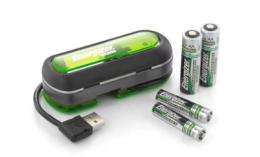
Energizer Duo USB battery charger

Enlarge

Energizer Duo USB battery charger

(PhysOrg.com) -- The Energizer Duo USB battery charger has been hiding a backdoor Trojan in its software that affects computers using Windows. According to Symantec the Trojan has probably been there since 10th May 2007.

Energizer has now taken the software for the model CHUSB charger off the market and removed the site from which it could be downloaded, and the company is asking customers who downloaded the Windows version to uninstall it. There are easy steps to fight the Trojan in affected machines, and Macintosh users are not affected.

’s Director of Global Intelligence, Dean Turner, said it’s impossible to be certain the Trojan has always been in the software that monitors the Duo USB charger, but the Trojan’s binary header states it was created in May 2007. It is not known how the Trojan came to be in the software, but malware has previously been found to be hidden inside products. Energizer is working with the US Computer Emergency Readiness Team (US-CERT) and the US government to try to find out how the code found its way into the software.

The Trojan allows an attacker to operate with the same privileges as the user who is logged in, and to remotely control the system via connections on 7777/tcp to send and receive files, run programs, and list the contents of directories.

US-CERT advises that to fix the problem, users can delete the Arucer.dll file from the Windows system32 directory, and then restart the system. An alternative fix is to remove the USB charger software. The Arucer.dll file will still be present but the code cannot be executed in the absence of the charger software. It is also advisable to block access to port 7777 using a firewall or via network perimeter devices.

Energizer’s Duo USB battery chargers have been available in the US, Europe, Asia, and Latin America since 2007. They allow computer users to recharge the Nickel Metal Hydride (NiMH) batteries either from a wall outlet or a . It also enabled the user to monitor the status of charging on the PC.

© 2010 PhysOrg.com

4.8 /5 (17 votes)  

Filter


Move the slider to adjust rank threshold, so that you can hide some of the comments.


Display comments: newest first

Nik_2213
Mar 09, 2010

Rank: not rated yet
What has the world come to when you can't even trust a lowly wall-wart ??

( Metaphorically speaking ;-)
Royale
Mar 09, 2010

Rank: 3.8 / 5 (4)
can anyone say foreign nations are prepping for a cyber war a lot more than we are? where was the program written, where was the hardware made? we need to start acting and stop reacting.
fuzz54
Mar 09, 2010

Rank: not rated yet
If you have a proper firewall running then it would block the trojan or the charger software from accessing the internet. With that being said, most people don't have a proper firewall running.
Skeptic_Heretic
Mar 09, 2010

Rank: 5 / 5 (1)
When I first read this I was thinking more along the lines of "for those surprise encounters, a hidden trojan compartment".

I laughed, then I read the article. Who really uses a monitor program for a USB battery charger? It's 24 hours for a charge, so said the manual.

If you have a proper firewall running then it would block the trojan or the charger software from accessing the internet. With that being said, most people don't have a proper firewall running.
Most firewalls stop uninitiated incomming connections and ignore outgoing connections by default. Unless you've spent ten thousand on a hardware appliance, you're just as unprotected as those you look down on.
Royale
Mar 09, 2010

Rank: 5 / 5 (1)
Probably not energizer as a company, but for their outsourced developers looking to make some extra money the motive is right there.
bluehigh
Mar 09, 2010

Rank: not rated yet
Originally intended for remote diagnostic support.
Switch
Mar 09, 2010

Rank: not rated yet
April Fools?
MorituriMax
Mar 09, 2010

Rank: not rated yet
I got up late one night to get some milk, suspiciously it looked like my refrigerator's ice maker light was in sync with my cable modem.... hmmmm
GaryB
Mar 10, 2010

Rank: not rated yet
"All your bases are belong ..."
pubwvj
Mar 13, 2010

Rank: 1 / 5 (1)
One more reason to use a Mac.
paulthebassguy
Mar 15, 2010

Rank: not rated yet
I think this is hilarious haha. It was probably put there by a developer with a grudge against the company.

Rank 4.8 /5 (17 votes)
Related Stories
Relevant PhysicsForums posts
  • Flow around a reducing bend - effect on pumping work
    created7 hours ago
  • Formula for deflection of 6061 T6 hollow tube, please help.
    created12 hours ago
  • Help to make a Unit Hydrograph of Reservoir Level - Storage Curve for a Dam
    created22 hours ago
  • Heating frozen water pipes by induction?
    createdFeb 05, 2012
  • Bending around sheave or pulley
    createdFeb 05, 2012
  • Electric company meter reading
    createdFeb 05, 2012
  • More from Physics Forums - General Engineering

More news stories

Airborne robot swarms are making complex moves (w/ video)

(PhysOrg.com) -- The GRASP Lab at the University of Pennsylvania this week released a video that shows their new look in GRASP Lab robotic flying devices. They are now showing flying devices with more complex ...

Electronics / Robotics

created Feb 02, 2012 | popularity 4.9 / 5 (28) | comments 10 | with audio podcast report

New Nokia phone no standout, but worth a look

The first of Nokia's new generation of smartphones isn't flashy and certainly isn't an iPhone killer. But it's a nice device, and at $40 with a two-year contract, a bargain.

Electronics / Consumer & Gadgets

created Feb 03, 2012 | popularity 1 / 5 (2) | comments 3

Some HTC Android phones found vulnerable to WiFi password leak

(PhysOrg.com) -- The United States Computer Emergency Readiness Team (U-CERT) has issued a warning to users of some HTC Android phones regarding a security vulnerability that has been found. The warning pert ...

Electronics / Consumer & Gadgets

created Feb 02, 2012 | popularity 5 / 5 (1) | comments 2 | with audio podcast report

New Vizio HD-TV breaks wide-screen barrier for movies, apps

The shape of TVs to come might be even wider than wide-screen. Today's high-definition sets evolved to a rectangular 16-by-9 shape from the more square analog TVs. But a wider 21-by-9 display standard is in ...

Electronics / Consumer & Gadgets

created Jan 30, 2012 | popularity 3.8 / 5 (4) | comments 1

Studying butterfly flight to help build bug-size flying robots

To improve the next generation of insect-size flying machines, Johns Hopkins engineers have been aiming high-speed video cameras at some of the prettiest bugs on the planet. By figuring out how butterflies ...

Electronics / Robotics

created Feb 02, 2012 | popularity 5 / 5 (2) | comments 1 | with audio podcast


Nicira promises virtual networks will transform networking

(PhysOrg.com) -- For the past four years, founders of the start-up company Nicira have been developing cutting-edge software that they predict will transform the networking technology underlying the Internet. ...

Navy to begin tests on electromagnetic railgun prototype launcher

The Office of Naval Research (ONR)'s Electromagnetic (EM) Railgun program will take an important step forward in the coming weeks when the first industry railgun prototype launcher is tested at a facility ...

Study of diving beetles suggest sperm evolution may be driven by changes in female reproductive organs

Studying female reproductive tracts and sperm in diving beetles (Dytiscidae), researchers from the University of Arizona and Syracuse University have obtained a glimpse into a bizarre and amazing world of spe ...

Fossil cricket: Jurassic love song reconstructed

Some 165 million years ago, the world was host to a diversity of sounds. Primitive bushcrickets and croaking amphibians were among the first animals to produce loud sounds by stridulation (rubbing certain body parts together). ...

New insight from whole-genome sequencing of Europe's 2011 E. coli outbreaks

Using whole-genome sequencing, a team led by researchers from Harvard School of Public Health (HSPH) and the Broad Institute has traced the path of the E. coli outbreak that sickened thousands and killed over 50 people in Ger ...

Redder ladybirds more deadly, say scientists

A ladybird's colour indicates how well-fed and how toxic it is, according to an international team of scientists. Research led by the Universities of Exeter and Liverpool directly shows that differences between ...