Desert ants perceive odor maps in stereo and use this information for navigation
March 9, 2010
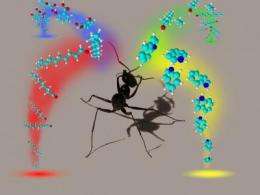
Its two antennae enable the desert ant to smell in stereo. The ant is not only able to use a single odor source for navigation, it can also memorize several odor sources in the vicinity of its nest. The picture shows four separate sources of odor molecules that the insect is able to recognize with its antennae. Credit: Picture/Photomontage: MPI for Chemical Ecology, Markus Knaden
Desert ants are well-known for their remarkable orientation: they use a compass along with a step counter and visible landmarks to locate their nest. After researchers from the Max Planck Institute for Chemical Ecology discovered that these ants can navigate also by using olfactory cues, they now found that the animals even can take advantage of the distribution of different odors in a map-like manner by utilizing their antennae to smell their environment in stereo.
Scientists of the Max Planck Institute for Chemical Ecology in Jena have investigated another navigational skill of desert ants. These ants are already well-known for their remarkable visual orientation: they use a sun compass along with a step counter and visible landmarks to locate their nest after foraging for food. After the research team from Jena recently discovered that these ants also use olfactory cues to pinpoint their nests, they conducted new experiments: they revealed that the animals can not only locate an odour source, but also use the distribution of different odours in the vicinity of their nests in a map-like manner. The scientists found that the ants need both their antennae for this odour-guided navigation: they smell the scenery in stereo.
The desert ant Cataglyphis fortis is an insect native to the inhospitable salt-pans of Tunisia. To pinpoint the nest - a tiny hole in the desert ground - after foraging for food, Cataglyphis combines several navigation systems: a sun compass, a path integrator (the ant literally counts its steps), and visual recognition of landmarks. Recently, Kathrin Steck, Bill Hansson and Markus Knaden, neuroethologists at the Max Planck Institute for Chemical Ecology in Jena, discovered that local odours also play an important role in the insect's orientation (Frontiers in Zoology, 2009, Vol. 6 No. 5): ants learn to associate a smell with their nest and distinguish this smell from others. But the researchers wanted to know if the insects are also able to recognize odour patterns that emerge, when several odour sources are located at different positions around the nest. And if so, they asked, do ants need both their antennae like stereo receivers just as we employ two eyes and two ears for spatial perception?
"We conducted two key experiments," says Kathrin Steck, PhD student at the institute. "First we marked four odour sources surrounding the nest entrance with the substances methyl salicylate, decanal, nonanal, and indole, and got the ants trained on them. If these four odour points were shifted away from the nest in the original arrangement, the ants repeatedly headed for the odours, even though the nest wasn't there anymore. If we rearranged the odour sources relative to each other, the ants were completely confused." Therefore the researchers assumed that ants do not "think" one-dimensionally - i.e. they do not associate the nest with only one smell - but multi-dimensionally, i.e., they relate an odour landscape to their nest. The odour landscape comprising the four substances was monitored with the help of a special measuring technique: the scientists used a specific photoionisation detector to determine the distribution of the odour substances in space and time.
Spatial perception can easily be acquired if two separate sensory organs are available, such as two eyes for visual orientation. In the case of the ants, this would be their two antennae. "With this assumption, the second key experiment seemed obvious: We tested ants that only had one antenna," Markus Knaden, the leader of the study, explains. In fact, ants with only one sensory device were unable to make use of the odour landscape for navigation.
Stereo smelling in animals is not new - rats and humans are thought to have this ability as well. This new study shows that ants smell in stereo, but not only that: "In our experiments we demonstrated that ants successfully use stereo smelling for navigation in the desert," says Bill Hansson, director at the institute.
More information: Kathrin Steck, Markus Knaden, Bill S. Hansson: Do desert ants smell the scenery in stereo? Animal Behaviour, online first, doi:10.1016/j.anbehav.2010.01.011
Provided by Max Planck Institute
-
Desert ants smell their way home
Feb 27, 2009 |
not rated yet |
0
-
Scientists: Ants have internal pedometer
Jul 04, 2006 |
not rated yet |
0
-
Ants die alone, protecting their nest mates from infection
Feb 16, 2010 |
not rated yet |
0
-
How house-hunting ants choose the best home
Apr 22, 2009 |
not rated yet |
0
-
Temporary infidelity may contribute to the stability of ancient relationships
Jun 01, 2009 |
not rated yet |
0
-
Engineers build first sub-10-nm carbon nanotube transistor
Feb 01, 2012 |
4.9 / 5 (30) |
30
-
Something old, something new: Evolution and the structural divergence of duplicate genes
Jan 31, 2012 |
4.6 / 5 (7) |
1
-
The hidden nanoworld of ice crystals: Revealing the dynamic behavior of quasi-liquid layers
Jan 30, 2012 |
5 / 5 (3) |
1
-
Stock market network reveals investor clustering
Jan 27, 2012 |
3.9 / 5 (23) |
8
-
Of microchemistry and molecules: Electronic microfluidic device synthesizes biocompatible probes
Jan 26, 2012 |
5 / 5 (1) |
0
-
Pertubance in a model
3 hours ago
-
Cancer drugs and Alzheimer's, Oh my!
11 hours ago
-
Squishing cells
11 hours ago
-
Any books/articles for evolutionary stable strategy models in humans?
23 hours ago
-
Science behind the bore feeling?
Feb 09, 2012
-
Homo Sapien vs. Chimpanzee - Divergence Timeline
Feb 09, 2012
- More from Physics Forums - Biology
More news stories
The power of estrogen -- male snakes attract other males
A new study has shown that boosting the estrogen levels of male garter snakes causes them to secrete the same pheromones that females use to attract suitors, and turned the males into just about the sexiest ...
1 hour ago |
not rated yet |
0
|
Experts reveal how plants don't get sunburn
(PhysOrg.com) -- Experts at the University of Glasgow have discovered how plants survive the harmful rays of the sun.
1 hour ago |
5 / 5 (1) |
0
|
Miami battling invasion of giant African snails
No one knows how they got there. But an invasion of African giant snails has southern Florida in a panic over potential crop damage, disease and general yuckiness surrounding the slimy gastropods.
5 hours ago |
not rated yet |
2
New drugs schedule makes horse racing a sure thing
What do Gai Waterhouse and Anthony Cummings have in common with Queen Elizabeth II?
1 hour ago |
not rated yet |
0
Ultraviolet protection molecule in plants yields its secrets
Lying around in the sun all day is hazardous not just for humans but also for plants, which have no means of escape. Ultraviolet (UV) radiation from the sun can damage proteins and DNA inside cells, leading ...
19 hours ago |
5 / 5 (5) |
0
|
Fool's gold may prove an unlikely alternative to overexploited catalytic materials
Catalytic materials, which lower the energy barriers for chemical reactions, are used in everything from the commercial production of chemicals to catalytic converters in car engines. However, with current catalytic materials ...
Curry spice component may help slow prostate tumor growth
Curcumin, an active component of the Indian curry spice turmeric, may help slow down tumor growth in castration-resistant prostate cancer patients on androgen deprivation therapy (ADT), a study from researchers ...
What lies beneath: Mapping hidden nanostructures
The ability to diagnose and predict the properties of materials is vital, particularly in the expanding field of nanotechnology. Electron and atom-probe microscopy can categorize atoms in thin sheets of material, ...
Netflix light on flicks as viewers soak up TV shows
Like most fresh faces that arrive in Hollywood, Netflix wanted to be a movie star. But now it's learning what many in Tinseltown have known for decades: Movies are sexy, but the real money is in television.
To avoid early labor and delivery, weight and diet changes not the answer
One of the strongest known risk factors for spontaneous or unexpected preterm birth any birth that occurs before the 37th week of pregnancy, most often without a known cause is already having had one. For women ...
Arthritic knees, but not hips, have robust repair response
Researchers at Duke University Medical Center used new tools they developed to analyze knees and hips and discovered that osteoarthritic knee joints are in a constant state of repair, while hip joints are not.