Company to sell 'world's first practical jetpack' for $75,000 (w/ Video)
March 9, 2010 by Lisa Zyga
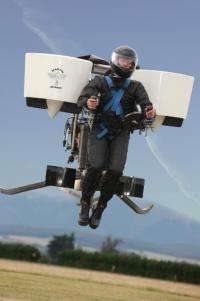
The Martin jetpack can fly for 30 minutes on a five-gallon tank of gas, reaching a top speed of 60 mph. Credit: Martin Aircraft Company.
Taking a leap into the future, the New Zealand-based Martin Aircraft Company plans to start selling commercial jetpacks to anyone with an interest and $75,000.
As a recent article in The Telegraph has reported, Martin has partnered with an unnamed international aircraft company, resulting in enough capital to produce 500 jetpacks per year. The partnership has brought the jetpacks closer to reality compared with a year ago, when Martin’s goal was to produce 10 units at $100,000 each.
As Martin jetpack inventor Glenn Martin demonstrates in the video below, the 200-horsepower, dual-propeller jetpacks seem to offer all that one could hope for in a personal flying machine. The jetpack can travel for about 30 minutes on a five-gallon tank of premium gasoline (the same used by cars). Tests have shown that the jetpack can reach top speeds of 60 mph, giving it a range of 30 miles per tank. The newest model can also reach heights of 2,400 meters (about 1.5 miles).
This video is not supported by your browser at this time.
Video demonstration of the Martin jetpack
Since the jetpacks weigh less than 254 pounds, they don’t require a pilot’s license to fly. However, Martin says that buyers will be required to go through training before taking to the skies. The jetpack is also equipped with a low-altitude emergency parachute.The jetpack, which can lift up to 120 kilograms (265 pounds), has two propellers that generate lift. The air in the propellers moves at about 300 km per hour, creating an upward thrust. The pilot uses both hands to fly, one on the throttle and one for steering. A flight display in front reveals information such as what the engines are doing and where it’s going. If the pilot lets go of the controls, the jetpack hovers in one spot. This self-righting mechanism occurs since the center of mass is below the jetpack’s center of pressure, which is located at the bottom of the ducts (near the pilot’s shoulders).
Although the company is on the cusp of commercialization, the project itself has been almost 30 years in the making. Glenn Martin began working on a concept in 1981, which was later verified by the University of Canterbury’s Mechanical Engineering Department. In 2005, the ninth prototype achieved sustained flight times, laying the foundation for pre-production development.
Later this year, Martin plans to begin production of the jetpacks at an undisclosed location outside of New Zealand. The company plans to market the jetpacks to emergency services, the military, and private users. As volume increases, according to its website, the cost may decrease to that of a “mid-range motorcycle or car.”
More information: www.martinjetpack.com
via: The Telegraph
© 2010 PhysOrg.com
-
New type of aircraft is under development
Feb 01, 2006 |
not rated yet |
0
-
Lockheed Martin aerospace division to cut 800 jobs
Aug 17, 2009 |
not rated yet |
0
-
Puffin: the one-person electric aircraft (w/ Video)
Jan 22, 2010 |
not rated yet |
0
-
New bunker buster bomb is in development
Jul 14, 2005 |
not rated yet |
0
-
Flying car takes wing: MIT alums' invention makes its first test flights (w/Video)
Mar 19, 2009 |
not rated yet |
0
-
Engineers build first sub-10-nm carbon nanotube transistor
Feb 01, 2012 |
5 / 5 (21) |
19
-
Something old, something new: Evolution and the structural divergence of duplicate genes
Jan 31, 2012 |
4.6 / 5 (7) |
1
-
The hidden nanoworld of ice crystals: Revealing the dynamic behavior of quasi-liquid layers
Jan 30, 2012 |
5 / 5 (2) |
1
-
Stock market network reveals investor clustering
Jan 27, 2012 |
4.1 / 5 (21) |
8
-
Of microchemistry and molecules: Electronic microfluidic device synthesizes biocompatible probes
Jan 26, 2012 |
not rated yet |
0
-
Tennis Court Speed Measurement
12 hours ago
-
Fastest way to cool water
20 hours ago
-
Counter-weights
Feb 02, 2012
-
Composite electric glass heating elements
Feb 02, 2012
-
pipe stress analysis
Feb 02, 2012
-
Interested in average household energy consumption in 2011...
Feb 01, 2012
- More from Physics Forums - General Engineering
More news stories
Hackers intercept FBI, Scotland Yard call (Update)
(AP) -- Trading jokes and swapping leads, investigators from the FBI and Scotland Yard spent the conference call strategizing about how to bring down the hacking collective known as Anonymous, responsible ...
13 hours ago |
5 / 5 (7) |
22
Japanese entrepreneurs aim for Silicon Valley
For an emerging generation of Japanese innovators, the dream isn't a job for life at a big company. They have new ambitions, and they're determined to go places. Especially Silicon Valley.
10 hours ago |
5 / 5 (1) |
1
A 'natural' solution for transportation
As the United States transitions away from a primarily petroleum-based transportation industry, a number of different alternative fuel sourcesethanol, biodiesel, electricity and hydrogenhave each ...
Technology / Energy & Green Tech
14 hours ago |
3 / 5 (2) |
13
Hackers deface website of lawyers for US Marine
Members of the hacker group Anonymous defaced the website on Friday of the law firm that defended a US Marine who faced charges in connection with the 2005 killing of 24 Iraqi civilians.
7 hours ago |
5 / 5 (2) |
2
TV executives crave viewers who watch 2 screens
Forget the small screen and the big screen. The hottest new thing in television is the "second screen" - the one on the tablet computer or cell phone that an increasing number of viewers keep an eye on while they're watching ...
7 hours ago |
1 / 5 (2) |
0
Amazon fungi found that eat polyurethane, even without oxygen
(PhysOrg.com) -- Until now polyurethane has been considered non-biodegradable, but a group of students from Yale University in the US has found fungi that will not only eat and digest it, they will do so even in the absence ...
Scientists chart high-precision map of Milky Way's magnetic fields
(PhysOrg.com) -- Scientists at the Naval Research Laboratory (NRL) are part of an international team that has pooled their radio observations into a database, producing the highest precision map to date of ...
Whole exome sequencing identifies cause of metabolic disease
Sequencing a patient's entire genome to discover the source of his or her disease is not routine yet. But geneticists are getting close.
Hearing metaphors activates brain regions involved in sensory experience
When a friend tells you she had a rough day, do you feel sandpaper under your fingers? The brain may be replaying sensory experiences to help understand common metaphors, new research suggests.
Renowned physicist invents microscope that can peer at living brain cells
(PhysOrg.com) -- Ever since scientists began studying the brain, theyve wanted to get a better look at what was going on. Researchers have poked and prodded and looked at dead cells under electron microscopes, ...
New kind of high-temperature photonic crystal could someday power everything from smartphones to spacecraft
A team of MIT researchers has developed a way of making a high-temperature version of a kind of materials called photonic crystals, using metals such as tungsten or tantalum. The new materials which ...
Mar 09, 2010
Rank: 4 / 5 (2)
Mar 09, 2010
Rank: 5 / 5 (3)
Looks well made!
Mar 09, 2010
Rank: 4 / 5 (1)
Mar 09, 2010
Rank: 2.4 / 5 (5)
Why don't they show a demo flight outside?
Mar 09, 2010
Rank: 4 / 5 (1)
or 6 ultra lights 100 miles ...
Evidently the power goes wasted in providing forced lift ..
They evidently havent read about "coanda" effect .
:)
Mar 09, 2010
Rank: 4 / 5 (2)
Mar 09, 2010
Rank: 4.3 / 5 (3)
Then fit a footbar for comfort.
Might it be possible to plate in front of the pilot to provide additional lift as a lifting body?
Mar 09, 2010
Rank: 4 / 5 (1)
Mar 10, 2010
Rank: 4.7 / 5 (3)
crosswind.
The reason its indoors is that a crosswind makes this thing into a death trap. What it needs is some fail safe stabilization that keeps it level. At the moment all the controls are 100% manual.
Needed:
fly by wire
full autopilot,
auto-throttle,
sat nav,
parachute.
Then it is a winner. Expensive at first but mass production would keep costs down.
I hope sooner than later. I could fly to work over the ocean - very cool.
Mar 10, 2010
Rank: 4 / 5 (1)
Mar 10, 2010
Rank: 5 / 5 (2)
That would (barely) get me to work and back. But 5 gallons a day?
No thanks: I'll stick with my car which uses about 10% of that (and is faster to boot)
I can see it being a 'fun' vehicle - but not really as a 'mid-range motorcycle or car' replacement.
Mar 10, 2010
Rank: 5 / 5 (3)
all it needs is a light and powerful fuel cell + light engine
it will all come together eventually with all ongoing nanotech research
Mar 10, 2010
Rank: 5 / 5 (1)
Mar 10, 2010
Rank: 4.7 / 5 (3)
Mar 10, 2010
Rank: 5 / 5 (2)
Mar 10, 2010
Rank: 4 / 5 (1)
Mar 10, 2010
Rank: 5 / 5 (3)
No, since no one will be charged with FUI (flying under the influence) - because there will not be enough of you left to sue.
Mar 10, 2010
Rank: not rated yet
Mar 10, 2010
Rank: not rated yet
..working on my sales pitch to the wife..
It's not so much that I want one as IT wants ME!
Mar 10, 2010
Rank: 5 / 5 (1)
Gonna go WAY out on a limb as say you're not commuting to NYC, LA, SF, Chicago..... Back when I did the NYC grind day in and day out my commute time (22 miles driveway to parking garage) took me on a good day 2 hours (each way). This would be an enormous benefit if weather and regulations and flying thru spanish harlem weren't in the way.
Mar 10, 2010
Rank: not rated yet
Marry the two designs and you would get either a monopod flier with decent range or a Moller skycar.
One thing, if you lived in hilly or swampy country with poor access this would provide a solution.
Mar 11, 2010
Rank: not rated yet
Mar 12, 2010
Rank: not rated yet
Fortunately my job applows me to pick the time at which I go there - so traffic jams are not my problem :P
Mar 14, 2010
Rank: 5 / 5 (1)
60mph, fuel for .5 hrs, =
30 miles.. with NO room for error!
BUT: 5 gal x $3/gal = $15 bucks .. I dare you to go to your local airport and charter a Cessna for that!
Of course, amortizing the $75 grand is another issue ...
but this is progress!
tkjtkj@gmail.com
Mar 15, 2010
Rank: 5 / 5 (1)
Mar 15, 2010
Rank: not rated yet
Mar 15, 2010
Rank: not rated yet
And if you live in area with above ground power lines this looks like an accident waiting to happen.
Also, I'm uncertain how this craft would handle shifting air currents and changes in atmospheric pressure.
Would it be safe to fly over fast moving traffic?
So let's assume it is relatively safe... why not a larger fuel tank? 30 minutes of flight / 30 miles of flight is not very far... even if it is as the 'crow flies'.
Mar 15, 2010
Rank: not rated yet
Mar 15, 2010
Rank: not rated yet
Mar 30, 2010
Rank: not rated yet
My point is that this concept needs major backing. Throw a billion dollars R&D and let the Japanese work all nighters on it. Have you seen asimo and the toyota robots recently. Honda/Toyota will dominate robotics this century. Then think about what happens when you have a robot that can make itself - asymptotic zero labor cost.
Remember we are seeing a prototype. Look at an early helicopter prototype and then compare with a modern one. Now think modern composites, fly by wire and avionics.
Apr 16, 2010
Rank: not rated yet
- Honda sure okay..
- Toyota... I'd have to really give that one some serious research... :D
- Hyundai... Sorry but as cool as the concept is I'd have to pass. :(