Hidden habits and movements of insect pests revealed by DNA barcoding
March 9, 2010
Hidden habits and movements of insect pests revealed by DNA barcoding

Enlarge

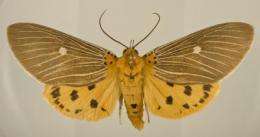
The Asota caricae moth has a two-inch wingspan and a 2,500 mile distribution. Credit: Lauren Helgen, Smithsonian Institution

University of Minnesota researcher George Weiblen and colleagues have found a faster way to study the spread and diet of insect pests.

Using a technique called DNA barcoding, which involves the identification of species from a short DNA sequence, Weiblen and an international team of researchers studied populations of numerous moth and butterfly species across Papua New Guinea. DNA barcodes showed that migratory patterns and caterpillar diets are very dynamic. In one case, a tiny that is distributed from Taiwan to Australia, has recently crossed thousands of miles of Pacific Ocean.

"DNA barcoding was developed for rapid identification but it also provides information about the habits and history of species," Weiblen says. He says this technique is of particular interest in , a country slightly larger in size than California with an insect diversity more than three times that of the United States. "New Guinea is one of those special places on Earth where we know very little about its biodiversity. This rich natural environment is increasingly threatened by economic development, and I'm concerned about how much might be lost before we've had a chance to understand it. DNA barcoding helps to increase the pace of discovery."

Weiblen says that DNA barcoding can play an important role in studying the arrival of , such as the emerald ash borer, a species recently introduced from Asia. "We need to understand the genetic history of invasion in order to combat the pests that threaten trees and crops," Weiblen says. " can pinpoint the geographic source of an invading species and measure the distances over which pest species can travel."

More information: The research, "Population genetics of ecological communities with DNA barcodes: An example from New Guinea Lepidoptera," was published in the Early Online edition of Proceedings of the National Academy of Sciences on March 1. To view the complete article, visit http://www.pnas.or … ull.pdf+html

Provided by University of Minnesota (news : web)


Rank 5 /5 (2 votes)
Related Stories
Relevant PhysicsForums posts

More news stories

Integrated weed management best response to herbicide resistance

Over-reliance on glyphosate-type herbicides for weed control on U.S. farms has created a dramatic increase in the number of genetically-resistant weeds, according to a team of agricultural researchers, who say the solution ...

Biology / Ecology

created 12 minutes ago | popularity not rated yet | comments 0

5-10 percent corn yield jump using erosion-slowing cover crops shown in new study

The most recent annual results from a four-year Iowa State University study on using cover crops between rows of corn reveals that higher yields – by as much as 10 percent – are possible using the ...

Biology / Other

created 13 minutes ago | popularity not rated yet | comments 0

Ocean warming causes elephant seals to dive deeper

Global warming is having an effect on the dive behaviour and search for food of southern elephant seals. Researchers from the Alfred Wegener Institute for Polar and Marine Research in the Helmholtz Association cooperating ...

Biology / Ecology

created 2 hours ago | popularity not rated yet | comments 0

Deciding to go left or right: Researchers use device to determine that lower animals can navigate too

For decades, scientists have associated binary decision making — opting to go left or right — with higher-ranking animals, including humans. A team of Harvard researchers, however, is rewriting that ...

Biology / Plants & Animals

created 4 hours ago | popularity not rated yet | comments 2 | with audio podcast

New Zealand team finds early plant arrivers dominated landscape

(PhysOrg.com) -- It seems intuitive that not all plant species could have taken a foothold on land at the same time all those millions of years ago as conditions on Earth evolved to the point where they could survive; some ...

Biology / Ecology

created 5 hours ago | popularity not rated yet | comments 0 | with audio podcast report


Secrets of immune response illuminated in new study

When disease-causing invaders like bacteria infect a human host, cells of various types swing into action, coordinating their activities to address the threat.

Nanotube therapy takes aim at breast cancer stem cells

Wake Forest Baptist Medical Center researchers have again proven that injecting multiwalled carbon nanotubes (MWCNTs) into tumors and heating them with a quick, 30-second laser treatment can kill them.

Potentially important new mechanisms found anti-aging effects of resveratrol

A well-conducted experimental study in mice has provided potentially important new insights into the association of the intake of resveratrol and like compounds with health benefits. Resveratrol is a constituent of red wine ...

Touch screens create online shopping experiences at stores

Imagine browsing knife sets in an airport and then ordering one before you board your plane, or going to a department store to look at makeup without having to bounce from counter to counter to check out each brand's selection.

Doctors telling more adults: Get out and exercise

(AP) -- More and more U.S. adults are being told by their doctor to get out and exercise, according to government survey released Thursday.

Study shows fainting factor in cardiac arrests

A new study by Dr. Andrew Krahn shows that over a quarter of unexplained cardiac arrests occurred after the patient had an event of fainting, known as syncope. According to Dr. Krahn, a Cardiologist at London Health Sciences ...