High-Speed Pipeline Revs Up Biomass Analysis
(PhysOrg.com) -- High throughput system can analyze enzymes, poplars, switch grass, thousands at a time to help determine which plants are best suited for biofuels.
A new pipeline at the National Renewable Energy Lab is analyzing 1,000 samples of biomass at a time, finding which one, combined with the right enzyme, most eagerly gives up its sugars to be converted into biofuel.
The deadline is just 12 years away to turn switch grass, poplar trees or other renewable biomass into 36 billion gallons of fuel for cars and trucks.
The Energy Independence and Security Act requires that the United States produce 36 billion gallons of biofuel by 2022. That would comprise one-third of the annual transportation fuels budget, now dominated by gasoline. Last month, President Obama voiced his enthusiasm for the act, saying it would reduce U.S. dependence on foreign oil, cut pollution, boost national security, and bolster good-paying clean-energy jobs.
That's a lot of biomass. And that's a lot of excursions to field, forest and lab to find the trees and plants easiest for enzymes to break down into fermentable sugars. A year ago, it would have taken a week and dozens of overworked graduate students to analyze a handful of trees or plants for their potential as a renewable fuel. Now, thanks to the work done by NREL scientists and their partners, more than 1,000 samples can be tested in the same time it used to take to test just a half dozen. Just as important, NREL's new high throughput pipeline can screen both the feedstock and the enzymes that chew on them to find the combinations that best convert biomass to sugar.
Extreme Analytical Capacity is New, Vital
The high throughput Biomass Recalcitrance Pipeline was created to analyze the large number of poplar, switch grass and other biomass samples being produced by the BioEnergy Science Center. BESC is a collaboration of 20 university, industrial and national laboratory partners developing a fundamental understanding of the factors controlling the release of sugar in biomass feedstocks. The BESC was developed under sponsorship from programs in both the Department of Energy's Office of Energy Efficiency and Renewable Energy's Biomass Program and DOE's Office of Biological and Environmental Research. Part of NREL's role in the BESC is the daunting task of screening thousands of plant variants for clues to overcome plant cell wall recalcitrance.
The pipeline's extreme analytical capacity, unheard of a few years ago, is important because it's not just a question of finding the right species of poplar tree, but finding that needle in a haystack, a single tree that for reasons of genetics and chemistry, gladly gives up its sugars to enzymes. Find that tree, and a new line of fast-growing poplars can sprout from agri-forests, providing an ongoing harvest for renewable transportation fuel.
To find the juiciest plants, scientists create mini-breweries, employing enzymes to break down plant cell walls so structural sugars are released to serve as microbial food to be converted via fermentation to biofuel.
The stubbornness with which a particular plant resists conversion to sugars is referred to as its recalcitrance. The effort at NREL to find the hidden genes and the underlying chemistry of the least recalcitrant plants has caught the attention of international experts in a half dozen fields. They are turning to NREL and its newly created high throughput process to rapidly and simultaneously analyze the chemistry, genetics and recalcitrance of plants.
So far, even though they've barely begun their search, the NREL researchers and their partners in the BioEnergy Science Center have found an unexpectedly high natural recalcitrance variance of 25 percent in the first thousand poplars analyzed.
Re-engineered Plate Can Handle Complicated Assays
The key breakthrough at NREL was devising an assay system that could handle the severe temperatures, pressures, and pH conditions needed to screen for recalcitrance, and to do it for hundreds of trees simultaneously, not a handful at a time.
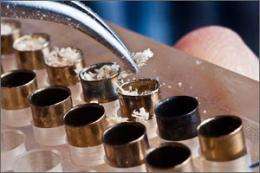
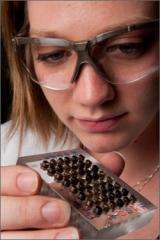
"It's fair to say that this was the Eureka," Jim Brainard, director of NREL's Biosciences Center, said as he held up a 96-well plate the size of a wallet. Typically, such plates are used for dispensing and sampling liquids, but the NREL team found a way to re-engineer it to handle extreme assay conditions and to teach a robot to do the leg — and arm — work of precisely adding the biomass to the wells. The poplar samples from the Pacific Northwest arrive at NREL as sawdust in small plastic baggies, where a robot grabs a pinch from each and carefully sets it in a well in the plate. The most unique aspect of the NREL plate is that it acts as both the reactor vessel for acid and heat pretreatment of the biomass and as the subsequent reactor for the release of glucose, xylose, and other sugars as the enzymes chew on the samples.
Typically, each of the 96 wells in a plate holds a 5 milligram sample of biomass. Because the plates can be stacked 20-high, almost 2,000 samples can be analyzed at the same time. As the samples pass from instrument to instrument, they are analyzed for how well the enzymes can release sugars and chew into the crystalline cellulose.
Simultaneously, part of each sample is analyzed for cell wall chemistry and genetic characteristics that contribute to recalcitrance, said Mark Davis, principal manager for NREL's Chemical and Catalyst Science Group. When those results are in, and correlated with information on location, environment and other factors, "We can begin to identify what genes are controlling recalcitrance," Davis said.
Finding Best Enzymes and Plants Requires Genetics, Chemistry
"It's not just about finding the miracle plants, it's about finding a miracle enzyme, too," Davis said. The high throughput assays "will allow us to screen libraries of enzymes that are able to break down the crystalline cellulose and help us develop new enzyme cocktails," Davis said. The goal is to develop screens that can optimize both the biomass feedstock and the enzymes together, as well as finding the plant with the lowest natural recalcitrance.
It is only when the chemistry of recalcitrance is understood that commercial interests can make better than hit-or-miss guesses as to what a planting will accomplish.
Davis's group, collaborating with other university and BESC researchers, has already found elegant ways to identify QTLs, or Quantitative Trait Loci, which are spots on chromosomes that indicate something interesting is going on within about 100 genes in either direction on a 20,000-gene chain of DNA. Once this team of researchers has narrowed down the hot spots, geneticists can take over. They quickly sort through 100 or so genes and find the one that is the true outlier — in this case, the one instructing the plant's cell walls to shamefully give in to the enzymes.
That still leaves the poor graduate students out there getting all those core samples, but while harvesting and sample-prep "used to be the easy part of the experiment, now it's the labor-intensive part," Davis said.
As the scientists in the lab zero in on the genes they likely will find not just ones that promote sugar-friendliness, but those that might link to differences in cell wall thickness or polymer composition. "The real power of this pipeline is that it is so long; extending from plant ecologists and environmental scientists, to plant breeders and molecular biologists, to analytical chemists and enzymologists, to bioinformaticists, to plant cell wall structure experts," Davis said. "Without all of these scientists working together we would not able to do this."
"We're really getting cranked up this year, thanks to the samples flowing in from industry and universities," Davis added. NREL's partners include the Oak Ridge National Laboratory, where tree geneticists analyzed the first 1,000 trees sampled, and companies such as ArborGen that are industrial partners in searching for the miracle tree.
Davis and Brainard say the potential for biomass is huge. "Biomass can concentrate and use carbon dioxide from the atmosphere, thus slowing or perhaps reversing increases in atmospheric greenhouse gases," Brainard said. "It is self-assembling, it is self-repairing, and it regenerates. Yes, there are some issues with water and land use that need attention, but I believe it is the leading candidate for renewable transportation fuels over the next 20 years."
Provided by National Renewable Energy Laboratory


