Scientists discover 'catastrophic event' behind the halt of star birth in early galaxy formation
March 9, 2010
Scientists discover 'catastrophic event' behind the halt of star birth in early galaxy formation

Enlarge

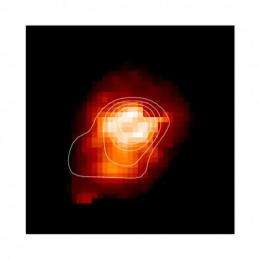
This is an observation showing gas in the galaxy SMM J1237+6203 seen using the Gemini Observatory’s Near-Infrared Integral Field Spectrometer (NIFS). The contours show how the blast of energy is traveling through the galaxy. Credit: Dave Alexander/Mark Swinbank, Durham University, and Gemini Observatory

Scientists have found evidence of a catastrophic event they believe was responsible for halting the birth of stars in a galaxy in the early Universe.

The researchers, led by Durham University's Department of Physics, observed the as it would have appeared just three billion years after the Big Bang when the Universe was a quarter of its present age.

According to their findings the galaxy exploded in a series of blasts trillions of times more powerful than any caused by an atomic bomb. The blasts happened every second for millions of years, the scientists said.

The explosions scattered the gas needed to form new stars by helping it escape the of the galaxy called SMM J1237+6203, effectively regulating its growth, the scientists added.

They believe the huge surge of energy was caused by either the outflow of debris from the galaxy's black hole or from powerful winds generated by dying stars called supernovae.

The research, funded by the Royal Society and the Royal Astronomical Society, is published in the . Observations were carried out using the Gemini Observatory's Near-Infrared Integral Field Spectrometer (NIFS).
Scientists discover 'catastrophic event' behind the halt of star birth in early galaxy formation
Enlarge

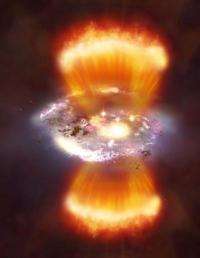
This is an artist's representation showing outflow from a supermassive black hole inside the middle of a galaxy. Credit: NASA/CXC/M.Weiss

The Durham-led team hopes the finding could increase understanding about the formation and development of galaxies.

Properties seen in massive galaxies near to our own Milky Way suggest that a major event rapidly turned off star formation in early galaxies and halted their expansion.

Theorists, including scientists at Durham University, have argued that this could be due to outflows of energy blowing galaxies apart and preventing further new stars from forming, but evidence of this has been lacking until now.

Lead author Dr Dave Alexander, of Durham University's Department of Physics, said: "We are looking into the past and seeing a catastrophic event that essentially switched off star formation and halted the growth of a typical massive galaxy in the local Universe.

"Effectively the galaxy is regulating its growth by preventing new stars from being born. Theorists had predicted that huge outflows of energy were behind this activity, but it's only now that we have seen it in action.

"We believe that similar huge outflows are likely to have stopped the growth of other galaxies in the early Universe by blowing away the materials needed for ."

The Durham-led team now plans to study other massive star-forming galaxies in the to see if they display similar characteristics.

Durham University is part of a team building the K-Band Multi-Object Spectrometer (KMOS) for the European Southern Observatory's (ESO) Very Large Telescope. KMOS will be used to further investigate the physical and environmental processes that shape the formation and evolution of .

Provided by Durham University (news : web)

3.9 /5 (12 votes)  

Filter


Move the slider to adjust rank threshold, so that you can hide some of the comments.


Display comments: newest first

Parsec
Mar 09, 2010

Rank: not rated yet
So... where did all the gas go?
Shootist
Mar 09, 2010

Rank: not rated yet
constituent of dark matter, yet they say not. how they know? i know not.
EarthlingX
Mar 10, 2010

Rank: not rated yet
Parsec wrote:
'So... where did all the gas go?'
Perhaps to the later formed dwarf galaxies around the big one ? It would probably also depend on the neighbourhood influence, if strong enough.

But just to see the evidence of such an event is awesome, there is probably a better word ..
Rank 3.9 /5 (12 votes)
Related Stories
Relevant PhysicsForums posts
  • Titan's lack of impact craters
    created13 hours ago
  • Real pictures of black hole eating a star?
    createdFeb 08, 2012
  • Hypothetical way to travel faster than light, but not technically exceed lightspeed
    createdFeb 06, 2012
  • How do scientists monitor the Sun's activity?
    createdFeb 05, 2012
  • Search patterns in observational studies
    createdFeb 05, 2012
  • Derivation of Pogson's law
    createdFeb 03, 2012
  • More from Physics Forums - General Astronomy

More news stories

Deconstructing a mystery: What caused Snowmaggedon?

In the quiet after the storms, streets and cars had all but disappeared under piles of snow. The U.S. Postal Service suspended service for the first time in 30 years. Snow plows struggled to push the evidence ...

Space & Earth / Earth Sciences

created 8 hours ago | popularity 4.7 / 5 (3) | comments 1 | with audio podcast

Ocean microbe communities changing, but long-term environmental impact is unclear

As oceans warm due to climate change, water layers will mix less and affect the microbes and plankton that pump carbon out of the atmosphere – but researchers say it's still unclear whether these processes ...

Space & Earth / Earth Sciences

created 10 hours ago | popularity 5 / 5 (2) | comments 2 | with audio podcast

Researchers create 3-D laser maps that show how earthquake changes landscape

Geologists have a new tool to study how earthquakes change the landscape down to a few inches, and it's giving them insight into how earthquake faults behave. In the Feb. 10 issue of the journal Science, a team ...

Space & Earth / Earth Sciences

created 10 hours ago | popularity 5 / 5 (4) | comments 0 | with audio podcast

New views show old NASA Mars landers

(PhysOrg.com) -- The High Resolution Imaging Science Experiment (HiRISE) camera on NASA's Mars Reconnaissance Orbiter recorded a scene on Jan. 29, 2012, that includes the first color image from orbit showing ...

Space & Earth / Space Exploration

created 16 hours ago | popularity 4.9 / 5 (7) | comments 5 | with audio podcast

Black holes and star formation

(PhysOrg.com) -- It has long been recognized that galaxy mergers or even close interactions can play a vital role in shaping the morphology of galaxies. One way they can do so, it is thought, is by triggering ...

Space & Earth / Astronomy

created 15 hours ago | popularity 4 / 5 (6) | comments 3 | with audio podcast


'Dark plasmons' transmit energy

Microscopic channels of gold nanoparticles have the ability to transmit electromagnetic energy that starts as light and propagates via "dark plasmons," according to researchers at Rice University.

Hydrogen from acidic water: Researchers develop potential low cost alternative to platinum for splitting water

A technique for creating a new molecule that structurally and chemically replicates the active part of the widely used industrial catalyst molybdenite has been developed by researchers with the Lawrence Berkeley ...

FDA-approved drug rapidly clears amyloid from the brain, reverses Alzheimer's symptoms in mice

Neuroscientists at Case Western Reserve University School of Medicine have made a dramatic breakthrough in their efforts to find a cure for Alzheimer's disease. The researchers' findings, published in the journal Science, show t ...

Ultraviolet protection molecule in plants yields its secrets

Lying around in the sun all day is hazardous not just for humans but also for plants, which have no means of escape. Ultraviolet (UV) radiation from the sun can damage proteins and DNA inside cells, leading ...

Anyone can learn to be more inventive, cognitive researcher says

There will always be a wild and unpredictable quality to creativity and invention, says Anthony McCaffrey, a cognitive psychology researcher at the University of Massachusetts Amherst, because an "Aha moment" is rare and ...

Flexible paper robots

(PhysOrg.com) -- These inexpensive robots can stretch, bend and twist under control, and lift objects up to 120 times their own weight. Being soft, they can apply gentle and even pressure, and adapt to varied ...