Why chameleon tongues work in the cold (w/ Video)
March 10, 2010 by Lin Edwards
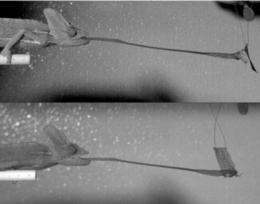
Two feedings by a single Chamaeleo calyptratus at 15 °C (Lower) and 35 °C (Upper) showing similar projection performance yet different retraction performance. Image sequences are synchronized at tongue launch and play at 1/100 real time (original rate, 3,000 Hz). The retractor muscle slackens when the tongue accelerator muscle approaches the entoglossal process of the hyoid skeleton (i.e., the stiff structure protruding from the mouth), after which retraction is considerably slower. (Please see a movie below).
(PhysOrg.com) -- In cold weather a chameleon’s metabolism slows down, but its tongue continues to work quickly to capture prey. A new study has found out why: the tongue does not rely on direct muscle contractions, and this mechanism is more resistant to cold than are muscles.
The veiled chameleon (Chamaeleo calyptratus) catches prey by shooting out its tongue, but since it is cold-blooded (ectothermic) it relies on the heat of its environment to keep warm. When temperatures drop, its muscles do not function as well as they do when it is warm. Now researchers at the University of South Florida, led by Christopher Anderson, have found the chameleon’s tongue accelerates at 41 Gs and reaches two body lengths, and that the mechanism for projecting it has additional benefits in cold weather. Scientists had previously assumed the chameleon’s special mechanism for shooting its tongue out was solely to produce the speed it needs to catch insects.
In ectotherms cold temperatures can considerably reduce their speed, and their ability to catch prey or escape from predators. In frogs, for example, the distance they can jump can be reduced by more than a third in cold weather. The special mechanism that operates the chameleon’s tongue, however, means they can feed at all temperatures in their habitats, from 3.5°C in mountainous areas up to 39°C in the desert.
This video is not supported by your browser at this time.
Movie credit: PNAS
The tongue mechanism is a stretch-and-release system, rather like a bow and arrow. Elastic tissue in the tongue is stretched by a contracting muscle. The energy is stored in the elastic tissue and when it is released the tongue shoots out to catch the prey, reaching full length in only 70 ms, which is about a fifth of the time it takes to blink an eye. In cold temperatures the contracting muscle works more slowly, but the same amount of energy is stored in the elastic tissue.The researchers used a high-speed camera, the photron, to compare the performance of the muscles that retract the tongue back into the mouth (which are affected by the cold) and the tongue projection mechanism at 15, 25, and 35°C. They found that the tongue retraction speed dropped by over 42% for each 10°C in temperature drop, but there was only a 10 to 19% drop in projection speed over the same temperature drop.
Anderson said the research may help scientists understand how temperature changes can affect behaviors in other animals. It may also find application for humans, such as in the design of prosthetic limbs that need to function well in low temperatures.
The new research is published in this week’s Proceedings of the National Academy of Sciences (PNAS).
More information: Ballistic tongue projection in chameleons maintains high performance at low temperature , Christopher V. Anderson, Stephen M. Deban, Published online before print March 8, 2010, doi:10.1073/pnas.0910778107
© 2010 PhysOrg.com
-
Toad research could leapfrog to new muscle model
Jun 02, 2008 |
not rated yet |
0
-
Isopod Replaces Fish's Tongue
Sep 14, 2009 |
not rated yet |
0
-
Classifying 'clicks'
Jul 15, 2009 |
not rated yet |
0
-
Death rates will rise because of global warming
Jul 02, 2007 |
not rated yet |
0
-
Ice-cream better licked than spooned says food expert
Oct 24, 2008 |
not rated yet |
0
-
Engineers build first sub-10-nm carbon nanotube transistor
Feb 01, 2012 |
4.9 / 5 (29) |
30
-
Something old, something new: Evolution and the structural divergence of duplicate genes
Jan 31, 2012 |
4.6 / 5 (7) |
1
-
The hidden nanoworld of ice crystals: Revealing the dynamic behavior of quasi-liquid layers
Jan 30, 2012 |
5 / 5 (3) |
1
-
Stock market network reveals investor clustering
Jan 27, 2012 |
3.9 / 5 (23) |
8
-
Of microchemistry and molecules: Electronic microfluidic device synthesizes biocompatible probes
Jan 26, 2012 |
5 / 5 (1) |
0
-
Science behind the bore feeling?
7 hours ago
-
Homo Sapien vs. Chimpanzee - Divergence Timeline
11 hours ago
-
a single mRNA strand is attached to sevaral ribosomes?
Feb 08, 2012
-
Oestrogen and FSH
Feb 07, 2012
-
Linear Blood Vessel Network Examples in Animals or Plants
Feb 07, 2012
-
Neuroscientists: What is a Principal Cell Layer?
Feb 06, 2012
- More from Physics Forums - Biology
More news stories
Ocean warming causes elephant seals to dive deeper
Global warming is having an effect on the dive behaviour and search for food of southern elephant seals. Researchers from the Alfred Wegener Institute for Polar and Marine Research in the Helmholtz Association cooperating ...
1 hour ago |
not rated yet |
0
Deciding to go left or right: Researchers use device to determine that lower animals can navigate too
For decades, scientists have associated binary decision making opting to go left or right with higher-ranking animals, including humans. A team of Harvard researchers, however, is rewriting that ...
3 hours ago |
not rated yet |
2
|
Fresh city tomatoes, any time
Why not produce lettuce, beans and tomatoes where most of the consumers are to be found: in the city? The flat roofs of many buildings are well-suited for growing vegetables. Rooftop greenhouses can also make ...
1 hour ago |
not rated yet |
0
New Zealand team finds early plant arrivers dominated landscape
(PhysOrg.com) -- It seems intuitive that not all plant species could have taken a foothold on land at the same time all those millions of years ago as conditions on Earth evolved to the point where they could survive; some ...
Can indigenous insects be used against the light brown apple moth?
The light brown apple moth (LBAM), Epiphyas postvittana (Walker), an invasive insect from Australia, was found in California in 2006. The LBAM feeds on apples, pears, stonefruits, citrus, grapes, berries and many other plants ...
2 hours ago |
not rated yet |
0
Secrets of immune response illuminated in new study
When disease-causing invaders like bacteria infect a human host, cells of various types swing into action, coordinating their activities to address the threat.
Nanotube therapy takes aim at breast cancer stem cells
Wake Forest Baptist Medical Center researchers have again proven that injecting multiwalled carbon nanotubes (MWCNTs) into tumors and heating them with a quick, 30-second laser treatment can kill them.
Touch screens create online shopping experiences at stores
Imagine browsing knife sets in an airport and then ordering one before you board your plane, or going to a department store to look at makeup without having to bounce from counter to counter to check out each brand's selection.
Genetic risks for type 2 diabetes span multiple ethnicities
A recent large and comprehensive analysis of 50,000 genetic variants across 2,000 genes linked to cardiovascular and metabolic function has identified four genes associated with type 2 diabetes (T2D) and six independent disease-associated ...
Digital photos could put kids at risk
A study published in the International Journal of Electronic Security and Digital Forensics this month suggests that parents and carers could be putting children at risk if they upload digital photos that are automatically "geota ...
Fuel from market waste
Mushy tomatoes, brown bananas and overripe cherries -- to date, waste from wholesale markets has ended up on the compost heap at best. In future it will be put to better use: Researchers have developed a new ...
Mar 10, 2010
Rank: 5 / 5 (1)