Nanometer Graphene Makes Novel OLEDs Display
March 10, 2010 Nanometer Graphene Makes Novel OLEDs Display

Enlarge

Image credit: Junbo Wu/Stanford University

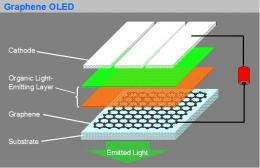
Researchers at Stanford University have successfully developed brand new concept of organic lighting-emitting diodes (OLEDs) with a few nanometer of graphene as transparent conductor. This paved the way for inexpensive mass production of OLEDs on large-area low-cost flexible plastic substrate, which could be rolled up like wallpaper and virtually applied to anywhere you want.

Due to its superb image quality, low and ultra-thin device structure, has been developed for more than 20 years, and recently finds its application in ultra-thin televisions and other display screens such as those on digital cameras and mobile phones. OLEDs consist of active organic luminescent structure sandwiched between two electrodes, one of which must be transparent. Traditionally, (ITO) is used in this type of devices. However, indium is rare, expensive and difficult to recycle. Scientists have been actively searching for an alternative candidate.

The next generation of optoelectronic devices requires transparent conductive electrodes to be lightweight, flexible, cheap, environmental attractive, and compatible with large-scale manufacturing methods. , single layer of graphite, is becoming a very promising candidate due to its unique electrical and in last two years. Very recently, Junbo Wu et al., researchers at Stanford University, successfully demonstrated the application of graphene in OLEDs for the first time.

Junbo Wu, leading researcher of the development, said that they achieved OLEDs on graphene with performance similar to a control device on conventional ITO transparent anodes, which is very exciting and promising for real-world application. ‘The current report by Wu et al. puts forward a strong case for graphene as a transparent conductor given its competitive performance, even with significantly high sheet resistance.’ said Chongwu Zhou, professor at University of Southern California in the Perspective of ACS Nano, 4(1), 2010.

‘Graphene has the potential to be a transparent electrode with higher performance, which means, more transparent, while at the same time, being more conductive. It could also be orders of magnitude cheaper than conventional transparent conductor, like ITO. It really has the potential to be both better and cheaper.’ said Prof. Peter Peumans in Podcast Episode 30, ACS Nano January 2010. ‘It (graphene) does have additional advantage that the electrode is very thin, only a couple of nanometer thick, which gives you potentially a lot more freedom how you design your devices.’ Peter also added.

This research sheds light on the enormous potential of graphene, and opens up an entirely new avenue towards the development of efficient and economical transparent conductors for flexible optoelectronic devices, such as OLEDs and organic photovoltaic cells. Transferring of large-area graphene thin film to a foreign flexible substrate has been previously demonstrated. Combining these technologies together, we have good reason to expect graphene OLEDs product on flexible plastic in the near future.

More information: The research is published in the journal ACS Nano, 4(1), 2010, entitled ‘Organic Light-Emitting Diodes on Solution-Processed Graphene Transparent Electrodes’. The authors are Junbo Wu, Mukul Agrawal, Hector A. Becerril, Zhenan Bao, Zunfeng Liu, Yongsheng Chen and Peter Peumans. For detailed information, please refer to http://pubs.acs.or … 21/nn900728d

-- More about the Peumans research group: http://peumansgrou … du/Main_Page

Provided by Stanford University (news : web)


Rate this story - 4.8 /5 (21 votes)

Rank Filter

Move the slider to adjust rank threshold, so that you can hide some of the comments.


Display comments: newest first

  • xamien - Mar 11, 2010
    • Rank: not rated yet
    Imagine a roll-out sheet of this combined with that touchscreen technology of the same vein! Throw up a touchscreen on the wall on the same order of size as a 40" flatscreen tv, with it connected to a laptop or netbook!

March 10, 2010 all stories

Comments: 1

4.8 /5 (21 votes)


  • hide
  • Related Stories

  • Super material will make lighting cheaper and fully recyclable
    created Feb 05, 2010 | popularity not rated yet | comments 0
  • Researchers develop new method for producing transparent conductors
    created May 13, 2009 | popularity not rated yet | comments 0
  • New technology will allow for flexible television and computer screens
    created May 11, 2006 | popularity not rated yet | comments 0
  • Light-speed nanotech: Controlling the nature of graphene
    created Jan 21, 2009 | popularity not rated yet | comments 0
  • Toward 'invisible electronics' and transparent displays
    created Feb 05, 2009 | popularity not rated yet | comments 0


  • hide
  • Relevant PhysicsForums posts

  • Trying to find substitution material for Ultrasound gel
    created 21 hours ago
  • Simple Steam Problem, need help.
    created Sep 03, 2010
  • aluminium alloys.
    created Sep 03, 2010
  • CK45 or C45N
    created Sep 03, 2010
  • More from Physics Forums - Materials & Chemical Engineering

Other News

Researchers create new self-assembling photovoltaic technology that repairs itself

Researchers create new self-assembling photovoltaic technology that repairs itself

Nanotechnology / Nanomaterials

created 13 hours ago | popularity 4.9 / 5 (11) | comments 3 | with audio podcast

Plants are good at doing what scientists and engineers have been struggling to do for decades: converting sunlight into stored energy, and doing so reliably day after day, year after year. Now some MIT scientists ...


Cheaper, better solar cell is full of holes

Cheaper, better solar cell is full of holes

Nanotechnology / Nanomaterials

created Sep 03, 2010 | popularity 5 / 5 (22) | comments 17 | with audio podcast

A new low-cost etching technique developed at the U.S. Department of Energy's National Renewable Energy Laboratory can put a trillion holes in a silicon wafer the size of a compact disc.


High-speed filter uses electrified nanostructures to purify water at low cost

High-speed filter uses electrified nanostructures to purify water at low cost

Nanotechnology / Bio & Medicine

created Aug 31, 2010 | popularity 4.9 / 5 (20) | comments 12 | with audio podcast

(PhysOrg.com) -- By dipping plain cotton cloth in a high-tech broth full of silver nanowires and carbon nanotubes, Stanford researchers have developed a new high-speed, low-cost filter that could easily be ...


Silicon oxide circuits break barrier

Silicon oxide circuits break barrier: Nanocrystal conductors could lead to massive, robust 3-D storage

Nanotechnology / Nanophysics

created Aug 31, 2010 | popularity 4.9 / 5 (34) | comments 8 | with audio podcast

Rice University scientists have created the first two-terminal memory chips that use only silicon, one of the most common substances on the planet, in a way that should be easily adaptable to nanoelectronic ...


Researchers create new class of piezoelectric logic devices using zinc oxide nanowires

Piezotronics: Researchers create new class of piezoelectric logic devices using zinc oxide nanowires

Nanotechnology / Nanophysics

created Sep 02, 2010 | popularity 5 / 5 (5) | comments 5 | with audio podcast

Researchers at the Georgia Institute of Technology have developed a new class of electronic logic device in which current is switched by an electric field generated by the application of mechanical strain ...