Large Hadron Collider set for high speed bash by early April: CERN
March 10, 2010
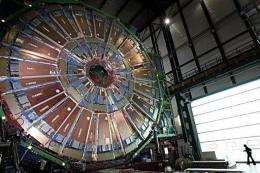
A view of a superconducting solenoid magnet at the European Organization for Nuclear Research (CERN) near Geneva. The European Organisation for Nuclear Research said that the world's most powerful atom smasher will be brought up to unprecedented power by early April.
The world's most powerful atom smasher will be brought up to unprecedented power by early April, the European Organisation for Nuclear Research said on Wednesday.
"We hope to have collisions at 7.0 TeV (teraelectronvolts) at the end of March or the beginning of April," CERN spokesman James Gillies told AFP.
The 3.9 billion euro (5.6 billion dollar) Large Hadron Collider (LHC) was restarted after a winter break two weeks ago to ready it for collisions at unfathomed energy levels.
The particle collider -- inside a 27-kilometre (16.8-mile) tunnel straddling the Franco-Swiss border near Geneva -- is aimed at understanding the origins of the universe by recreating the conditions that followed the Big Bang.
"During this first physics run, the LHC experiments will open up the biggest range of potential new discovery that particle physics has seen in over a decade," CERN said in a statement.
Gillies reiterated that the experiments would run for 18 to 24 months before another technical shutdown.
That halt would last for eight to 10 months while the LHC is prepared for the next stage, full power operation with beams running at 14 TeV, he added.
CERN's engineers decided in January to change the annual cycle they followed with its previous, smaller, accelerator, which used to be shut down for four months in winter for maintenance.
Instead they were aiming for longer period of continued operation with the LHC followed by a longer shutdown when needed, because of the total of two months its takes to heat up then cool down the huge cryogenically cooled colliders before and after maintenance.
The collider was revived from a 14-month breakdown last November, following a technical glitch that put it out of action days after it was launched in September 2008.
(c) 2010 AFP
-
World's most powerful atom smasher restarts: CERN
Feb 28, 2010 |
not rated yet |
0
-
Giant atom-smasher set to restart this weekend: CERN
Nov 20, 2009 |
not rated yet |
0
-
CERN atom-smasher restarts after 14-month hiatus: official
Nov 20, 2009 |
not rated yet |
0
-
LHC Ready for Duty Again
Feb 21, 2010 |
not rated yet |
0
-
German fails to prove atom-smasher will end world
Mar 09, 2010 |
not rated yet |
0
-
Engineers build first sub-10-nm carbon nanotube transistor
Feb 01, 2012 |
4.9 / 5 (31) |
30
-
Something old, something new: Evolution and the structural divergence of duplicate genes
Jan 31, 2012 |
4.6 / 5 (7) |
1
-
The hidden nanoworld of ice crystals: Revealing the dynamic behavior of quasi-liquid layers
Jan 30, 2012 |
5 / 5 (3) |
1
-
Stock market network reveals investor clustering
Jan 27, 2012 |
3.9 / 5 (23) |
8
-
Of microchemistry and molecules: Electronic microfluidic device synthesizes biocompatible probes
Jan 26, 2012 |
5 / 5 (1) |
0
-
Liverpool vs Manchester United
1 hour ago
-
Wearing black in a desert
1 hour ago
-
Did space exist before mass?
1 hour ago
-
How can E&M Waves be polarized?
1 hour ago
-
Does light travel for ever?
2 hours ago
-
Infinity by Particles
3 hours ago
- More from Physics Forums - General Physics
More news stories
Putting the squeeze on planets outside our solar system
(PhysOrg.com) -- Using high-powered lasers, scientists at Lawrence Livermore National Laboratory and collaborators discovered that molten magnesium silicate undergoes a phase change in the liquid state, abruptly ...
9 hours ago |
4.4 / 5 (5) |
0
|
Hovering not hard if you're top-heavy, researchers find
Top-heavy structures are more likely to maintain their balance while hovering in the air than are those that bear a lower center of gravity, researchers at New York University's Courant Institute of Mathematical Sciences ...
10 hours ago |
5 / 5 (1) |
1
|
SLAC, Stanford team focuses on high-energy electrons to treat cancer
Accelerator physicists at SLAC and cancer specialists from Stanford are working on a new technology that could dramatically reduce the time needed for cancer radiation treatments. The team ran an initial experiment ...
13 hours ago |
5 / 5 (1) |
0
Measurements from high-energy collisions lead to better understanding of why meson particles disappear
For several years, physicists at the Relativistic Heavy Ion Collider (RHIC) at Brookhaven National Laboratory (BNL), USA, have studied an unusual state of matter called the quarkgluon plasma, which they ...
13 hours ago |
4.5 / 5 (2) |
0
Explained: Sigma
It's a question that arises with virtually every major new finding in science or medicine: What makes a result reliable enough to be taken seriously? The answer has to do with statistical significance -- but ...
Feb 09, 2012 |
5 / 5 (16) |
53
Google users warned of threat to smartphone wallets
Users of Google smartphone wallets were being warned on Friday that there is a way to crack pass codes intended to thwart thieves from going on illicit shopping sprees.
Anonymous knocks CIA website offline (Update)
The website of the Central Intelligence Agency was inaccessible on Friday after the hacker group Anonymous claimed to have knocked it offline.
New error-correcting codes guarantee the fastest possible rate of data transmission
Error-correcting codes are one of the triumphs of the digital age. Theyre a way of encoding information so that it can be transmitted across a communication channel such as an optical fiber o ...
Complex wiring of the nervous system may rely on a just a handful of genes and proteins
Researchers at the Salk Institute have discovered a startling feature of early brain development that helps to explain how complex neuron wiring patterns are programmed using just a handful of critical genes. ...
The power of estrogen -- male snakes attract other males
A new study has shown that boosting the estrogen levels of male garter snakes causes them to secrete the same pheromones that females use to attract suitors, and turned the males into just about the sexiest ...
Humans may have helped the decline of African rainforests 3000 years ago
(PhysOrg.com) -- Large areas of rainforests in Central Africa mysteriously disappeared over three thousand years ago, to be replaced by savannas. The prevailing theory has been that the cause was a change ...
Mar 10, 2010
Rank: 1 / 5 (4)
CERN is using media with a new strategy. Post daily, no matter if you have anything new to say. This keeps CERN in everybody's thoughts constantly.
Of course, the aim is to make CERN and the LHC household words, all the way to the remotest Lapland log cabin or Rio shantytown. This makes it vastly easier to secure funding in the coming years, and it helps pre-empt competition.
Survival of the shrewdest. Watch it, Tevatron guys, or you'll be annihilated by oblivion.
Mar 10, 2010
Rank: 5 / 5 (1)
Mar 10, 2010
Rank: 1 / 5 (6)
http://www.newsci...lhc.html
Mar 11, 2010
Rank: not rated yet
Mar 11, 2010
Rank: not rated yet
-- In any event @ 7 TeV they will acquire 1 Femtobarn ^-1 collsions in just over a year. In retrospect it took Fermilab a decade to acquire that many collisions. Which is supposed to be a ton of data to go through.
If by pretty fast you mean they were going to take two years to get to 14 TeV then yes -- but the current director has stated that that was a bit too ambitious, due to the size of the accerelator and shear complexity of getting to 'know' it.
14 TeV is ' I beleive ' to gaina foothold into new territory.. to explore the world of possibly new physics and at that level something new should emmerge
Mar 11, 2010
Rank: not rated yet
Mar 11, 2010
Rank: 5 / 5 (2)
www.lhcportal.com
I've spent hours watching every little activity and the lower power collisions. It's great fun. I can't wait to see the fireworks the higher power collisions will create.
Mar 12, 2010
Rank: 1 / 5 (2)
http://www.newsci...lhc.html
Mar 12, 2010
Rank: 1 / 5 (2)
http://tinyurl.com/ya4zmm6
A review of safety papers concerning black holes at the LHC:
http://www.risk-e...fety.pdf
LHC to shut down for a year to address design faults:
http://news.bbc.c...6621.stm
Mar 12, 2010
Rank: 1 / 5 (2)
Mar 14, 2010
Rank: 1 / 5 (1)
From Wikipedia: Mad Scientist:
...Mad scientists also, whilst definitely being intelligent, if not necessarily brilliant, usually fail to think things through to their conclusion...
Some excerpts from the LSAG (CERN safety committee) summary report:... So just what do they think stable, neutral black holes, which remain on Earth, might do next?
Mar 14, 2010
Rank: not rated yet
http://www3.inter...abstract
It's a risk of Hirschsprung's disease, Down's syndrome or the risk of melanoma syndrome development during human lifetime.
Mar 14, 2010
Rank: not rated yet
Mar 16, 2010
Rank: 1 / 5 (1)