Study validates general relativity on cosmic scale, existence of dark matter
March 10, 2010 By Robert Sanders
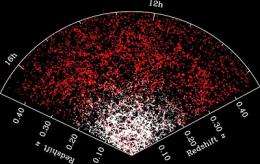
A partial map of the distribution of galaxies in the Sloan Digital Sky Survey, going out to a distance of 7 billion light years. The amount of galaxy clustering that we observe today is a signature of how gravity acted over cosmic time, and allows as to test whether general relativity holds over these scales. (M. Blanton, Sloan Digital Sky Survey)
(PhysOrg.com) -- An analysis of more than 70,000 galaxies by University of California, Berkeley, University of Zurich and Princeton University physicists demonstrates that the universe - at least up to a distance of 3.5 billion light years from Earth - plays by the rules set out 95 years ago by Albert Einstein in his General Theory of Relativity.
By calculating the clustering of these galaxies, which stretch nearly one-third of the way to the edge of the universe, and analyzing their velocities and distortion from intervening material, the researchers have shown that Einstein's theory explains the nearby universe better than alternative theories of gravity.
One major implication of the new study is that the existence of dark matter is the most likely explanation for the observation that galaxies and galaxy clusters move as if under the influence of some unseen mass, in addition to the stars astronomers observe.
"The nice thing about going to the cosmological scale is that we can test any full, alternative theory of gravity, because it should predict the things we observe," said co-author Uros Seljak, a professor of physics and of astronomy at UC Berkeley, a faculty scientist at Lawrence Berkeley National Laboratory, and a professor of physics at the Institute of Theoretical Physics at the University of Zurich. "Those alternative theories that do not require dark matter fail these tests."
In particular, the tensor-vector-scalar gravity (TeVeS) theory, which tweaks general relativity to avoid resorting to the existence of dark matter, fails the test.
The result conflicts with a report late last year that the very early universe, between 8 and 11 billion years ago, did deviate from the general relativistic description of gravity.
Seljak and his current and former students, including first authors Reinabelle Reyes, a Princeton University graduate student, and Rachel Mandelbaum, a recent Princeton Ph.D. recipient, report their findings in the March 11 issue of the journal Nature. The other co-authors are Tobias Baldauf, Lucas Lombriser and Robert E. Smith of the University of Zurich, and James E. Gunn, professor of physics at Princeton and father of the Sloan Digital Sky Survey.
Einstein's General Theory of Relativity holds that gravity warps space and time, which means that light bends as it passes near a massive object, such as the core of a galaxy. The theory has been validated numerous times on the scale of the solar system, but tests on a galactic or cosmic scale have been inconclusive.
"There are some crude and imprecise tests of general relativity at galaxy scales, but we don't have good predictions for those tests from competing theories," Seljak said.
Such tests have become important in recent decades because the idea that some unseen mass permeates the universe disturbs some theorists and has spurred them to tweak general relativity to get rid of dark matter. TeVeS, for example, says that acceleration caused by the gravitational force from a body depends not only on the mass of that body, but also on the value of the acceleration caused by gravity.
The discovery of dark energy, an enigmatic force that is causing the expansion of the universe to accelerate, has led to other theories, such as one dubbed f(R), to explain the expansion without resorting to dark energy.
Tests to distinguish between competing theories are not easy, Seljak said. A theoretical cosmologist, he noted that cosmological experiments, such as detections of the cosmic microwave background, typically involve measurements of fluctuations in space, while gravity theories predict relationships between density and velocity, or between density and gravitational potential.
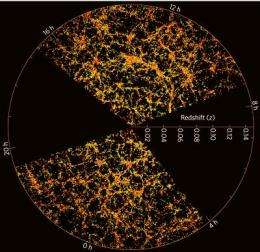
A collection of galaxies from the Sloan Digital Sky Survey. Red galaxies composed of older stars are more luminous; the recent study used a sample of 70,000 red luminous galaxies to combine galaxy clustering, weak gravitational lensing, and redshifts to compare and test competing theories of gravity. Image by Michael Blanton for SDSS
"The problem is that the size of the fluctuation, by itself, is not telling us anything about underlying cosmological theories. It is essentially a nuisance we would like to get rid of," Seljak said. "The novelty of this technique is that it looks at a particular combination of observations that does not depend on the magnitude of the fluctuations. The quantity is a smoking gun for deviations from general relativity."Three years ago, a team of astrophysicists led by Pengjie Zhang of Shanghai Observatory suggested using a quantity dubbed EG to test cosmological models. EG reflects the amount of clustering in observed galaxies and the amount of distortion of galaxies caused by light bending as it passes through intervening matter, a process known as weak lensing. Weak lensing can make a round galaxy look elliptical, for example.
"Put simply, EG is proportional to the mean density of the universe and inversely proportional to the rate of growth of structure in the universe," he said. "This particular combination gets rid of the amplitude fluctuations and therefore focuses directly on the particular combination that is sensitive to modifications of general relativity."
Using data on more than 70,000 bright, and therefore distant, red galaxies from the Sloan Digital Sky Survey, Seljak and his colleagues calculated EG and compared it to the predictions of TeVeS, f(R) and the cold dark matter model of general relativity enhanced with a cosmological constant to account for dark energy.
The predictions of TeVeS were outside the observational error limits, while general relativity fit nicely within the experimental error. The EG predicted by f(R) was somewhat lower than that observed, but within the margin of error.
In an effort to reduce the error and thus test theories that obviate dark energy, Seljak hopes to expand his analysis to perhaps a million galaxies when SDSS-III's Baryon Oscillation Spectroscopic Survey (BOSS), led by a team at LBNL and UC Berkeley, is completed in about five years. To reduce the error even further, by perhaps as much as a factor of 10, requires an even more ambitious survey called BigBOSS, which has been proposed by physicists at LBNL and UC Berkeley, among other places.
Future space missions, such as NASA's Joint Dark Energy Mission (JDEM) and the European Space Agency's Euclid mission, will also provide data for a better analysis, though perhaps 10-15 years from now.
Seljak noted that these tests do not tell astronomers the actual identity of dark matter or dark energy. That can only be determined by other types of observations, such as direct detection experiments.
Provided by University of California - Berkeley (news : web)
-
Astronomers Gravitate Toward Einstein's Telescope
Feb 20, 2009 |
not rated yet |
0
-
Do we need dark matter?
Nov 12, 2009 |
not rated yet |
0
-
Leading physicists convene in Tucson for conference on gravity
Jan 12, 2007 |
not rated yet |
0
-
Penn astrophysicist outlines a multi-pronged approach in the hunt for dark energy
Feb 18, 2005 |
not rated yet |
0
-
Dark energy -- 10 years on
Nov 30, 2007 |
not rated yet |
0
-
Engineers build first sub-10-nm carbon nanotube transistor
Feb 01, 2012 |
4.9 / 5 (29) |
30
-
Something old, something new: Evolution and the structural divergence of duplicate genes
Jan 31, 2012 |
4.6 / 5 (7) |
1
-
The hidden nanoworld of ice crystals: Revealing the dynamic behavior of quasi-liquid layers
Jan 30, 2012 |
5 / 5 (3) |
1
-
Stock market network reveals investor clustering
Jan 27, 2012 |
3.9 / 5 (23) |
8
-
Of microchemistry and molecules: Electronic microfluidic device synthesizes biocompatible probes
Jan 26, 2012 |
5 / 5 (1) |
0
-
How physicists handle the idea of Free Will?
2 hours ago
-
Orbital Decay Question
3 hours ago
-
Pure energy
8 hours ago
-
How to remove the magnetic property for screw driver?
11 hours ago
-
How to magnetize a concrete wall?
15 hours ago
-
Upward speed of an object in water
16 hours ago
- More from Physics Forums - General Physics
More news stories
Borexino Collaboration succeeds in spotting pep neutrinos emitted from the sun
(PhysOrg.com) -- To learn more about how the sun works, scientists study particles that are emitted from it into space due to thermonuclear reactions that occur inside; by applying known physics principles, ...
Physics research suggests new pathways for cancer progression
Observing that certain cancer cells may exhibit greater flexibility than normal cells, some scientists believe that this capability promotes rapid tumor growth. Now computer simulations developed by Boston University Biomedical ...
3 hours ago |
5 / 5 (1) |
0
Explained: Sigma
It's a question that arises with virtually every major new finding in science or medicine: What makes a result reliable enough to be taken seriously? The answer has to do with statistical significance -- but ...
5 hours ago |
5 / 5 (5) |
6
Quantum physicist explains $100K offer for proof scaled-up quantum computing is impossible
(PhysOrg.com) -- MIT researcher Scott Aaronson has certainly riled the physics community with his offer this past Friday, of $100,000 to anyone who can prove that scaled-up quantum computing is impossible. ...
Physicists build highly efficient 'no-waste' laser
A team of University of California, San Diego researchers has built the smallest room-temperature nanolaser to date, as well as an even more startling device: a highly efficient, "thresholdless" laser that ...
Feb 08, 2012 |
5 / 5 (17) |
5
|
Secrets of immune response illuminated in new study
When disease-causing invaders like bacteria infect a human host, cells of various types swing into action, coordinating their activities to address the threat.
Nanotube therapy takes aim at breast cancer stem cells
Wake Forest Baptist Medical Center researchers have again proven that injecting multiwalled carbon nanotubes (MWCNTs) into tumors and heating them with a quick, 30-second laser treatment can kill them.
Potentially important new mechanisms found anti-aging effects of resveratrol
A well-conducted experimental study in mice has provided potentially important new insights into the association of the intake of resveratrol and like compounds with health benefits. Resveratrol is a constituent of red wine ...
Touch screens create online shopping experiences at stores
Imagine browsing knife sets in an airport and then ordering one before you board your plane, or going to a department store to look at makeup without having to bounce from counter to counter to check out each brand's selection.
Doctors telling more adults: Get out and exercise
(AP) -- More and more U.S. adults are being told by their doctor to get out and exercise, according to government survey released Thursday.
Study shows fainting factor in cardiac arrests
A new study by Dr. Andrew Krahn shows that over a quarter of unexplained cardiac arrests occurred after the patient had an event of fainting, known as syncope. According to Dr. Krahn, a Cardiologist at London Health Sciences ...

Mar 10, 2010
Rank: 2.8 / 5 (4)
Mar 10, 2010
Rank: 2 / 5 (4)
I hope they will test "planar gravitation" some day: http://classicala...ace.html
An explanation why the "dark matter" is confined to a spherical halo outside the visible matter would also be welcome...
Mar 11, 2010
Rank: 1.8 / 5 (4)
No theories that I know of says that dark matter is always confined to a spherical halo. However, since dark matter is sensitive to the forces of gravitation, it would tend to collect into a spherical shape just by its own mutual attraction.
Mar 11, 2010
Rank: 2 / 5 (1)
Mar 11, 2010
Rank: 5 / 5 (1)
Mar 11, 2010
Rank: 3.5 / 5 (8)
Heck, the whole Universe could be explained just by the basic Newton's Laws when using that kind of an approach..
-------
Seljak: "Rachel, how far off are we, compared to the observational data?"
Rachel: "43%, Mr. professor."
Seljak: "OK. Lets add some dark matter here, a bit here, and a tiny bit there. What's the status now?"
Rachel: "17%, Mr. professor."
Seljak: "Good job Rachel! You see, this dark matter theory is really awesome! Others just fail so much.. Let's keep it up, we are getting there!"
-------
Am I missing something or is the pot of logic and rational thinking slowly cracking at Berkeley and Princeton?
Mar 11, 2010
Rank: not rated yet
The point, in which TeVeS differs from reality is the fact, the space-time deformed in TeVeS contains additional amount of material particles, trapped in it. In this way, the space-time deformed by dark matter is always curved more, then the TeVeS theory could predict, because this theory accounts only to omnidirectional expansion of space-time, but not to the observable matter distribution.
The question is, whether relativity could differ from observation at all, if it's using the amount of matter observed for estimation of space-time curvature. In this way relativity cannot violate observations in the same way, like epicycles model, which fitted model to observed data. But TeVeS model actually predicts dark matter!
Mar 11, 2010
Rank: 4.5 / 5 (6)
You've quoted the age of the universe multiplied by the speed of light as the radius of the universe. Such a simplified calculation will not give you the radius of the universe given the inflation that is likely to have occurred after the Big Bang.
Mar 11, 2010
Rank: 4.7 / 5 (3)
That's... Not how it works... =\
You take a theory, for example, General Relativity, and make predictions about the universe. Then we ask: "Where does it fail? Why does it fail where it does?" Then we look for answers to those questions. The fact that the prediction of dark matter accounts for not only the disagreement of GR with the observed rotational velocities of galaxies, but the anisotropy of the the CMB gives strong evidence that it's a possibly valid explanation. It's also testable, otherwise I would also be labeling it a bunch of phooey.
Mar 11, 2010
Rank: 1.3 / 5 (4)
Mar 11, 2010
Rank: 2.6 / 5 (7)
And when there are no clear answers, we fill the error margin with some dark stuff..
And by the way, I'm well aware of the whole preceding process, but the only thing that matters are the final conclusions.
Of course it is possibly valid, but it is far from being possibly the most valid. And using CMB anisotrophy as proof is a rather weak argument aswell.
Mar 11, 2010
Rank: 3.8 / 5 (6)
Why is nothing attracted to the flame of a candle?
Newton used heavy balls to study gravity. According to what you say, a flame of a candle should interfere with this experiment. I don't think so.
Mar 11, 2010
Rank: 1 / 5 (2)
Mar 11, 2010
Rank: 5 / 5 (3)
TeVeS, as a theory of gravitation, cannot predict dark matter. Since it intrinsically does not deal with the theory of electromagnetism, there is no means by which to predict matter that does not couple (or at least does not do so very strongly) to photons. General relativity does not predict the existence of matter. It describes the behavior of spacetime in the presence of mass-energy.
Mar 11, 2010
Rank: 3 / 5 (4)
Dark Matter has been a fudge factor from the very beginning. It was not predicted a priori, it was postulated a posteriori to salvage a failed theory. It's a mathematical variable, among several others, that's required for the theory of GR to match observations.
Plasma Cosmology does not require fudge factor variables to match theory with observation. PC simulations provide an accurate match of observed rotation curves, radiation signatures, relative percentages of galaxy types, and the general structure of the cosmos. It's just a simple matter of including electromagnetic forces along with gravity, which makes sense given the universe is 99% plasma.
http://plasmascie...esII.pdf
http://plasmascie...S-II.pdf
Dark matter/energy are just substitutes for EM forces ignored by GR.
Mar 11, 2010
Rank: 1 / 5 (2)
Mar 11, 2010
Rank: 5 / 5 (2)
Want to rephrase that? I think you made a misstep in your statement.
In the article above I have some rather serious disagreements. In order for this methodology to be plausably eliminative in it's testing of gravitational theory it must first address how gravity does work and what it is composed of.
For all we know gravity could be the stable sum of two universes seperated by a division of a planck length. After all, we never did find out where all that antimatter went....
Mar 11, 2010
Rank: 5 / 5 (2)
All theory is a posteriori. By definition.
Mar 11, 2010
Rank: 4 / 5 (4)
But theories must also be able to generate (observable) predictions - this is their a-priori duty.
DM was never a prediction as there was and is no theory postulating DM. Especially no particle physics prediction.
Mar 11, 2010
Rank: 4.5 / 5 (2)
We get a very small amount of light from far away objects, yet those objects, and their mass, are very large, so there's a big proportionality constant somewhere(bear with my lack of expertise). Then, wouldn't even small observation errors translate into serious prediction errors?
Maths and physics start breaking down, and getting interesting, as we approach 0 or infinity. Trying to get close to 0, we got quantum phenomena. Maybe something similar will occur near infinity. Bit further from us than 0, though.
Mar 11, 2010
Rank: 1 / 5 (1)
The fact, Einstein's was aware of this consequence of relativity we can demonstrate further by famous Einstein’s 1920 Leyden lecture (see http://www.zionis...vity.htm ), where he talks about the stress-energy of space itself, and says its inhomogeneous:
".. the recognition of the fact that "empty space" in its physical relation is neither homogeneous nor isotropic.."
Mar 12, 2010
Rank: not rated yet
Mar 12, 2010
Rank: 1 / 5 (2)
If you look at my site where my experiments are posted, you will see that in four of the experiments, the masses were heated by a 1000 W heat element for 4-5 minutes. This is more energy compared to what a candle can put out. Also I used a cold source to make heat tend to flow in one direction. As as I have said, I observed a 2% to 16% change in the weight of the test mass. It is this experimental set-up and not some candle and heavy ball situation, that must be looked at and properly interpreted by scientists who have believed for 300 years that some mysterious, yet-to-be-specified property of mass can either attract other mass or warp space. Who incidentally have spent close to a billion dollars looking for years for the dark matter which so far has not been found.
Mar 12, 2010
Rank: 1 / 5 (2)
Why is nothing attracted to the flame of a candle?
Newton used heavy balls to study gravity. According to what you say, a flame of a candle should interfere with this experiment. I don't think so.
If you look at my site where my experiments are posted, you will see that in four of the experiments, the masses were heated by a 1000 W heat element for 4-5 minutes. This is more energy compared to what a candle can put out. Also I used a cold source to make heat tend to flow in one direction. As as I have said, I observed a 2% to 16% change in the weight of the test mass. It is this experimental set-up and not some candle and heavy ball situation, that must be looked at and properly interpreted by scientists who have believed for 300 years that some mysterious, yet-to-be-specified property of mass can either attract other mass or warp space. Who incidentally have spent close to a billion dollars looking for years for the dark matter which so far has not been found.
Mar 12, 2010
Rank: 4.8 / 5 (5)
Someone tell that to the climatologists, so they can update their models. Global warming leads to variations in the Moon's orbit, thus affecting tides and creating yet another feedback loop!
pbfred, did you perform your experiments in a vacuum, by chance? You do know how a hot-air balloon works, right? Furthermore, did you take into account dilation and contraction? Different shapes have different centres of mass. Last, but not least, try to perform your experiment with just the heat source and the force sensor you keep in a wooden box. See what happens to the sensor.
Oh, and it was actually Cavendish who used balls and a sensitive torsion pendulum to study gravity.
Mar 12, 2010
Rank: 1 / 5 (1)
Mar 12, 2010
Rank: not rated yet
Mar 13, 2010
Rank: 1 / 5 (2)
Mar 13, 2010
Rank: 5 / 5 (3)
Secondly, depending on how the sensor is oriented(object weight vector vs. sensor surface normal), an increase in mass could actually mean a decrease in force and vice versa. You're not really showing that wooden box anywhere. Also, you still haven't addressed the dilation of the spheres. Oh, and, I assume that after you heated the sensor to see how that would affect it, you used another one, not the one you just fried, right?
Most importantly, however, considering your experimental setup, a 10% error range is quite acceptable. I'm not going over the theory, but I doubt it's anywhere near as exhaustive as it should be for such an assertion.
Mar 14, 2010
Rank: 1 / 5 (1)
Mar 14, 2010
Rank: 2 / 5 (1)
Mar 14, 2010
Rank: 1 / 5 (1)
My hypothesis has no real DM but emulates DM effectively giving a mass equivalent of DM. Check the publication on 5th tab at cosmicdarkmatter dot com.
Mar 16, 2010
Rank: 5 / 5 (1)
Mar 16, 2010
Rank: not rated yet
http://www.physor...032.html
Mar 16, 2010
Rank: 1 / 5 (2)
Mar 16, 2010
Rank: 1 / 5 (1)
Mar 16, 2010
Rank: 1 / 5 (3)
The radius of a dark matter particle can reach from the order of 1 cm to 10000 light years depending on where it is.
I am serious..