Leonardo's anatomical sketches fascinate modern-day anatomist
March 10, 2010
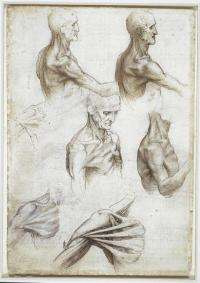
The superficial anatomy of the shoulder and neck from Leonardo da Vinci’s Folio 2V, part of the artist's "Anatomical Manuscript A." This print is one of dozens included in 'Leonardo da Vinci: The Mechanics of Man,' an art catalog co-authored by Ron Philo, Ph.D., of the University of Texas Health Science Center at San Antonio and Martin Clayton, deputy curator of the Print Room at Windsor Castle, England. The catalog was produced by the Royal Collection of Her Majesty Queen Elizabeth II in association with the Vancouver Art Gallery. Credit: Royal Collection © 2010, Her Majesty Queen Elizabeth II.
Sketched at a time when few dared oppose prevailing medical dogma, the anatomical drawings of Leonardo da Vinci display his rare and courageous curiosity, says a Texas anatomist who co-authored a new art catalog of the medieval drawings.
Ron Philo, Ph.D., senior lecturer of cellular and structural biology at The University of Texas Health Science Center at San Antonio, teaches anatomy to bioscience students through the art of cadaveric dissection, the same activity that attracted Leonardo later in his life.
Dr. Philo is the co-author of "Leonardo da Vinci: The Mechanics of Man," a catalog produced by the Royal Collection of Her Majesty Queen Elizabeth II in association with the Vancouver Art Gallery in Vancouver, British Columbia.
Manuscript A commemorated
This catalog features the renowned drawings of Leonardo's "Anatomical Manuscript A." Dr. Philo's co-author is Martin Clayton, deputy curator of the Print Room at Windsor Castle, England, and a noted authority on Leonardo's drawings. The drawings' permanent home is the Royal Library at Windsor Castle.
The catalog debuted in conjunction with the exhibition "Leonardo da Vinci: The Mechanics of Man," which is on view at the Vancouver Art Gallery until May 2. Generously loaned from the Royal Collection by Queen Elizabeth II for presentation during the Vancouver 2010 Olympic and Paralympic Games, this exhibition presents the entire suite of Manuscript A — the artist's finest anatomical drawings — for the first time in history.
Studies conducted in Florence, Milan
"The Mechanics of Man" stems from Leonardo's interest in sketching the anatomy of the deceased in hospitals, mostly in Florence and Milan. The 160-page catalog begins with a historical section by Mr. Clayton. The next section presents facsimiles of each drawing, followed by facsimiles with Leonardo's extensive notes translated into English, together with commentary by Mr. Clayton and Dr. Philo. The book also contains many labeled close-ups of anatomical systems.
This is the second Royal Collection collaboration for Dr. Philo, who annotated a 1992 volume, "Leonardo da Vinci: The Anatomy of Man," which has been translated into French, Spanish and Japanese. A portion of the anatomical sketches being shown in Vancouver traveled to Houston in 1992, and the host museum wanted a local anatomist to be the commentator on a new book about them. A colleague in 1991 recommended Dr. Philo to Martin Clayton, beginning a 19-year partnership.
Years later, Leonardo still holds Dr. Philo's fascination.
Amazing detail, given the era
"Leonardo's drawings are so precise they appear to have been drawn robotically," Dr. Philo said. "They were not 100 percent correct, and much of that was probably because he was drawing from material that was not embalmed. You can't take days to do a dissection under those conditions. He did much of this work in the cool months of the year.
"He was ahead of his time," Dr. Philo added. "He was dissecting and drawing while others were not. He drew according to the medical philosophy of the day but didn't always agree with it."
Leonardo got even by making comments such as, "This is what is believed, but I've never seen it that way because it is too small," Dr. Philo said.
A self-taught dynamo
Artists of the day were not scholars and Leonardo was therefore self-taught, but he pushed the Renaissance envelope with creativity and curiosity.
"One cannot appreciate what a good artist he was," Dr. Philo said. "The closer you look at a sketch, the more detail there is. It is almost microscopic. He's not only a better artist than you have been told, he's a better artist than you can imagine."
More information: "Leonardo da Vinci: The Mechanics of Man," by Martin Clayton and Ron Philo, is listed at $29.95 and is available through U.S. booksellers and online.
Provided by University of Texas Health Science Center at San Antonio
-
Leonardo's cellar dissection studio opened
Nov 14, 2006 |
not rated yet |
0
-
Leonardo show opens in Florence, Italy
Mar 28, 2006 |
not rated yet |
0
-
Study: Mona Lisa neither man nor da Vinci
Mar 07, 2006 |
not rated yet |
0
-
Leonardo's machines shown in Rome, Naples
Feb 09, 2006 |
not rated yet |
0
-
Is the Mona Lisa a Self-Portrait?
Jan 25, 2010 |
not rated yet |
0
-
Engineers build first sub-10-nm carbon nanotube transistor
Feb 01, 2012 |
4.9 / 5 (30) |
30
-
Something old, something new: Evolution and the structural divergence of duplicate genes
Jan 31, 2012 |
4.6 / 5 (7) |
1
-
The hidden nanoworld of ice crystals: Revealing the dynamic behavior of quasi-liquid layers
Jan 30, 2012 |
5 / 5 (3) |
1
-
Stock market network reveals investor clustering
Jan 27, 2012 |
3.9 / 5 (23) |
8
-
Of microchemistry and molecules: Electronic microfluidic device synthesizes biocompatible probes
Jan 26, 2012 |
5 / 5 (1) |
0
-
Bohr-Einstein debate: why did Bohr not simply say...
Feb 06, 2012
-
Best/Worst U.S. Presidents
Jan 31, 2012
- More from Physics Forums - History & Humanities
More news stories
A frank discussion of the power law and linking correlation to causation
(PhysOrg.com) -- Michael Stumpf a mathematics professor at Imperial College in London, and Mason Porter a lecturer at Oxford have teamed together to write and publish a perspective piece in Science regarding the in ...
Sonic Cradle lands spot in TED exhibition
A Simon Fraser University graduate student project that melds music, meditation and modern technology has landed a rare spot as an exhibit at TEDActive 2012 in Palm Springs, California this month.
1 hour ago |
not rated yet |
0
The question of life in the ancient world
Theres a general feeling that we dont get the Greeks ancient or modern. Many, including heads of state like Angela Merkel, visibly shake their head in exasperation, rightly or wrongly, at ...
Other Sciences / Archaeology & Fossils
5 hours ago |
1 / 5 (1) |
2
US workers are 'giving away the store,' costing firms billions
Nearly 70 percent of the nation's service employees give away free goods and services from hamburgers to cable TV costing companies billions of dollars a year, according to a groundbreaking study.
Other Sciences / Economics & Business
23 hours ago |
4.5 / 5 (2) |
10
Chilean miners' rescue capsule on show in London
The capsule used to rescue Chilean miners trapped underground for two months goes on display Saturday at the Science Museum in London -- the first time it has been seen in Europe.
4 hours ago |
not rated yet |
0
Hovering not hard if you're top-heavy, researchers find
Top-heavy structures are more likely to maintain their balance while hovering in the air than are those that bear a lower center of gravity, researchers at New York University's Courant Institute of Mathematical Sciences ...
Grass to gas: Researchers' genome map speeds biofuel development
Researchers at the University of Georgia have taken a major step in the ongoing effort to find sources of cleaner, renewable energy by mapping the genomes of two originator cells of Miscanthus x giganteus, a large perenn ...
Drug halts organ damage in inflammatory genetic disorder
A new study shows that Kineret (anakinra), a medication approved for the treatment of rheumatoid arthritis, is effective in stopping the progression of organ damage in people with neonatal-onset multisystem inflammatory disease ...
Cochlear implants may be safe, effective for organ transplant patients
Cochlear implants may be a safe, effective option for some organ transplant patients who've lost their hearing as an unfortunate consequence of their transplant-related drug regime, researchers report.
Researchers develop new method for creating tissue engineering scaffolds
Researchers at Northwestern University have developed a new method for creating scaffolds for tissue engineering applications, providing an alternative that is more flexible and less time-intensive than current technology.
Molecular profiling reveals differences between primary and recurrent ovarian cancers
There is a need to analyze tumor specimens at the time of ovarian cancer recurrence, according to a new study published in Molecular Cancer Therapeutics. Researchers used a diagnostic technology called molecular profiling to examine ...