Mysterious Cosmic 'Dark Flow' Tracked Deeper into Universe (w/ Video)
March 10, 2010
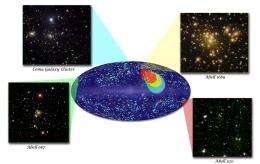
The colored dots are clusters within one of four distance ranges, with redder colors indicating greater distance. Colored ellipses show the direction of bulk motion for the clusters of the corresponding color. Images of representative galaxy clusters in each distance slice are also shown. Credit: NASA/Goddard/A. Kashlinsky, et al.
(PhysOrg.com) -- Distant galaxy clusters mysteriously stream at a million miles per hour along a path roughly centered on the southern constellations Centaurus and Hydra. A new study led by Alexander Kashlinsky at NASA's Goddard Space Flight Center in Greenbelt, Md., tracks this collective motion -- dubbed the "dark flow" -- to twice the distance originally reported.
"This is not something we set out to find, but we cannot make it go away," Kashlinsky said. "Now we see that it persists to much greater distances -- as far as 2.5 billion light-years away." The new study appears in the March 20 issue of The Astrophysical Journal Letters.
The clusters appear to be moving along a line extending from our solar system toward Centaurus/Hydra, but the direction of this motion is less certain. Evidence indicates that the clusters are headed outward along this path, away from Earth, but the team cannot yet rule out the opposite flow. "We detect motion along this axis, but right now our data cannot state as strongly as we'd like whether the clusters are coming or going," Kashlinsky said.
The dark flow is controversial because the distribution of matter in the observed universe cannot account for it. Its existence suggests that some structure beyond the visible universe -- outside our "horizon" -- is pulling on matter in our vicinity.
Cosmologists regard the microwave background -- a flash of light emitted 380,000 years after the universe formed -- as the ultimate cosmic reference frame. Relative to it, all large-scale motion should show no preferred direction.
The hot X-ray-emitting gas within a galaxy cluster scatters photons from the cosmic microwave background (CMB). Because galaxy clusters don't precisely follow the expansion of space, the wavelengths of scattered photons change in a way that reflects each cluster's individual motion.
This results in a minute shift of the microwave background's temperature in the cluster's direction. The change, which astronomers call the kinematic Sunyaev-Zel'dovich (KSZ) effect, is so small that it has never been observed in a single galaxy cluster.
This video is not supported by your browser at this time.
But in 2000, Kashlinsky, working with Fernando Atrio-Barandela at the University of Salamanca, Spain, demonstrated that it was possible to tease the subtle signal out of the measurement noise by studying large numbers of clusters.
In 2008, armed with a catalog of 700 clusters assembled by Harald Ebeling at the University of Hawaii and Dale Kocevski, now at the University of California, Santa Cruz, the researchers applied the technique to the three-year WMAP data release. That's when the mystery motion first came to light.
The new study builds on the previous one by using the five-year results from WMAP and by doubling the number of galaxy clusters.
"It takes, on average, about an hour of telescope time to measure the distance to each cluster we work with, not to mention the years required to find these systems in the first place," Ebeling said. "This is a project requiring considerable followthrough."
According to Atrio-Barandela, who has focused on understanding the possible errors in the team's analysis, the new study provides much stronger evidence that the dark flow is real. For example, the brightest clusters at X-ray wavelengths hold the greatest amount of hot gas to distort CMB photons. "When processed, these same clusters also display the strongest KSZ signature -- unlikely if the dark flow were merely a statistical fluke," he said.
In addition, the team, which now also includes Alastair Edge at the University of Durham, England, sorted the cluster catalog into four "slices" representing different distance ranges. They then examined the preferred flow direction for the clusters within each slice. While the size and exact position of this direction display some variation, the overall trends among the slices exhibit remarkable agreement.
The researchers are currently working to expand their cluster catalog in order to track the dark flow to about twice the current distance. Improved modeling of hot gas within the galaxy clusters will help refine the speed, axis, and direction of motion.
Future plans call for testing the findings against newer data released from the WMAP project and the European Space Agency's Planck mission, which is also currently mapping the microwave background.
-
Astronomers find most crowded collision of galaxy clusters
Apr 16, 2009 |
not rated yet |
0
-
Massive galaxy cluster found 10 billion light years away
Jun 06, 2006 |
not rated yet |
0
-
Survey Reveals Building Block Process For Biggest Galaxies
Apr 12, 2006 |
not rated yet |
0
-
Planck Satellite ready to measure the Big Bang
May 11, 2009 |
not rated yet |
0
-
Galaxy cluster smashes distance record
Oct 22, 2009 |
not rated yet |
0
-
Engineers build first sub-10-nm carbon nanotube transistor
Feb 01, 2012 |
4.9 / 5 (30) |
30
-
Something old, something new: Evolution and the structural divergence of duplicate genes
Jan 31, 2012 |
4.6 / 5 (7) |
1
-
The hidden nanoworld of ice crystals: Revealing the dynamic behavior of quasi-liquid layers
Jan 30, 2012 |
5 / 5 (3) |
1
-
Stock market network reveals investor clustering
Jan 27, 2012 |
3.9 / 5 (23) |
8
-
Of microchemistry and molecules: Electronic microfluidic device synthesizes biocompatible probes
Jan 26, 2012 |
5 / 5 (1) |
0
-
Titan's lack of impact craters
20 hours ago
-
Real pictures of black hole eating a star?
Feb 08, 2012
-
Hypothetical way to travel faster than light, but not technically exceed lightspeed
Feb 06, 2012
-
How do scientists monitor the Sun's activity?
Feb 05, 2012
-
Search patterns in observational studies
Feb 05, 2012
-
Derivation of Pogson's law
Feb 03, 2012
- More from Physics Forums - General Astronomy
More news stories
Humans may have helped the decline of African rainforests 3000 years ago
(PhysOrg.com) -- Large areas of rainforests in Central Africa mysteriously disappeared over three thousand years ago, to be replaced by savannas. The prevailing theory has been that the cause was a change ...
NASA budget will axe Mars deal with Europe: scientists
US President Barack Obama's budget proposal to be submitted next week for 2013 will cut NASA's budget by 20 percent and eliminate a major partnership with Europe on Mars exploration, scientists said Thursday.
Space & Earth / Space Exploration
1 hour ago |
not rated yet |
1
New views show old NASA Mars landers
(PhysOrg.com) -- The High Resolution Imaging Science Experiment (HiRISE) camera on NASA's Mars Reconnaissance Orbiter recorded a scene on Jan. 29, 2012, that includes the first color image from orbit showing ...
Space & Earth / Space Exploration
23 hours ago |
4.9 / 5 (7) |
9
|
Black holes and star formation
(PhysOrg.com) -- It has long been recognized that galaxy mergers or even close interactions can play a vital role in shaping the morphology of galaxies. One way they can do so, it is thought, is by triggering ...
22 hours ago |
4.1 / 5 (7) |
5
|
Ocean microbe communities changing, but long-term environmental impact is unclear
As oceans warm due to climate change, water layers will mix less and affect the microbes and plankton that pump carbon out of the atmosphere but researchers say it's still unclear whether these processes ...
Space & Earth / Earth Sciences
17 hours ago |
5 / 5 (2) |
2
|
Breastfeeding protects against asthma up to six years of age
(Medical Xpress) -- Research by the University of Otago in Christchurch and Wellington has shown that breastfeeding of infants has a clear protective effect against children developing asthma or wheezing up to six years of ...
Study finds stress hormones fluctuate with mood during pregnancy
(Medical Xpress) -- While pregnant, women pay particular attention to factors such as diet and exercise to ensure their babies are born healthy and develop normally. New research from the University of Calgarys Faculty ...
Japan scientist makes 'Avatar' robot
A Japanese-developed robot that mimics the movements of its human controller is bringing the Hollywood blockbuster "Avatar" one step closer to reality.
Protein libraries in a snap
(PhysOrg.com) -- A Rice University undergraduate will depart with not only a degree but also a possible patent for his invention of an efficient way to create protein libraries, an important component of biomolecular ...
Miami battling invasion of giant African snails
No one knows how they got there. But an invasion of African giant snails has southern Florida in a panic over potential crop damage, disease and general yuckiness surrounding the slimy gastropods.
Sleep breathing machine shows clear benefits in children with sleep apnea
Children and adolescents with obstructive sleep apnea had substantial improvements in attention, anxiety and quality of life after treatment with positive airway pressure (PAP)a nighttime therapy in which a machine ...
Mar 10, 2010
Rank: 4.5 / 5 (6)
Mar 10, 2010
Rank: 3 / 5 (3)
That's going to be a lot of dark matter! Prevalent beyond expectations!
Mar 10, 2010
Rank: 2.6 / 5 (5)
Mar 10, 2010
Rank: 4 / 5 (1)
Mar 10, 2010
Rank: 3.5 / 5 (4)
Which would likely be mostly dark matter (since most matter in the observable universe is dark), but not necessarily.
I wonder if this is evidence that ours is a bubble universe that is "off to one side" of the main mass of universes. Or if that even makes sense.
Mar 10, 2010
Rank: 4 / 5 (1)
makes sense if we live in a bubble multiverse :)
Mar 10, 2010
Rank: 2.7 / 5 (10)
Either that, or the author(s) of the article contend that they've disproven the theory of General Relativity...
Mar 10, 2010
Rank: 3 / 5 (1)
But of course. There is a string theorist in the US (I forget her name. I am horrible with names,) who wrote a paper completely routed in M-theory, and since it is considered "The only working theory on gravity" as per the popular news rags, it makes sense that Relativity was thrown out of the door.
Mar 11, 2010
Rank: 4 / 5 (2)
Mar 11, 2010
Rank: 3 / 5 (1)
Well, it would help explain why everything seems to be accelerating away from us (and everything else).
Mar 11, 2010
Rank: 4.1 / 5 (7)
• the Big Bang theory to be absolutely true
• the 13.7 Bly radius of the Universe to be correct
• the 2*13.7 billion years to be refferenced as the "start of time"
• that the Universe is only as big as far we can currently see
Although many currently famous theorists would agree with all the above as being true, I for myself, beg to differ.
Mar 11, 2010
Rank: not rated yet
Mar 11, 2010
Rank: 1.7 / 5 (6)
Mar 11, 2010
Rank: 4.2 / 5 (5)
FYI: to the above posters Dark flow and Dark matter are not necessarily linked. The use of the term Dark means either we can't see it or it is indeterminant, ie: dark within our understanding, not necessarily by nature.
One interesting thought I've entertained was the Big Crunch. Perhaps our observational frame of reference is wrong. If we were closer to the edge of reality, or effectively an elder statesman amongst galaxies, we could rather easily be misintepreting the "expansion" of the Universe and actually be on the lagging end of a compression mechanism.
In any event our increasing ability to produce deeper and deeper scans on the universe should prove rather enlightening once we can "view" out to a range where this supposed attractor is.
Mar 11, 2010
Rank: 2.5 / 5 (4)
Most astrophysicists acknowledge that space is every bit as much a creation as is time and matter. Matter displaces space, yet the expanding Universe theory must account for the mutable nature of an expanding space in which the dynamic of the gravity field is constant and relative.
Mar 11, 2010
Rank: 3.7 / 5 (3)
Mar 11, 2010
Rank: 3 / 5 (3)
A 13.7Bly radius would assume that the Universe was not infinite if the Big Bang is correct.
With one aspect being "established" the other must be false except under incredibly specific conditionals which have been proved false based upon hyper-inflational observation.
This is colloquially referred to as Hubble's Toxin. He was right in calling expansion, he was toxic in stating it was steady or slowing.
Mar 11, 2010
Rank: 3.7 / 5 (3)
Of course, being able to see even 13.7 billion light years out, is rather difficult at this time. It would take a very large telescope of exquisite sensitivity, to pick out anything smaller than a galaxy cluster at such distances...
Mar 11, 2010
Rank: 4 / 5 (2)
Yes I understand that, but, with an expanding Universe and your capacity for logic you know that the Universe must be larger than what we can see.
Reasoning for this is simple. Light CANNOT travel in a straight line in the early universe unless gravity doesn't exist. The pull of so much matter in distinct space would immediately delay and redirect said light until the true measurement was obscured.
The easiest way to explain this is a photon of light escaping from the sun. It can take several million years for that photon to escape simply due to being redirected, bent, absorbed and re-emitted billions and perhaps trillions of times. Imagine what the path would look like in the early universe where for millions of years the density of the matter and energy in the universe was far greater than the density of the sun.
The mechanics here are mind boggling. To get even a reasonable approximation of 13.75 Bly is intellectually tenuous at best. Now toss in hyperinflation...
Mar 11, 2010
Rank: 5 / 5 (2)
If we cannot see anything older than 13.75Bly away then that means that nothing was emitting light 13.75 Billion years ago, (even this must wrong due to uncalculated hyperinflation and special relativity).
Does that make my assertion a little more clear? I know these things can get supremely confusing and sometimes simplifying only obscures the point even more.
Mar 11, 2010
Rank: 3.7 / 5 (3)
It then took some more time (dozens or perhaps hundreds of millions of years) for the first stars to begin forming, then quasars, then sizable galaxies. By then, the currently visible volume of the universe was already pretty large, and continuing to expand rapidly. Today, we can only see anything approximately to the edges of this volume.
Mar 11, 2010
Rank: 4.5 / 5 (2)
And yes, you are mostly right about the "2*", though the part where I used it was certainly not about numbers, but I think you got the point..
Mar 11, 2010
Rank: 5 / 5 (4)
Mar 11, 2010
Rank: 3.7 / 5 (3)
The universe can be easily infinite in extent, in which case the Big Bang could have caused simultaneous eruption of matter-energy-space at every point on an infinite continuum (e.g. as in the ekpyrotic hypothesis.)
Mar 11, 2010
Rank: 3.7 / 5 (3)
When we talk of the light horizon, it's just a sphere with a 13.7 billion light-year radius, that happens to be centered on us. Any OTHER point in the universe -- even one at the very edge of our particular light sphere, would have an identical 13.7 billion light-year horizon extending from IT in all directions.
Mar 11, 2010
Rank: 5 / 5 (2)
Unless the Universe actually is a torus. In which case only particular places would have a radius and others would be on a measure of combinant arc length with a similar resultant view. I hope someone understands what I'm talking about, it's very difficult to explain and my english is leaving me at a loss.
Mar 11, 2010
Rank: 4 / 5 (4)
The simplest assumption is that the Universe is infinite in extent, and topologically flat at any fixed time instant (if you could imagine somehow gauging its topology instantaneously everywhere, without regard to causality or light speed.) As far as I know, there's no evidence to contradict such a postulate.
Mar 11, 2010
Rank: 2 / 5 (2)
This is why you should read stuff. Here's my post again:
------
They're not postulating dark matter exactly, but matter outside our observable universe.
Which would likely be mostly dark matter (since most matter in the observable universe is dark), but not necessarily.
I wonder if this is evidence that ours is a bubble universe that is "off to one side" of the main mass of universes. Or if that even makes sense.
-------
Also, you seem to be getting confused between the size of the Universe and the size of the *Observable* Universe.
Mar 11, 2010
Rank: 5 / 5 (1)
Mar 11, 2010
Rank: 3 / 5 (2)
I believe the correct answer may be that the universe is infinitely old but that we can only measure up to ~13.7 Billion years or so when the mass became dispersed enough to start the clock moving at a fast enough clip.
Mar 11, 2010
Rank: 5 / 5 (1)
An object we see at a distance of 13 billion LY was only 4 billion LY separated from "us" when the light we see now was emitted. And "now" it may be 26 billion LY away. Of course, we can't see it where it is now. We see it where it has been 13 billion LY ago. (The numbers given here are just symbolic, not calculated.)
Mar 11, 2010
Rank: 2 / 5 (2)
That's a big negative. Although I appreciate your challenge to my statement you've also misread.
Any matter outside of our observable universe cannot be quantified and as such your statement is a mere supposition.
Realistically the "observable" universe and the extent of the Universe are one in the same. It goes back to the perception of the CMB. As we can quantify the CMB and we know that the minor variances within temperature correlate with the presence of abundant mass we can calculate the size and extent of our reality as it evolves based upon our observation.
This predicts that if the universe began to contract we would see an immediate doubling in the intensity of all non-local objects.
You're getting hung up on the fact I'm using 13.7 Bly away as opposed to an assumed potential 40 Bly away.
Mar 11, 2010
Rank: 4 / 5 (1)
After reading all that has been written over again + your last posts, I found where the "missunderstanding" came from. Now all gives sense to me and I agree with most of the reasonings. At first it looked to me like you were proposing a classical BB version, with a "start of time", "absolute edge", and all that stuff associated with it - and that is also the reason why I objected.
To me, it looks like the next step in this discussion should be, wether matter that was "just" created (converted) from pure energy, is affected by gravity from distant sources instantly, or with a time-lag equal to the distance divided by the speed of light. With emphasis on the fact, that the energy, from which the matter was made, was allready present BEFORE the conversion took place.
I think it will be the former (instantly)..
Btw PE, that's alot of words just to express that The Bang was a local event instead of "universal" :)
Mar 11, 2010
Rank: 2.3 / 5 (3)
Maybe this movement is toward the so-called "missing mass"-which isn't missing at all- just out of sight- as perhaps it moved "outwards' first at the time of the big bang- a first bubble ejected by initial shock wave- and the light hasn't reached us yet?
This is really stretching my ability to conceptualize, given my limited understanding, so my apologies for any murkiness or outright bone-headedness.
Does this notion make any sense to anyone?
Mar 11, 2010
Rank: 5 / 5 (1)
Mar 11, 2010
Rank: 3 / 5 (1)
is of course to be replaced by
Mar 11, 2010
Rank: 3 / 5 (2)
That's right! Have a cookie. Was it the words "likely" and "not necessarily" in my post that tipped you off? Cuz that's what they were there for.
The article says:
If that's even possible, then no, the Observable Universe and the Universe are not one and the same.
Mar 11, 2010
Rank: 5 / 5 (1)
You could say that at time of emission the "real" distance (by what metric?) was 4 billion ly, and at time of arrival the "real" distance (again, by what metric?) is whatever, but in terms of the distance actually covered by the photon: 13 billion ly is the answer.
Admittedly, things would be a lot less muddled in vernacular if spacetime weren't expanding...
Mar 11, 2010
Rank: 5 / 5 (1)
BTW, I think the picture you linked contains a conceptual error (or at least, a rather misleading aspect.) The red curve is as it should be, but the orange curve is incorrect: if the quasar emitted a photon from its current position (assuming it's still a quasar, 13 billion years later... haha), that photon would take a spiraling curved path up the expanding "cone", just like the red curve, and consequently would take a lot longer than 26 billion years to reach us (as the universe keeps expanding.)
The orange curve shows an instantaneous distance measurement (ignoring the lightspeed limit), which is physically unsound even if it does have some mathematical interpretation in the context of tensor geometry...
Mar 11, 2010
Rank: 5 / 5 (1)
Maybe what you really mean, is that the visible universe was in communication with entities outside of the visible universe. But under GR, if the communication was possible gravitationally, it was also by definition possible optically. IOW, we should be seeing the photons that arrived together with the gravity well.
Mar 11, 2010
Rank: 4 / 5 (1)
Mar 11, 2010
Rank: 4 / 5 (1)
It seems you missed slightly what I was trying to depict.Not necessarily. The universal lightspeed limit of energy/change propagation is well consistent with what I was trying to propose. It should not be in conflict with GR as such. When matter is "constructed" from energy, it will be under the effects of the local gravity field instantly, because it did not just came to existence "from nothing". Only nothing can come from nothing, and nothing else.. (weird sentence, I know) :)
It originated from energy that was allready there - or in other words, "it jumped on an allready rolling wave" - and therefor there is no violation of GR involved in the whole process.
Mar 11, 2010
Rank: 5 / 5 (1)
If the universe is infinite, then yes, it should very well be "in communication", or rather, in a "dynamic relation" with itself, at least to a certain extent.
Yes, in fact, we should.. But all we "see" at the edge of our current observational capability, is just some strange noise, also called the CMB.
Maybe, just maybe - when considering a "local bang" model - the shockwave front of such blast should be quite dense (eg. high energy density) + travelling at relativistic speeds, and in this regard, it could possibly "smear"/deflect/deviate all the from outside incomming photons as it propagates, which would in turn limit our "optical" observation radius.
Mar 12, 2010
Rank: 3 / 5 (3)
Mar 12, 2010
Rank: 4 / 5 (1)
Condecension was unnecessary.
Observable and visible are not one in the same. Thanks for your time.
Mar 12, 2010
Rank: 3 / 5 (1)
GR is one of the two most accurate descriptions of the fundamental nature of the universe ever proposed by humanity?
Mar 12, 2010
Rank: 5 / 5 (1)
Make no mistake, mathematics is not the holy grail.
Mar 12, 2010
Rank: 4 / 5 (3)
Yes it is, when coupled with accurate observation.
Mar 12, 2010
Rank: 5 / 5 (1)
Mar 12, 2010
Rank: 4 / 5 (1)
Mar 12, 2010
Rank: 3.3 / 5 (3)
Mar 12, 2010
Rank: 4 / 5 (1)
I'd say that's a good way of looking at it.
Mar 13, 2010
Rank: not rated yet
Mar 13, 2010
Rank: not rated yet
Mar 13, 2010
Rank: not rated yet
Can the Universe break it's own speed limit. Right now we think so, and if that's the case physics may not hold true at all points throughout. That's why these topics become so hotly debated.
Mar 13, 2010
Rank: not rated yet
" Maybe, just maybe - when considering a "local bang" model - the shockwave front of such blast should be quite dense (eg. high energy density) + travelling at relativistic speeds, and in this regard, it could possibly "smear"/deflect/deviate all the from outside incomming photons as it propagates, which would in turn limit our "optical" observation radius. "
Maybe it deflected Gravitons as well ?
Mar 14, 2010
Rank: not rated yet
Its important to remember that every point in the universe has its own horizion that is different from every other point. The observable universe is 13.7b ly but the actual universe is much larger.
Surely it is possible to view the effects of contributions from objects outside of our horizion on objects within our horizion.
One must also consider at large scales hubble expansion can hide objects that were once within our horizion.
Mar 14, 2010
Rank: not rated yet
yeah, but we don't live in your universe.
Mar 14, 2010
Rank: not rated yet
It is always possible that the effect is a statistical anomaly. We need to examine more universes...
Mar 15, 2010
Rank: not rated yet
13.7: I'm guessing as long as those nice polite photons travelling along the straight and narrow line didn't get subverted by any massive objects, dark matter and definitely did not get sucked into any dark flows since that seminal cosmic ejaculation. And wasn't that cosmos dark anyway for the first so many hundreds of thousands or even millions of years?
But then again, what is a year before an earth existed to measure it?
Mar 15, 2010
Rank: 5 / 5 (1)
If there are any observations of influence on the clusters, those influences travel to us at the light speed (LS) with the observation of the influenced. This means the influence from the influencing object(s) (including visible light) would travel towards us and reach us at the same time as the influence on the clusters (or sooner). This means that the influencer would be in our OU. Or the reverse statement: If it's not in our OU, neither is an observable influence on any object in our universe.
Even if expansion between the influencer and the influenced is now greater than LS (having pushed the influencer beyond our OU since the influence), we still would be seeing the light from the influencer as it was when it influenced the cluster, even though at present day, the influencer is outside of our OU.
In both cases, we'd never see influences of any influencer outside our OU.
Mar 15, 2010
Rank: not rated yet
Just because gravity is having an effect on a galaxy at the edge of OU at the speed of light doesn't mean that light coming from that galaxy is coming at us from 2X light speed.
Mar 16, 2010
Rank: 5 / 5 (1)
With three objects (us, the influenced, and the influencer) in a triangle, the straight line between us and the influencer is shorter than the angled line between the influencer, the influenced, and us. That's all. Just simple geometry.
Nothing goes faster than C. I'm just explaining that if we see the /influence/ on an object, then whatever's influencing it should also be in our visible universe. The light from all objects travels at C. The influence travels
Mar 16, 2010
Rank: not rated yet
Nothing goes faster than C. I'm just explaining that if we see the /influence/ on an object, then whatever's influencing it should also be in our visible universe. The light from all objects travels at C. The influence travels < = C.
(Limitations on posting size prevent fuller explanations.)
Mar 16, 2010
Rank: not rated yet
That's essentially what I've been arguing, as well.
But upon further reflection, there's one potential hitch: the "dark" gravitational influence might have occurred during the inflationary phase, or during the "dark ages", when no currently-visible light could propagate to us from the entity/entities exerting the influence. By the time the plasma filling the universe condensed enough to allow long-distance light transmission, the influencing objects might have been "inflated" beyond our light horizon. This, it seems to me, is one of only two conceivable scenarios that's consistent with GR. The other scenario, would be a "naked" embedded gravitational well in space, transient in nature, with no matter/energy to anchor it, resulting from a quantum fluctuation that got hugely magnified during the inflation.
Both of the scenarios seem rather improbable, but not impossible...
Mar 16, 2010
Rank: not rated yet
Mar 16, 2010
Rank: not rated yet
Mar 16, 2010
Rank: 1 / 5 (2)
Not knowing what the consensus is, do we consider gravity as having a velocity equal to the speed of light, or is the phenomenon of gravity instantaneous over, and coterminate at every point throughout the universe, and only exerting greater or lesser force as a result of local differences in the distribution of mass?
Mar 16, 2010
Rank: 5 / 5 (1)
In GR, gravity is limited to light-speed. Generally speaking, all forms of information transfer (communication) are light-speed limited. You can imagine communicating over long distances, by wiggling a mass, thus causing a slight ripple in gravitational field. If this wiggle could be perceived instantaneously everywhere, then you've just achieved instantaneous (i.e. in GR's framework, a-causal) communication. This would allow you to create all sorts of paradoxes within the framework of GR, by violating causality.
Since the entire mathematical edifice of GR is thus vitally dependent on light-speed propagation for gravity, one either accepts GR as empirically valid, or reverts back to the Newtonian view and all of its contradictions with observations.
Here's another way to see it: if the gravitational field gives you an instantaneous and absolute view of the universe, there's no longer any relativity of inertial observers, which invalidates both GR and SR.
Mar 16, 2010
Rank: not rated yet
http://www.scient...k_energy
It rings true, somehow. It feels "right".
Mar 16, 2010
Rank: 1 / 5 (2)
Thanks for the gloss. I suppose GR will have to do, at least for now. There have always been aspects of it which seemed counterintuitive, at least for me. The abrupt truncation of my academic career didn't help, either. Thus my spotty understanding of some of these concepts, even though I find them endlessly fascinating.
Besides- you never know when some casual question may lead to a revolution in understanding.
As to the holographic model- the idea of all the information in the universe being contained inside a singularity, which then expands omnidirectionally, at the speed of light, and projecting itself into existence in it's own wake- well, that's causing some conceptual difficulties, too...for instance- with increasing distance, would not the amount of information eventually attenuate, as the holographic surface area increased?
I'm starting to get a headache...
Mar 17, 2010
Rank: 5 / 5 (1)
Reminds me of those number jugglers who see all cosmological and physical entities coded in the ancient pyramids.
Mar 17, 2010
Rank: not rated yet
I've pondered something like this myself, though less formally. I've wondered if gravity were a "drag" on matter/energy, caused by some sort of congealing or interference in the spacetime medium from nearby matter/energy. The specifics of how something like this would work, depend highly on a detailed theory of the medium's fundamental structure. The entropic approach sidesteps the detailed theory, creating a more generic argument.