The mode of action of certain toxins that accumulate in seafood
March 10, 2010
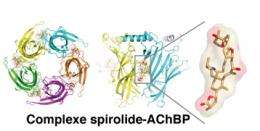
The spirolide-AChBP complex AChBP, the protein used as a model for nRACh by the researchers, is made up of five identical sub-units (shown here in different colors). They are assembled in a ring, seen from above (left) and from the side when looking at the blue and yellow sub-units (middle image). The neurotransmitter inserts itself at the interfaces between the sub-units. It is also here that each phycotoxin (one of which is shown enlarged on the right) binds in order to inhibit the channel receptor function of nRACh. © Yves Bourne and Pascale Marchot / CNRS 2010
Toxins released by certain microalgae can contaminate fish and shellfish which then become toxic to humans. French researchers from CNRS and CEA have, for the first time, identified the mechanisms of action of two of these toxins.
They have shown how and why they cause neurological symptoms. These findings could provide a basis for the development of new tests to screen for these toxins. This work was published online this week on the website of the journal PNAS.
Marine biotoxins are produced naturally by several species of single-cell algae. They can accumulate in the flesh of fish and shellfish and are then referred to as phycotoxins. In humans, the consumption of shellfish contaminated by these substances can cause diarrheal, paralytic, neurological and other symptoms. Phycotoxins can spread rapidly throughout the world, notably via the emptying of ballast tanks by merchant ships. As early as 1991, shellfish contamination was observed in Canada, then along the coasts of Norway, Spain and Tunisia. In 2005, contaminated oysters were detected in the Arcachon Basin on the west coast of France, which led the health authorities to impose a temporary ban on their sale.
A Franco-American collaborative project involving two joint CNRS/University laboratories in Marseilles, a CNRS intra-mural laboratory, a CEA laboratory in Gif-sur-Yvette and an American laboratory at the University of California has studied the functioning of two types of phycotoxins, a spirolide and a gymnodimine. These are "rapid-acting" neurotoxins; their injection in laboratory mice causes severe neurological symptoms that have a fatal outcome within a few minutes. The researchers were able to characterize the target of these toxins: they attack a receptor that is essential in living beings, the nicotinic acetylcholine receptor (nRACh), a channel receptor situated on the membrane of muscle or nerve cells that allows the passage of small ionized molecules into and out of the cell. nRACh plays a crucial role in neuromuscular and neuronal transmission. More precisely, these toxins act by rapidly and almost irreversibly blocking the channel receptor function of nRAChs. This inhibition then causes muscle and/or cerebral dysfunctions, reminiscent of those observed during certain muscle diseases or cognitive disorders.
The scientists then characterized how the two phycotoxins bound to the receptor. Resolved using X-ray crystallography, the 3D structures of the complexes that formed between the phycotoxins and the receptor revealed that each toxin inserts itself at the heart of the binding site for acetylcholine, the natural neurotransmitter of this receptor. This is a key position in that it can block the channel receptor function of nRAChs. Of particular interest was the discovery that the binding mode of these toxins might provide new opportunities regarding the development of novel therapeutic agents active on nRAChs.
These results obtained in vitro thus explain the neurotoxicity of these phycotoxins in numerous animal species. A clearer understanding of their mode of action constitutes the first step towards the development of antidotes that might become a sanitary and economic necessity. Thus these findings raise hopes for the design of new, reliable, sensitive, practical and inexpensive tests that could detect the presence of phycotoxins in shellfish offered to consumers.
More information: Structural determinants in phycotoxins and AChBP conferring high affinity binding and nicotinic AChR antagonism. Yves Bourne, Zoran Radic, Romulo Aráoz, Todd T. Talley, Evelyne Benoit, Denis Servent, Palmer Taylor, Jordi Molgó, Pascale Marchot. Proc Natl Acad Sci USA, Online on PNAS website 8 March 2010.
Provided by CNRS
-
Study reveals molecular basis of botulism toxin's deadly activity
Dec 14, 2006 |
not rated yet |
0
-
EU drops mouse tests for shellfish
Apr 15, 2006 |
not rated yet |
0
-
Cause of mussel poisoning identified
Mar 24, 2009 |
not rated yet |
0
-
Molecular structure reveals how botulinum toxin attaches to nerve cells
Dec 13, 2006 |
not rated yet |
0
-
Compounds show significant promise against potential bioweapon toxins
Feb 06, 2007 |
not rated yet |
0
-
Engineers build first sub-10-nm carbon nanotube transistor
Feb 01, 2012 |
4.9 / 5 (31) |
30
-
Something old, something new: Evolution and the structural divergence of duplicate genes
Jan 31, 2012 |
4.6 / 5 (7) |
1
-
The hidden nanoworld of ice crystals: Revealing the dynamic behavior of quasi-liquid layers
Jan 30, 2012 |
5 / 5 (3) |
1
-
Stock market network reveals investor clustering
Jan 27, 2012 |
3.9 / 5 (23) |
8
-
Of microchemistry and molecules: Electronic microfluidic device synthesizes biocompatible probes
Jan 26, 2012 |
5 / 5 (1) |
0
-
Stoichiometry
Feb 10, 2012
-
Boiling and melting point of impure substances
Feb 10, 2012
-
Safe nitrogen compound to decompose a 500 deg C in a furnace?
Feb 09, 2012
-
[ask]electron inside drinking water
Feb 08, 2012
-
How to avoid formation of Lithium Chromate ???
Feb 08, 2012
-
how to choose a reduced or oxidated form in a redox
Feb 08, 2012
- More from Physics Forums - Chemistry
More news stories
Fool's gold may prove an unlikely alternative to overexploited catalytic materials
Catalytic materials, which lower the energy barriers for chemical reactions, are used in everything from the commercial production of chemicals to catalytic converters in car engines. However, with current catalytic materials ...
18 hours ago |
4.4 / 5 (8) |
6
|
Unpicking HIV’s invisibility cloak
Drug researchers hunting for alternative ways to treat human immunodeficiency virus (HIV) infections may soon have a novel targetits camouflage coat. HIV hides inside a cloak unusually rich in a sugar ...
18 hours ago |
5 / 5 (5) |
0
Hydrogen from acidic water: Researchers develop potential low cost alternative to platinum for splitting water
A technique for creating a new molecule that structurally and chemically replicates the active part of the widely used industrial catalyst molybdenite has been developed by researchers with the Lawrence Berkeley ...
Feb 09, 2012 |
4.8 / 5 (14) |
15
|
No entry without protein recycling: Researchers discover new coherence in enzyme transport
The group of Prof. Dr. Ralf Erdmann at the Ruhr-Universität Bochum, Germany, discovered a connection of peroxisomal protein import and receptor export. In the Journal of Biological Chemistry, they disclo ...
18 hours ago |
not rated yet |
0
Under the microscope #7
In this video Dr Ingrid Graz shows us a thin layer of gold on top of rubber. Cracks in the gold allow it to stretch and we can use this for stretchable electronics.
20 hours ago |
not rated yet |
0
Anonymous knocks CIA website offline (Update)
The website of the Central Intelligence Agency was inaccessible on Friday after the hacker group Anonymous claimed to have knocked it offline.
New error-correcting codes guarantee the fastest possible rate of data transmission
Error-correcting codes are one of the triumphs of the digital age. Theyre a way of encoding information so that it can be transmitted across a communication channel such as an optical fiber o ...
Humans may have helped the decline of African rainforests 3000 years ago
(PhysOrg.com) -- Large areas of rainforests in Central Africa mysteriously disappeared over three thousand years ago, to be replaced by savannas. The prevailing theory has been that the cause was a change ...
New power source discovered
(PhysOrg.com) -- Researchers at the Massachusetts Institute of Technology (MIT) and RMIT University have made a breakthrough in energy storage and power generation.
Small modular reactor design could be a 'SUPERSTAR'
(PhysOrg.com) -- Though most of today's nuclear reactors are cooled by water, we've long known that there are alternatives; in fact, the world's first nuclear-powered electricity in 1951 came from a reactor ...
Google users warned of threat to smartphone wallets
Users of Google smartphone wallets were being warned on Friday that there is a way to crack pass codes intended to thwart thieves from going on illicit shopping sprees.