Prehistoric response to global warming informs human planning today
March 10, 2010
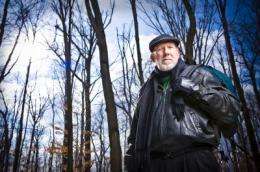
Since 2004, University at Buffalo anthropologist Ezra Zubrow has worked intensively with teams of scientists in the Arctic regions of St. James Bay, Quebec, northern Finland and Kamchatka to understand how humans living 4,000 to 6,000 years ago reacted to climate changes. Credit: Office of Communications, University at Buffalo
Since 2004, University at Buffalo anthropologist Ezra Zubrow has worked intensively with teams of scientists in the Arctic regions of St. James Bay, Quebec, northern Finland and Kamchatka to understand how humans living 4,000 to 6,000 years ago reacted to climate changes.
Their findings will tell governments, scientists and NGOs how relationships between human beings and their environments may change in decades to come as a result of global warming.
"The circumpolar north is widely seen as an observatory for changing relations between human societies and their environment," Zubrow explains, "and analysis of data gathered from all phases of the study eventually will enable more effective collaboration between today's social, natural and medical sciences as they begin to devise adequate responses to the global warming the world faces today."
This video is not supported by your browser at this time.
This study, which will collect a vast array of archaeological and paleoenvironmental data, began with the Social Change and the Environment in Nordic Prehistory Project (SCENOP), a major international research study by scientists from the U.S., Canada and Europe of prehistoric sites in Northern Quebec and Finland.Phases I and II of the study were headed by André Costopoulos and Gail Chmura of McGill University (Montreal), Jari Okkonen of Finland's Oulu University, and Zubrow, who directs UB's Social Systems Geographic Information Systems Lab.
Phase III, underway now, is the International Circumpolar Archaeological Project (ICAP) funded by $845,796 from the National Science Foundation's Arctic Social Sciences Program of the Office of Polar Programs, which is supported by the American Recovery and Reinvestment Act (ARRA). Headed by Zubrow, it focuses on a third sub-arctic region: Siberia's remote Kamchatka peninsula, a rough and extremely volcanic wilderness region the size of California.
"With forecasts of sea-level rises and changing weather patterns, people today have been forewarned about some likely ramifications of climate change," Zubrow says, "but those living thousands of years ago, during the Holocene climatic optimum, could not have known what lay ahead of them and how their land -- and lives -- would be changing.
"This was a slower change," he says, "about one-third the rate we face today. In the Holocene period, it took a thousand years for the earth to warm as much as it has over the past 300 years -- roughly the time spanned since the beginning of the Industrial Revolution.
"As in other phases of the study," Zubrow says, "our goal in Kamchatka is to clarify ancient regional chronologies and understand the ways prehistoric humans adapted to significant environmental changes, including warming, earthquakes, tsunamis, volcanic eruptions and the seismic uplift of marine terraces that impacted the environment during the period in question."
He points out that, despite our more sophisticated prediction technology, and technologies overall, many of the world's people have residences and lifestyles that are just as vulnerable to climatic shift as those of our prehistoric ancestors. They, too, live along estuaries and coastlines subject to marked alteration as oceans rise.
Most of the ARRA stimulus money used in the project is spent in the United States on salaries and research at various universities. Zubrow reiterates a point he often makes with his students: "This research funding is good for science, good for the economy, good for the government and good for the international reputation of the United States."
Ultimately, information gathered over the next year by the geologists, archaeologists, geochemists, volcanologists and paleoecologists on Zubrow's team will be compared with data from the two other ICAP sites.
During an additional study phase funded by a $300,000 grant from NSF, through the ARRA, Zubrow will conduct archaeological research in Mexico to ascertain how arctic climatic changes during the mid- and post-Holocene era affected human populations in a changing temperate climate.
-
Study: Arctic Undergoing Holistic Climate-Change Response
Oct 31, 2005 |
not rated yet |
0
-
Getting warmer? Prehistoric climate can help forecast future changes
Nov 24, 2008 |
not rated yet |
0
-
Arctic heats up more than other places
Jan 16, 2009 |
not rated yet |
0
-
Cantabrian cornice experienced seven cooling, warming phases over past 41,000 years
Jun 03, 2009 |
not rated yet |
0
-
Global warming impacting European seas
Mar 14, 2007 |
not rated yet |
0
-
Engineers build first sub-10-nm carbon nanotube transistor
Feb 01, 2012 |
4.9 / 5 (30) |
30
-
Something old, something new: Evolution and the structural divergence of duplicate genes
Jan 31, 2012 |
4.6 / 5 (7) |
1
-
The hidden nanoworld of ice crystals: Revealing the dynamic behavior of quasi-liquid layers
Jan 30, 2012 |
5 / 5 (3) |
1
-
Stock market network reveals investor clustering
Jan 27, 2012 |
3.9 / 5 (23) |
8
-
Of microchemistry and molecules: Electronic microfluidic device synthesizes biocompatible probes
Jan 26, 2012 |
5 / 5 (1) |
0
-
Discrepancy between oxygen and carbon-dioxide levels
11 hours ago
-
where gems are found in the world
14 hours ago
-
Wind Waves in Reservoir ~ Wind run-up and Wind set-up
Feb 08, 2012
-
Balance of oxygen in the atmosphere
Feb 01, 2012
-
The case for a methanol-based economy
Jan 30, 2012
-
Weather in a rotating cylinder
Jan 25, 2012
- More from Physics Forums - Earth
More news stories
Mars Science Laboratory computer issue resolved
(PhysOrg.com) -- Engineers have found the root cause of a computer reset that occurred two months ago on NASA's Mars Science Laboratory and have determined how to correct it.
Space & Earth / Space Exploration
43 minutes ago |
5 / 5 (1) |
1
|
Clam fields found at deep, low-temperature Mariana vents
(PhysOrg.com) -- Scientists have marveled at the unusual life forms thriving at high temperature hydrothermal vents of the deep ocean.
Space & Earth / Earth Sciences
18 minutes ago |
not rated yet |
0
|
Streams need trees to withstand climate change
(PhysOrg.com) -- More than twenty years of biological monitoring have confirmed the importance of vegetation for protecting Australia's freshwater streams and rivers against the ravages of drought and climate ...
27 minutes ago |
not rated yet |
0
The turbulent birth of super star clusters in galaxy mergers
By combining two of the most advanced telescopes in the world -- the new Atacama Large Millimeter Array (ALMA) and the Very Large Telescope (VLT) of ESO -- a team of French astronomers from the Institut d'astrophysique ...
9 minutes ago |
not rated yet |
0
Putin receives 'prehistoric' water from Antarctic lake
Prime Minister Vladimir Putin was given a water sample Friday taken from a pristine lake hidden under Antarctic ice for over a million years, after Russian scientists drilled down to its surface.
Space & Earth / Earth Sciences
49 minutes ago |
5 / 5 (1) |
0
A frank discussion of the power law and linking correlation to causation
(PhysOrg.com) -- Michael Stumpf a mathematics professor at Imperial College in London, and Mason Porter a lecturer at Oxford have teamed together to write and publish a perspective piece in Science regarding the in ...
Advanced power-grid model finds low-cost, low-carbon future in West
(PhysOrg.com) -- The least expensive way for the Western U.S. to reduce greenhouse gas emissions enough to help prevent the worst consequences of global warming is to replace coal with renewable and other ...
Small modular reactor design could be a 'SUPERSTAR'
(PhysOrg.com) -- Though most of today's nuclear reactors are cooled by water, we've long known that there are alternatives; in fact, the world's first nuclear-powered electricity in 1951 came from a reactor ...
Seeing colors in music, tasting flavors in shapes may happen in life's early months
Famed violinist Itzhak Perlman sees a deep forest green whenever he plays a B-flat on his Stradivarius' G string. The A on the E string is red.
The question of life in the ancient world
Theres a general feeling that we dont get the Greeks ancient or modern. Many, including heads of state like Angela Merkel, visibly shake their head in exasperation, rightly or wrongly, at ...
Study suggests girls can 'rewire' brains to ward off depression
(Medical Xpress) -- What if you could teach your brain to respond differently to things that make you feel sad, down or stressed out? What if doing that helped ward off depression?