The scientific brain: Human brain processes predictable sensory input in particularly efficient manner
March 10, 2010
The scientific brain: Human brain processes predictable sensory input in particularly efficient manner

Enlarge

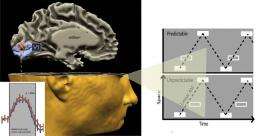
The brain does not predict the unpredictable: The sight of bars apparently moving from bottom left to top right (dotted line) evokes activity in the primary visual cortex (V1). Right: in the upper part of the image, the test stimulus (a white-framed bar) is presented in such a manner that it is integrated into the motion of the white bars. In contrast, the brain does not predict the appearance of the test stimulus in the lower part of the image. This test stimulus is presented with a certain time delay, so that the motion direction appears to be interrupted. Image detail bottom left: the activity in V1 is significantly higher for the unexpected test stimulus (brown graph) than for the expected test stimulus (blue graph). Image: Max Planck Institute for Brain Research

(PhysOrg.com) -- It turns out that there is a striking similarity between how the human brain determines what is going on in the outside world and the job of scientists. Good science involves formulating a hypothesis and testing whether this hypothesis is compatible with the scientist’s observations. Researchers in the Max Planck Institute for Brain Research in Frankfurt together with the University of Glasgow have shown that this is what the brain does as well. A study shows that it takes less effort for the brain to register predictable as compared to unpredictable images. (Journal of Neuroscience, February 24th, 2010)

Alink and colleagues based this conclusion on the characteristics of responses in the primary visual cortex. It is known that the is critical for vision and that responses in this area create a map of what we are currently looking at. Alink and colleagues, however, for the first time show that images induce smaller responses in this area when they are predictable. The implication of this finding is that the brain does not just sit and wait for visual signals to arrive. Instead, it actively tries to predict these signals and when it is right it is rewarded by being able to respond more efficiently. If it is wrong, massive responses are required to find out why it is wrong and to come up with better predictions.

One implication of this study is that when you enter the office the image of your colleague at his desk, who has the annoying trait of always being there before you, will require very little effort for your brain to register. The image of your mother in law sitting on the same chair, however, would make your brain go haywire. Not necessarily because you are not fond of this person but because this image makes it clear to your brain that it is doing a lousy job at predicting what is going to happen next and that it will have to make an effort to improve its predictions. This suggests that the brain’s main job, alike that of a scientist, is to generate hypotheses about what is going on in the outside world.

The study represents a significant advance in understanding how the brain supports . An important implication of this study is that visual perception depends on an active generation of predictions. This stands in contrast to the classical view that visual perception mainly results from a more passive cascade of responses to visual signals spreading through the brain.

Further research is still required to determine whether indeed we are all carrying along a little scientist in our head. At present the idea of the scientific brain is rapidly spreading through the neuroscience community and provides a novel approach to resolving how the most complex organ of the human body works.

More information: Alink A, Schwiedrzik CM, Kohler A, Singer W, Muckli L. Stimulus predictability reduces responses in primary visual cortex. Journal of Neuroscience, February 24th, 2010; 30(8):2960-6

Provided by Max-Planck-Gesellschaft (news : web)

4.4 /5 (8 votes)  

Filter


Move the slider to adjust rank threshold, so that you can hide some of the comments.


Display comments: newest first

Jeswin
Mar 10, 2010

Rank: not rated yet
Darwinian evolution anyone?
Sciencebee
Mar 10, 2010

Rank: not rated yet
I listened to a book titled On Intelligence a while ago. The author was basically arguing that the brain is one big prediction machine. In other words the way the human brain works is by prediction, according to him. Anyway, this made me think of that and I thought it was interesting.
frajo
Mar 11, 2010

Rank: not rated yet
Was the test person a scientist?
droid001
Mar 11, 2010

Rank: not rated yet
Does this mean that we are not holograms?
World is real?
Rank 4.4 /5 (8 votes)
Related Stories
Relevant PhysicsForums posts
  • Is Everyday Technology Killing Us?
    createdFeb 08, 2012
  • Exercise and weight loss
    createdFeb 08, 2012
  • Why do we have head aches? Our brains can't feel anything.
    createdFeb 07, 2012
  • "The end of diseases" by David Agus, interview from Daily Show with Jon Stewart
    createdFeb 04, 2012
  • Oncolytic adenovirus
    createdFeb 04, 2012
  • Nutrition label stuffs and diets
    createdFeb 02, 2012
  • More from Physics Forums - Medical Sciences

More news stories

Antidepressants and pregnancy: Women must consider the impact of drugs on baby, and of depression on baby, themselves

Upon learning they are pregnant, most women dutifully nix the alcohol, sushi and caffeine. But what about antidepressants?

Medicine & Health / Medications

created 34 minutes ago | popularity not rated yet | comments 0

Both maternal and paternal age linked to autism

Older maternal and paternal age are jointly associated with having a child with autism, according to a recently published study led by researchers at The University of Texas Health Science Center at Houston (UTHealth).

Medicine & Health / Psychology & Psychiatry

created 4 minutes ago | popularity not rated yet | comments 0 | with audio podcast

Curry spice component may help slow prostate tumor growth

Curcumin, an active component of the Indian curry spice turmeric, may help slow down tumor growth in castration-resistant prostate cancer patients on androgen deprivation therapy (ADT), a study from researchers ...

Medicine & Health / Cancer

created 1 hour ago | popularity not rated yet | comments 0 | with audio podcast

Arthritic knees, but not hips, have robust repair response

Researchers at Duke University Medical Center used new tools they developed to analyze knees and hips and discovered that osteoarthritic knee joints are in a constant state of repair, while hip joints are not.

Medicine & Health / Diseases

created 1 hour ago | popularity not rated yet | comments 0 | with audio podcast

Team isolates nerve cells involved in storing long term memory and gene proteins associated with them

(Medical Xpress) -- A research team in Taiwan has succeeded in isolating two nerve cells in fruit fly brains that are believed to be the major players in allowing for the formation of long term memories. Furthermore, ...

Medicine & Health / Neuroscience

created 2 hours ago | popularity 5 / 5 (4) | comments 1 | with audio podcast report


Netflix light on flicks as viewers soak up TV shows

Like most fresh faces that arrive in Hollywood, Netflix wanted to be a movie star. But now it's learning what many in Tinseltown have known for decades: Movies are sexy, but the real money is in television.

Zuckerberg's focus drives Facebook's ascent

When Mark Zuckerberg showed up to rent Judy Fusco's Los Altos, Calif., house in the fall of 2004, soon after he'd arrived in Silicon Valley, the landlord was immediately struck by his confidence.

The power of estrogen -- male snakes attract other males

A new study has shown that boosting the estrogen levels of male garter snakes causes them to secrete the same pheromones that females use to attract suitors, and turned the males into just about the sexiest ...

Humans may have helped the decline of African rainforests 3000 years ago

(PhysOrg.com) -- Large areas of rainforests in Central Africa mysteriously disappeared over three thousand years ago, to be replaced by savannas. The prevailing theory has been that the cause was a change ...

Fool's gold may prove an unlikely alternative to overexploited catalytic materials

Catalytic materials, which lower the energy barriers for chemical reactions, are used in everything from the commercial production of chemicals to catalytic converters in car engines. However, with current catalytic materials ...

Experts reveal how plants don't get sunburn

(PhysOrg.com) -- Experts at the University of Glasgow have discovered how plants survive the harmful rays of the sun.