US military developing geolocation system for underground
March 11, 2010 by Lin Edwards report
lightning

Enlarge

(PhysOrg.com) -- The US military is studying the feasibility of a system that could allow them to accurately navigate in enemy underground tunnels, an environment in which GPS does not work.

US military satellites provide (GPS) signals used by millions of gadgets, including car satellite navigation systems and smartphones, but GPS needs line-of-sight to the satellites, which is only available on the Earth’s surface and not underground. At the same time, the presence of US military and intelligence satellites has driven many people of interest underground, especially since subterranean engineering and tunnel building are becoming less expensive and easier. A deep tunnel system shields a group from spy satellites, and also gives them protection against bomb attacks.

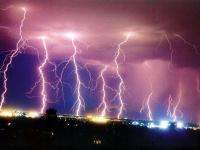
Scientists from the Pentagon agency have noted that very low frequency (VLF) radio signals called “spherics” or “sferics” are generated by lightning strikes and penetrate deep underground, and they are therefore studying the feasibility of a system of underground receivers that could possibly built to detect the signals hundreds of miles away. Receiving signals from lighting strikes in multiple directions, along with minimal information from a surface base station also at a distance, could allow operators to accurately pinpoint their position.

The system is known as Sferics-Based Underground Geolocation (S-BUG) and early studies found that it may be feasible. DARPA is now planning to hold a conference, which will mostly be classified as secret, with technology companies interested in developing the project further. The project will need to verify that sferic signals received on the surface can be correlated with sferics received underground to provide geolocation with enough resolution. The ultimate goal of the S-BUG project is to design a full navigation and tracking system for underground uses.

The project coincides with another DARPA project (Nimbus), which aims to trigger and manipulate artificial .

More information: DARPA project: http://www.darpa.m … /sferic.html

© 2010 PhysOrg.com

4.5 /5 (13 votes)  

Filter


Move the slider to adjust rank threshold, so that you can hide some of the comments.


Display comments: newest first

Bob_Kob
Mar 11, 2010

Rank: not rated yet
Breaking headlines: Osama Bin Laden killed by US weather control device.
ruckus101
Mar 11, 2010

Rank: not rated yet
This is so we can find the Iranian nuke plants.
Royale
Mar 11, 2010

Rank: not rated yet
no, no the iranians were only enriching uranium for power generation. (sarcasm, if it wasn't picked up by you).
PinkElephant
Mar 11, 2010

Rank: not rated yet
The project coincides with another DARPA project (Nimbus), which aims to trigger and manipulate artificial lightning.
That's pretty freaking stupid. What good is a weapon that only exists in the presence of thunderclouds?

DARPA ought to be looking into generating spherics artificially, instead of waiting for lightning strikes...
NotAsleep
Mar 12, 2010

Rank: not rated yet
"The system is known as Sferics-Based Underground Geolocation (S-BUG)"

If this is ever issued to the Army, it will immediately get the name "Ass Bug"
NotAsleep
Mar 15, 2010

Rank: not rated yet
In regards to NIMBUS, I think a primary focus is to PREVENT lightning strikes, contrary to what the article leads one to believe:

https://www.fbo.g..._cview=0

Although I'm sure CAUSING lightning strikes is an obvious off-shoot of that...
Rank 4.5 /5 (13 votes)
Related Stories
Relevant PhysicsForums posts
  • feed hold button on CNC lathe
    created16 hours ago
  • Mechanics of Solids ( Final exam question) please help!
    created17 hours ago
  • RFAC in Fortran
    created20 hours ago
  • dynamics 2/32
    createdFeb 08, 2012
  • dynamics
    createdFeb 08, 2012
  • Vibration Absorbtion Problem
    createdFeb 08, 2012
  • More from Physics Forums - General Engineering

More news stories

Soraa LED light may dim 50-watt halogen rivals

(PhysOrg.com) -- Soraa, a Fremont, California company founded in 2008, this week launched its first product, a light that uses LEDS (light emitting diodes). The "Soraa LED MR16 lamp" is the "perfect" replacement ...

Technology / Semiconductors

created 16 hours ago | popularity 4.3 / 5 (16) | comments 13 | with audio podcast report

First Google hire leaving for online academy

The first person hired by Google's founders is leaving the Internet giant to devote himself to an innovative online education website called Khan Academy.

Technology / Internet

created 4 hours ago | popularity not rated yet | comments 0

FBI file: Steve Jobs was considered for govt post

(AP) -- FBI background interviews of some people who knew Apple co-founder Steve Jobs reveal a man driven by power and alienating some of the people who worked with him.

Technology / Business

created 4 hours ago | popularity 3 / 5 (4) | comments 0

New integrated building model may improve fish farming operations

Today's "locavore" movement with its emphasis on eating more locally-produced food is a natural fit for fruits and vegetables in nearly every region, but few entrepreneurs have dared to apply the concept to ...

Technology / Engineering

created 5 hours ago | popularity not rated yet | comments 0

NY attorney general ends lawsuit against Intel

(AP) -- Intel Corp. is paying $6.5 million as part of a deal to terminate an antitrust lawsuit filed against the chip maker by the New York attorney general's office.

Technology / Business

created 4 hours ago | popularity not rated yet | comments 0


'Dark plasmons' transmit energy

Microscopic channels of gold nanoparticles have the ability to transmit electromagnetic energy that starts as light and propagates via "dark plasmons," according to researchers at Rice University.

Hydrogen from acidic water: Researchers develop potential low cost alternative to platinum for splitting water

A technique for creating a new molecule that structurally and chemically replicates the active part of the widely used industrial catalyst molybdenite has been developed by researchers with the Lawrence Berkeley ...

Ultraviolet protection molecule in plants yields its secrets

Lying around in the sun all day is hazardous not just for humans but also for plants, which have no means of escape. Ultraviolet (UV) radiation from the sun can damage proteins and DNA inside cells, leading ...

FDA-approved drug rapidly clears amyloid from the brain, reverses Alzheimer's symptoms in mice

Neuroscientists at Case Western Reserve University School of Medicine have made a dramatic breakthrough in their efforts to find a cure for Alzheimer's disease. The researchers' findings, published in the journal Science, show t ...

Anyone can learn to be more inventive, cognitive researcher says

There will always be a wild and unpredictable quality to creativity and invention, says Anthony McCaffrey, a cognitive psychology researcher at the University of Massachusetts Amherst, because an "Aha moment" is rare and ...

Cell biologists describes mechanism by which some people may be more susceptible to colon cancer

An international research team led by cell biologists at the University of California, Riverside has uncovered a new insight into colon cancer, the third leading cause of cancer-related deaths in the United ...