Shocking recipe for making killer electrons (w/ Video)
March 11, 2010
Shocking recipe for making killer electrons

Enlarge

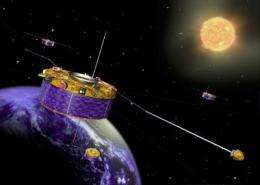
ESA's mission Cluster consists of four identical spacecraft flying in formation between 19 000 and 119 000 km above the Earth. They study the interaction between the solar wind and Earth’s magnetosphere, or the Sun-Earth connection in 3-D. Credit: ESA

Take a bunch of fast-moving electrons, place them in orbit and then hit them with the shock waves from a solar storm. What do you get? Killer electrons. That's the shocking recipe revealed by ESA's Cluster mission.

This video is not supported by your browser at this time.

Data from Cluster, and other spacecraft monitoring the magnetosphere, have shown that interplanetary shocks -- caused by coronal mass ejections from the Sun -- can create "killer electrons" in the near-Earth space environment within 15 minutes of the shock reaching the Earth's protective magnetic bubble. Killer electrons are highly energetic particles trapped in the Earth's outer radiation belt. Credit: ESA

Killer electrons are highly trapped in Earth's outer radiation belt, which extends from 12 000 km to 64 000 km above the planet’s surface. During solar storms their number grows at least ten times and they can be dislodged, posing a threat to satellites. As the name suggests, killer electrons are energetic enough to penetrate satellite shielding and cause microscopic lightning strikes. If these electrical discharges take place in vital components, the satellite can be damaged or even rendered inoperable.

On 7 November 2004, the Sun blasted a in Earth’s direction. It was composed of an interplanetary shock wave followed by a large magnetic cloud. When the shock wave first swept over the ESA-NASA solar watchdog satellite SOHO, the speed of the solar wind (the constant flow of solar particles) suddenly increased from 500 km/s to 700 km/s.

Shortly afterwards, the shock wave hit Earth’s protective , known as the magnetosphere. The impact induced a wave front propagating inside the magnetosphere at more than 1200 km/s at geostationary orbit (36 000 km altitude) around Earth. The quantity of energetic electrons in the outer radiation belt started to increase too, according to Cluster’s RAPID instruments (Research with Adaptive Particle Imaging Detectors). Cluster’s four satellites sweep around an elliptical orbit, coming as close as 19 000 km and going out as far as 119 000 km.

Understanding the origin of the killer electrons has been a focus for researchers. Thanks to previous data collected by Cluster and other space missions, scientists proposed two methods by which electrons can be accelerated to such harmful energy levels. One relies on very low frequency (VLF) waves of 3-30 kHz, the other on ultra low frequency (ULF) waves of 0.001-1 Hz. This latest work disentangles the problem.

Which waves are responsible? Both of them. “Both VLF and ULF waves accelerate electrons in Earth’s radiation belts, but with different timescales. The ULF waves are much faster than the VLF, due to their much larger amplitudes,” says Qiugang Zong from Peking University (China) and University of Massachusetts Lowell (USA), lead author of the paper describing this result.
The data show that a two-step process causes the substantial rise of killer electrons. The initial acceleration is due to the strong shock-related magnetic field compression. Immediately after the impact of the interplanetary shock, Earth’s magnetic field lines began wobbling at ultra low frequencies. In turn, these ULF waves were found to effectively accelerate the seed electrons provided by the first step, to become killer electrons.

This video is not supported by your browser at this time.

Solar activity in November 2004 as seen by the EIT instrument on SOHO. EIT stands for extreme ultraviolet imaging telescope. Credits: ESA/NASA/SOHO

Although the analysis has been a long one, the results have been worth the wait. Now astronomers know how killer electrons are accelerated. “Data from the four Cluster satellites allowed the identification of ULF waves able to accelerate electrons,” says Malcolm Dunlop, Rutherford Appleton Laboratory, Didcot (UK) and co-author of this study.

Thanks to this analysis of Cluster data, if the killer electrons happen to be ejected towards Earth, we now know that they can strike the atmosphere within just 15 minutes. “These new findings help us to improve the models predicting the radiation environment in which satellites and astronauts operate. With solar activity now ramping up, we expect more of these shocks to impact our over the months and years to come,” says Philippe Escoubet, ESA’s Cluster mission manager.

More information: Zong, Q.-G., X.-Z. Zhou, Y. F. Wang, X. Li, P. Song, D. N. Baker, T. A. Fritz, P. W. Daly, M. Dunlop, and A. Pedersen (2009), Energetic electron response to ULF waves induced by interplanetary shocks in the outer radiation belt, J. Geophys. Res., 114, A10204, doi:10.1029/2009JA014393

Provided by European Space Agency (news : web)

4.5 /5 (8 votes)  

Filter


Move the slider to adjust rank threshold, so that you can hide some of the comments.


Display comments: newest first

seneca
Mar 11, 2010

Rank: not rated yet
It's well known, high temperature / particle energy in solar corona could be explained by Alphén waves and the current article just extends this mechanism to Earth stratosphere.

http://en.wikiped...g_theory
Skepticus
Mar 11, 2010

Rank: not rated yet
I have come across many articles over the years regarding proposed spacecraft-generated magnetic fields, magnetized plasmas...etc, for shielding purposes, but almost all the current approaches focus on physical shielding. Consider the weight penalty, it seems to me some power sources (such as RTG, nuclear) would incur more favorable weigh and mass penalty while providing the same protection. Is it technology limitations, political considerations, or organizational cultural obstruction to new approaches? Or, the field of non-physical shielding technologies such as electromagnetics, are classified and thus non-mentionable? Engineers and scientists, I would dearly want to hear your input, thanks.
daywalk3r
Mar 11, 2010

Rank: not rated yet
^^
Skepticus, I think it's more about reliability than "feasibility", when it comes to active or passive shielding, that is..
Skepticus
Mar 11, 2010

Rank: not rated yet
^^
Skepticus, I think it's more about reliability than "feasibility", when it comes to active or passive shielding, that is..


You mean power systems such as on Voyager 2 (launched in 1977, and still working) were flukes, and nothing made with today's technology will be guaranteed to work reliably?
daywalk3r
Mar 11, 2010

Rank: 5 / 5 (1)
You mean power systems such as on Voyager 2 (launched in 1977, and still working) were flukes, and nothing made with today's technology will be guaranteed to work reliably?
Voyager did not have a human crew. When it comes to protecting human lives, reliability is far more of a concern than for situations, where only a robot is involved. And on top of that, in most cases the robot has far higher radiation level tolerances, as it was designed for it, which humans were not..
brant
Mar 11, 2010

Rank: not rated yet
I have come across many articles over the years regarding proposed spacecraft-generated magnetic fields, magnetized plasmas...etc, for shielding purposes, Is it technology limitations, political considerations, or organizational cultural obstruction to new approaches? Or, the field of non-physical shielding technologies such as electromagnetics, are classified and thus non-mentionable? Engineers and scientists, I would dearly want to hear your input, thanks.


An effective way to power a magnetic shield would require some new power technology. The power density would have to go up many orders of magnitude.

You would need an "aether" cell or something like that. Or a car battery that lasted forever would do it.....

To introduce such technologies(they exist) into society would change the economic structure(who makes the profit) and so on down the line.
So you can hope but I dont see the change happening in the near future..
sender
Mar 11, 2010

Rank: not rated yet
yay another renewable energy source!
Husky
Mar 12, 2010

Rank: not rated yet
letsd power the shielding by killer electrons, only halve joking here
SimonX
Mar 12, 2010

Rank: not rated yet
That's a good point imo.

It's funny seeing reference to power requirements when being bombarded with highly charged particles...

The same arguament could be applied to most vehicles. The biggest factor limiting speed is generally seen as friction. Perhaps more time should be spent looking at the potential to harness these sources of energy...
Rank 4.5 /5 (8 votes)
Relevant PhysicsForums posts
  • Scale of the Universe
    created13 hours ago
  • Titan's lack of impact craters
    createdFeb 09, 2012
  • Real pictures of black hole eating a star?
    createdFeb 08, 2012
  • Hypothetical way to travel faster than light, but not technically exceed lightspeed
    createdFeb 06, 2012
  • How do scientists monitor the Sun's activity?
    createdFeb 05, 2012
  • Search patterns in observational studies
    createdFeb 05, 2012
  • More from Physics Forums - General Astronomy

More news stories

Humans may have helped the decline of African rainforests 3000 years ago

(PhysOrg.com) -- Large areas of rainforests in Central Africa mysteriously disappeared over three thousand years ago, to be replaced by savannas. The prevailing theory has been that the cause was a change ...

Space & Earth / Environment

created Feb 10, 2012 | popularity 4.3 / 5 (13) | comments 13 | with audio podcast report

Could Venus be shifting gear?

(PhysOrg.com) -- ESA’s Venus Express spacecraft has discovered that our cloud-covered neighbour spins a little slower than previously measured. Peering through the dense atmosphere in the infrared, the ...

Space & Earth / Space Exploration

created 20 hours ago | popularity 5 / 5 (7) | comments 8 | with audio podcast

NASA budget will axe Mars deal with Europe: scientists

US President Barack Obama's budget proposal to be submitted next week for 2013 will cut NASA's budget by 20 percent and eliminate a major partnership with Europe on Mars exploration, scientists said Thursday.

Space & Earth / Space Exploration

created 23 hours ago | popularity 5 / 5 (2) | comments 20

Mars Science Laboratory computer issue resolved

(PhysOrg.com) -- Engineers have found the root cause of a computer reset that occurred two months ago on NASA's Mars Science Laboratory and have determined how to correct it.

Space & Earth / Space Exploration

created 21 hours ago | popularity 4.7 / 5 (6) | comments 4 | with audio podcast

Two new moons for Jupiter

Advances in technology have lead to the discovery of new planets outside of our Solar System, and now even new moons in our own backyard.

Space & Earth / Space Exploration

created 20 hours ago | popularity 4 / 5 (1) | comments 7


Anonymous knocks CIA website offline (Update)

The website of the Central Intelligence Agency was inaccessible on Friday after the hacker group Anonymous claimed to have knocked it offline.

New error-correcting codes guarantee the fastest possible rate of data transmission

Error-correcting codes are one of the triumphs of the digital age. They’re a way of encoding information so that it can be transmitted across a communication channel — such as an optical fiber o ...

Small modular reactor design could be a 'SUPERSTAR'

(PhysOrg.com) -- Though most of today's nuclear reactors are cooled by water, we've long known that there are alternatives; in fact, the world's first nuclear-powered electricity in 1951 came from a reactor ...

New power source discovered

(PhysOrg.com) -- Researchers at the Massachusetts Institute of Technology (MIT) and RMIT University have made a breakthrough in energy storage and power generation.

The power of estrogen -- male snakes attract other males

A new study has shown that boosting the estrogen levels of male garter snakes causes them to secrete the same pheromones that females use to attract suitors, and turned the males into just about the sexiest ...

Google users warned of threat to smartphone wallets

Users of Google smartphone wallets were being warned on Friday that there is a way to crack pass codes intended to thwart thieves from going on illicit shopping sprees.